Banyule City Council’s $6-million stormwater harvesting project – one of Melbourne’s largest – will capture, filter and store stormwater underground to irrigate parks and sports grounds.
By Brian McCormack
In the grip of dire drought a few years ago, Victorian councils were restricted to irrigating just one in four sports grounds, and many of Melbourne’s 1645 turf-topped assets faced ruin.
Fields were closed, games were cancelled, soccer mums brought knee ointment with them to dusty ovals, and there was widespread concern about the collapse of community networks if sporting clubs failed.
Fortunately the drought broke, but the crisis was a catalyst for reassessing the sustainability of parks and sports grounds. Consequently, many forward-thinking councils resolved to install stormwater-harvesting facilities, not only to save on irrigation costs (which the drought had starkly highlighted), but also to have a ‘bankable’ supply of water on hand in the event of a future prolonged dry spell.
One such trailblazer was Banyule City Council (BCC), which has 21 suburbs between 7km and 21km north-east of central Melbourne. Primarily residential and family orientated, BCC owns 466 hectares of open space, encompasses vast tracts of Parks Victoria parkland, and is noted for its flora, fauna and botanical beauty.
While sport, recreation and open space facilities are important for community health and wellbeing, 80 per cent of the Council’s potable water was until recently being used to keep these places green.
However, BCC is now changing all that by spending $6 million on one of Melbourne’s largest stormwater harvesting projects to capture, filter and store water underground for irrigating its parks and sports grounds. This will also improve wildlife habitats with a reduction in litter and other assorted nasties in the council’s waterways.
The project involves three locations – Chelsworth Park in Ivanhoe, Kalparrin Gardens in Greensborough, and DeWinton Park in Rosanna. At the time of going to press, the latter two were almost complete, with DeWinton Park due for completion by the end of the 2013.
“We will harvest 138 million litres of water a year – the equivalent of 45 Olympic swimming pools,” said BCC Environment and Sustainability Coordinator, John Milkins.
“That will save the council $300,000 of drinking water that was previously used for irrigation each year.”
According to Milkins, the work will also remove 70 tonnes of litter, 180 tonnes of sediment, one tonne of nitrogen and 250kg of phosphorous from creeks and waterways, including the Plenty and Yarra Rivers.
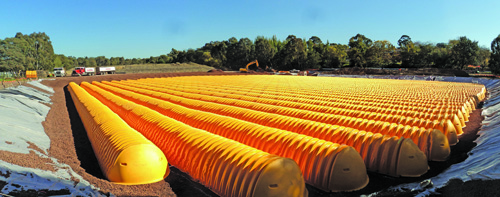
At all three sites, underground storage will ensure that no open space is lost. The water will be stored in a total of 1300 large ribbed arches buried at up to two metres deep and partially filled with scoria, a light volcanic rock that will play a valuable role in terms of algae build up. A bioactive film on the scoria contributes further to the removal of nitrogen and phosphorous. After these passive components, litter traps, wetlands, sand filters and ultra violet light will further assist in cleaning the stormwater for irrigation use.
At Kalparrin Gardens, for instance, a ‘double decker’ design has been incorporated with a wetland built on top of the storage. A pump house incorporating a UV disinfection system and sand filter then treats the stormwater before it is distributed to sports ovals a kilometre away via a pressure pipeline.
In total, more than 9000 square metres was excavated for the three storages and more than 200 tonnes worth of plant ranging from excavators and surface levellers to bobcats and trucks were put to work on the project.
The Banyule stormwater harvesting project is a unique partnership between the council, government and the Ivanhoe Grammar School, which uses and maintains Chelsworth Park.
Australian Federal Government funding was provided by the Water for the Future Incentive through the National Urban Water and Desalination Plan. The Victorian Government has provided funding through the Living Rivers Stormwater Program.
 |
Comment below to Continue the Conversation!
|