By Saniyat Islam and Kate Kennedy, RMIT University
Given the possibility single-use masks and gloves may be contaminated with COVID-19, we need clearer direction on how to dispose of them safely in public places. It is now mandatory for anyone in Victoria who leaves their home to wear a mask, and strongly encouraged elsewhere.
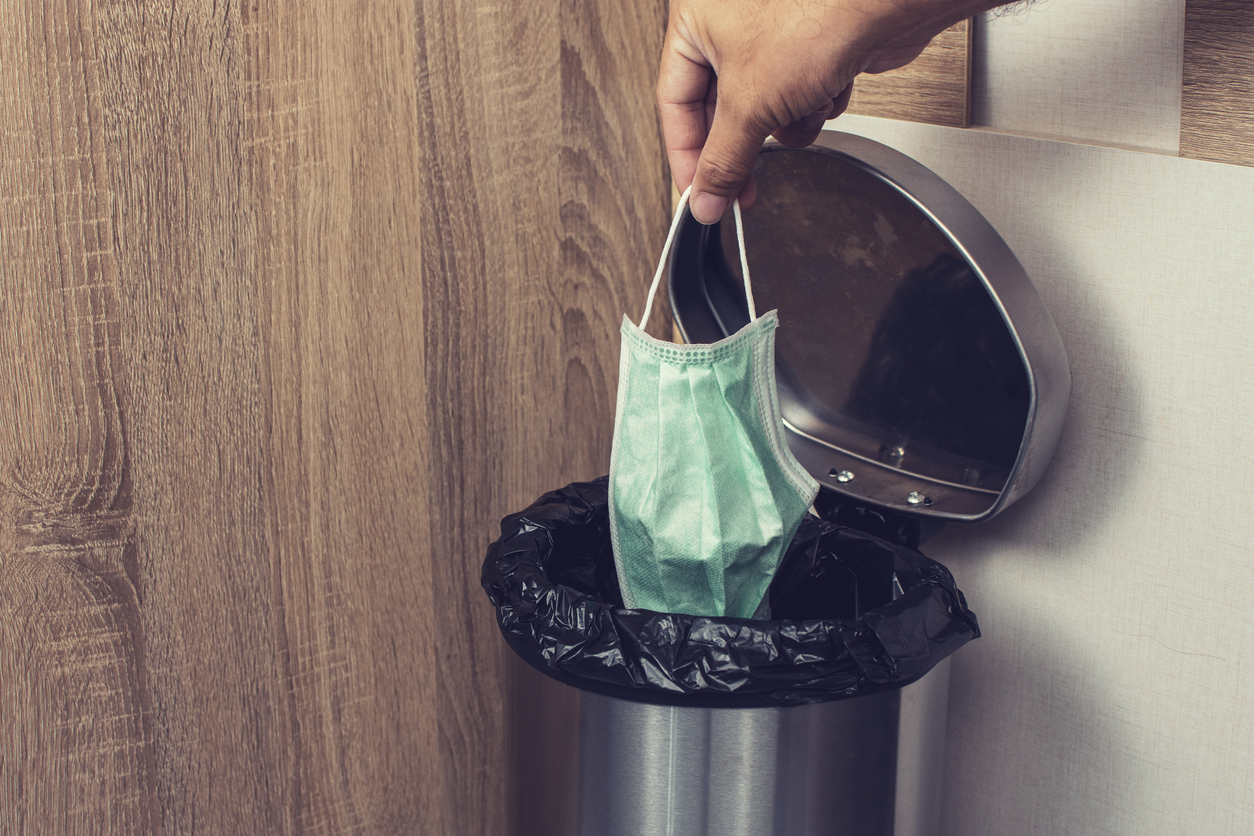
Many people have already been wearing masks for some time in a bid to protect themselves and others from COVID-19.
Evidence has shown masks likely do reduce the spread of COVID-19, so wearing them is a good thing – particularly as Victoria continues to grapple with a second wave.
But one conversation we’re not having enough is around how to safely dispose of single-use masks.
Disposing of used masks or gloves incorrectly could risk spreading the infection they’re designed to protect against.
A convenient choice
While reusable cloth masks are an option if you’ve been able to buy one or even make one yourself, disposable, single-use surgical masks appear to be a popular choice. They provide protection and they’re cheap and convenient.
It’s estimated the global use and disposal of masks and gloves will amount to 129 billion face masks and 65 billion plastic gloves for every month of the COVID-19 pandemic.
The effect on the environment is an important but separate issue to the health risks we’re discussing here.
Alarmingly, from what we’ve observed, people are discarding masks in communal rubbish bins and even leaving them in empty shopping trolleys.
People should know better than to leave used masks lying around. But they can’t be expected not to discard them in public bins when there’s no other option, and when they’re not given any advice on how to dispose of them properly.
Importantly, while there are clear guidelines on the disposal and separation of medical waste within health-care settings, guidelines for disposal of surgical masks in public settings are unclear.
The Victorian government simply advises they be disposed of “responsibly in the rubbish bin”, meaning they will be mixed with ordinary waste.
This is in contrast to personal protective equipment (PPE) used in health-care settings, which is disposed of separately to regular waste, transported to sealed landfill, and in some cases incinerated.
Why could this be a danger?
We don’t yet know a whole lot about the survival of SARS-CoV-2, the coronavirus that causes COVID-19, on textile materials.
One study published in the medical journal The Lancet found no infectious SARS-CoV-2 could be detected on textile materials after 48 hours.
A review study which looked at the survival of a range of pathogens on textiles found viruses could survive longer than 48 hours, though not as long as bacteria.
Although we need more research on this topic, it seems there is potential for cross-contamination, and therefore possibly COVID-19 infection, from disposed masks.
In all likelihood, other people, such as supermarket staff collecting trolleys, or waste handlers, will come into contact with discarded masks well within that 48-hour window.
In addition, if the discarded mask is carrying infectious particles, it may be possible for these to cross-contaminate the surfaces they come into contact with, such as shopping trolleys. And we know SARS-CoV-2 survives more readily on hard surfaces than porous ones, so this is a worry.
Who needs to act?
This issue is a potential biosecurity concern, and we need segregation of used masks from ordinary waste immediately. We urge attention from the Victorian government and local councils to act on this issue, including in the following ways:
- create general awareness of this problem, potentially by including messaging around how to properly dispose of masks in directives on their use
- install pop-up secured bins in public places such as shopping centres for used masks and gloves
- workers collecting the waste should follow biohazard protocols similar to those used to manage waste collected from health-care settings.
This article was first published at The Conversation.