The Elvis Festival Street Parade attracts diehard fans to Parkes, NSW every year – presenting unique challenges for road safety authorities.
Parkes might be best known for its 64-metre radio telescope, made famous by the 2000 film The Dish, but fewer may be aware that the central NSW town also hosts a massive annual festival and street parade to honour the king of rock and roll, Elvis Presley.
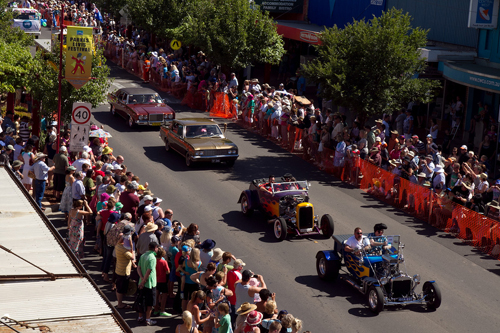
Held in January to coincide with the region’s tourism off-season – and to mark Elvis’ birthday – the five-day event started in 1993 and today attracts around 15,000 fans, impersonators, and revellers, doubling the town’s usual population.
“The Parkes Elvis Festival has invigorated the town and attracted increasing numbers of visitors on a hot weekend in the tourist off season, because it is well-organised, slightly weird, in a friendly town and above all, fun,” says Parkes Shire Council Road Safety Officer, Melanie Suitor.
Suitor co-presented a paper on managing the event, along with Phil King from Heath Consulting Engineers, at the 2013 IPWEA International Public Works Conference in Darwin. Both were suitably dressed in Elvis-inspired outfits for their presentation.
The street parade is the centrepiece of the Parkes Elvis Festival, with thousands of fans lining the streets to watch Elvis impersonators walking, riding, driving and dancing down closed roads on a variety of vehicles.
Responding to the continued growth and success of the festival, Parkes Shire Council established a Parade Planning Group in 2009, comprised of council staff, emergency services personnel and festival volunteers. “Ensuring the safety of parade participants and spectators is paramount in planning a successful parade,” says Suitor.
Recognising human frailty
Integral to the new emphasis on safety was the implementation of the ‘Safe System’ framework, introduced by the Australian Transport Council in 2005. Focussing on “human frailty”, the key components of the Safe System framework are: safer road user behaviour, safer speeds, safer vehicles, and safer roads and roadsides.
During the Parkes Elvis Festival parade route streets and connected side streets and laneways are closed from 6am on the day of the parade. “Council staff prepared traffic management plans and ensured that the required signage was erected, including a B-double detour being gazetted for the duration of the festival,” says Suitor.
Before 2008, there were no physical barriers separating spectators from vehicles along the parade route. Recognising the potential risk and working within the Safe System framework, a barrier was installed in 2009 in the form of temporary para-webbing fencing on poles.
In 2010, a spectator collapsed in the crowd, requiring the new webbing to be cut to facilitate ambulance access. In response, the Parade Planning Group installed keyrings at intervals along the lengths of the webbing for easy access for emergency services, with each length reduced from 100-metres to a more manageable 50-metres.
Another lesson was learned in 2010 when spectators climbed over and trampled the para-webbing to access the festival markets and other entertainment in the adjacent Cooke Park. In response, the planning group installed pedestrian channels across parade routes, which remained open until a warning sounded over the PA system just 10 minutes prior to the parade commencing. The changes “saw a marked improvement in public safety and compliance,” Suitor says.
In 2009, visitors complained about the parade frequently stopping and starting, caused by the media conducting interviews and taking photos of parade participants. To solve this problem, media was assigned a designated area, ensuring both their safety and that the parade could keep moving smoothly.
“Following the 2011 parade, an international journalist commented that during his career he had covered many parades but this was the first time he had seen a designated media area,” Suitor said. “He felt it worked extremely well.”
Since 2010, parade participants are restricted to a less-than 10km/h speed limit and float drivers are breath tested to enforce a 0.02 blood alcohol limit.
“All of these together demonstrate a successful Safe Systems approach which could be replicated by other councils,” says Suitor.
See more papers from the 2013 IPWEA International Public Works Conference.