John Keen, Manager Assets & Fleet at Lockyer Valley Regional Council in Queensland, discusses his background in fleet management, the issue of sustainability, and the value of hiring and retaining good staff.
What originally led you to a career in fleet (and asset) management?
My early career in road construction and maintenance as a plant operator gave me a great insight into the world of fleet management from a different perspective. In the early 1980s I worked for a central western Queensland shire council that did not have its own workshop, and operators performed all servicing – how times have changed!
In your opinion, what is the biggest challenge facing fleet managers at the moment? (And why?)
The issue of sustainability. Councils need to right-size fleets, standardise and look for other innovative ways of delivering services to the community. Fleet optimisation is the key; if you can’t keep it working, don’t own it.
 You previously oversaw the fleet of the newly amalgamated Toowoomba Regional Council. What are the biggest challenges that come with managing the fleet of amalgamated councils, and what did you learn from that period of your career?
The biggest challenge from a fleet perspective during the amalgamations was the human element and helping people to manage during a time of uncertainty.
Another challenge was the issue of the size of the fleet and what was the right size for this fleet. The Toowoomba amalgamation brought eight councils into one, with an area of 13,000km
2. The combined grader fleet of the eight former shires was 24 units – it was unknown initially what the right number was.
With the amalgamation also came eight geographically dispersed mechanical workshops, so another significant issue was manning the workshops and trying to achieve environmental compliance.
The most important thing I learnt during that period was to never underestimate the human impact that amalgamations have on staff – your staff are your greatest asset, and to attract and retain good tradesmen is becoming increasingly difficult, so make sure you treat the ones you have with respect.
How did you originally become involved with the IPWEA, and in what ways has membership added value to your work in fleet (and asset) management?
I originally became involved with the IPWEA through the persistence of Ged Brennan, current President of IPWEA Qld and former Director of Infrastructure at Toowoomba Regional Council. He never gave up on extolling the virtues of IPWEA to me. Ged is a great mentor and knowledge source of all things to do with local government engineering, and I thought if this bloke is so passionate about IPWEA then I need to get amongst it! The greatest value of IPWEA is the ability to share knowledge across the industry, as well as the information flow to remain current in a very dynamic operating environment.
Is there anything else you'd like to add?
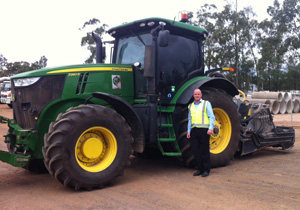
The photo is of me in front of council’s John Deere tractor and FAE road stabiliser attachment. Council recognised that it was not sustainable to be renewing pavements with traditional construction practices, and instead bought the tractor and stabiliser to achieve more cost effective measures in renewing pavements. Council at times uses cement stabilisation processes and for other lighter-trafficked roads it puts a gravel overlay over the top of existing pavements and incorporates with the existing pavement to give a deeper pavement profile. Early days yet.