Toyota Motor Corporation has developed a semiconductor chip it says could improve the fuel efficiency of hybrid vehicles, such as the Toyota Prius, by up to 10 per cent.
Toyota exhibited the new technology, developed in partnership with auto-parts maker Denso Corporation, at the 2014 Automotive Engineering Exposition in Yokohoma in May.
The silicon carbide (SiC) semiconductor resides in the hybrid vehicle’s Power Control Unit (PCU), which supplies electrical power from the battery to the motor to control vehicle speed, and also sends electricity generated during deceleration to the battery for storage.
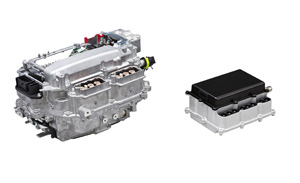
According to Toyota, SiC semiconductors have lower power loss when switching on and off, allowing for efficient current flow even at higher frequencies. This also allows for smaller sized PCUs – from 18kg down to 4kg (see image, right).
“PCUs account for approximately 25 per cent of the total electrical power loss in hybrid vehicles, with an estimated 20 per cent of the total loss associated with the power semiconductors alone,” said a press statement from Toyota. “Therefore, a key way to improve fuel efficiency is to improve power semiconductor efficiency, specifically by reducing resistance experienced by the passing current.”
While cost remains the biggest barrier to commercialising the new technology, Toyota will begin test-driving vehicles fitted with the new PCUs on public roads in Japan within a year.
In the picture: Left – PCU with silicon power semiconductors (Production model); Right – PCU with SiC power semiconductors (future target).