Warren Mashford, Manager Fleet Services at Moreton Bay Regional Council explains how preventative maintenance, in-house repairs and other tactics are keeping costs within budget.
What are some of the major issues facing fleet managers at present?
From my point of view, although Council is committed to providing high quality vehicles, plant and equipment for all operations, constraints to both operational and capital budgets is challenging. I find that’s also the case for other fleet managers I talk to. Councils are having a hard time funding all asset classes, and fleet budgets certainly don’t get any preferential treatment. Certainly things are a lot tighter today than they have been in the past. 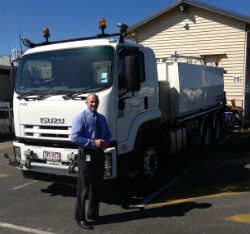
How are you are you getting around those challenges?
Essentially, it forces us to do a lot more with less, which means keeping an extremely careful eye on everything from judicious purchasing of parts and equipment through to whole-of-life costing. But the real key to a running a successful fleet, especially in these constrained times, is preventative maintenance rather than reactive repairs. If you have a good preventative maintenance program, you not only get maximum productivity out of your fleet, but you get extended service from each item of equipment. Routine maintenance can reduce downtime dramatically – simply forgetting to tighten a fan belt for instance, runs the risk of overheating an engine and doing in a head gasket, which translates into lost time.
Also, in face of rising fuel costs, we have found ways of achieving economies. Driver training has been part of that, but we’ve introduced other innovations, like using biodiesel of up to a 20% blend in our trucks, which is also good from an environmental standpoint, of course. And when we come to replace equipment we also demand that manufacturers demonstrate how fuel efficient their machines are before we make purchasing decisions. I do find though, that yellow equipment manufacturers are currently introducing a lot of refinements to provide better cost per hour results in backhoes, bulldozers and the like.
In what other ways have you adapted to rising costs and tighter budgets?
One thing that has really paid off is doing all repairs and maintenance in-house. We find it far more efficient in terms of getting repairs done quickly and less expensively. When we amalgamated with Caboolture Shire Council some years ago, we found ourselves with two different repair and maintenance systems – one had been consistently in-house for years and the other had been using contractors and dealerships. When we got around to comparing the two, we found that doing everything in-house was vastly more efficient than using external providers. So over recent years we’ve been entirely in-house and it has made a huge difference. For instance, we’ve more than halved the cost of maintaining our light vehicles, like cars, utes and vans.
What about finding and retaining the skills for in-house repairs and maintenance?
Well like many councils, we lost some people to the mines, but that’s turning around now. Firstly, the mining boom is slowing down a bit, and secondly, people are returning with tales about the 50 degree heat, and being away from family in the middle of nowhere. According to some, it’s not quite as rosy as they thought. For instance, when we advertise these days for a heavy vehicle mechanic we can get up to 30 applications, whereas a couple of years ago we were only getting two or three. But as far as staff retention goes, we provide an extremely high degree of training here because we have private enterprise benchmarks in place and are heavily focused on achieving quality outputs. That appeals to staff because it keeps them abreast of technical advances. For instance, we always ensure a number of staff go to the IPWEA Plant & Vehicle Management Workshops whenever they are held. They are a great means of honing skills and providing staff with a better understanding of fleet management.
While on the subject of IPWEA, which of their tools and systems do you use?
In short, practically everything! Along with other professionals, I was a member of the working party which helped put together the IPWEA’s Plant & Vehicle Management Manual and I’ve been involved since then with the re-writes and keeping it up to date with changing technology and conditions. Consequently, the Manual’s principles are pretty much embedded throughout our operation. They cover areas like establishing programs to preserve the value of equipment investments, minimising the incidence of unscheduled repairs, and collecting, analysing and reporting data so that good asset management decisions can be made. For instance we have a 10-year replacement program, but that involves a lot of work on whole-of-life costing and the analysis of data to maximise a return on investment. It also means keeping constant tabs on changing technology to ensure you’re replacing equipment with the best options available.
How do you take advantage of the best replacement options?
We do a fair bit of replacement because we have some 2,500 items in the fleet, from chainsaws and brush cutters through to backhoes and graders.
But on all equipment we have a very stringent tender evaluation process in place, and we get everyone involved, from leading hands and workshop staff through to drivers, operators and our workplace health and safety people.
For instance, just because you bought a certain type of plant last time doesn’t mean you have to buy the same thing next time – there might well be something with higher productivity and more useful features when replacement is needed.
Finally, we’ve heard a lot about Queensland councils coping with recent floods. How did your fleet manage?
Well there was tremendous pressure on a lot of items, to say nothing of drivers and operators. Fortunately though, the equipment emerged from it well, despite being immersed much of the time in salt water while building dams and levies and so forth. But that’s because we wasted no time in fully servicing them immediately afterwards. We were very proactive and meticulous in making sure there was no water in gearboxes or motors. I’ve heard that some organisations had serious problems with large equipment, which wasn’t properly serviced, after those floods. But as I said earlier, the key to running a successful fleet, is preventative maintenance rather than reactive repairs.