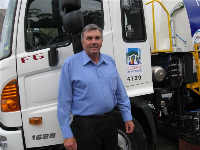
Greg Fannon, Fleet & Fabrication Services Manager at Hobart City Council shares his views on modern-day fleet management and explains why running a fleet across the Bass Strait is sometimes a challenge!
What are some of the challenges you face on a day-to-day basis as a fleet manager?
Well, apart from keeping abreast of rapidly changing technology and focussing increasingly on safety, the existence of Bass Strait creates particular challenges when it comes to fuel and freight costs, and delivery delays.
But that’s just the way it is for most fleet managers here, and while those factors are frequently frustrating, we’ve become pretty adept at managing them effectively.
On the technology front though, the constant emergence of new engine refinements, along with fuel, oil and additive enhancements, means that today’s fleet manager has to keep close watch over compatibility issues.
There are numerous brands of equipment on the market these days, and manufacturers from various countries are becoming increasingly particular about what fuels and oils to use. In fact, their warranties are often related to these specifications.
Meanwhile, at the other end of the spectrum, the range of fuel, oils and additives has expanded to become very type-specific.
So the challenge for a fleet manager is to try and rationalise the holding of fuel and oil types to match as widely as possible the entire range of equipment in the fleet.
And that of course, includes everything from brush cutters to bulldozers!
So it’s a complex task, but there are good savings to be made in terms of standardising on just a few oil types and dealing with just a few suppliers.
Often we will specifically select equipment or certain oil types with this in mind. Obviously, to do this effectively we need to consult closely with the suppliers of both the equipment and the consumables.
You mentioned that focussing increasingly on safety was an important issue for you. Can you elaborate on that?
The safety of our fleet and fabrication personnel has always been an important issue for us, but as equipment gets more sophisticated and complex, it becomes even more so.
Apart from complying with legislation and reducing the likelihood of injury, I believe a strong commitment to safety can boost workforce morale because everyone knows that no effort is being spared in training and assessing competency when it comes to operating equipment.
We place a lot of emphasis on doing a complete risk assessment on each item of our equipment. Each risk assessment is then placed with the specific piece of equipment it relates to.
Operators and mechanics are trained accordingly and we will frequently hold a thorough induction course for everyone who is likely to work with the item. Only once they have all reached a high level of competency, will they be asked to sign off on it.
All risk assessments are then regularly monitored and reviewed on the basis of our own observations and experience and also in terms of any legislative changes relating to their use.
The parallel advantage of closely monitoring each item of equipment in this way is that it also gives us useful data in terms of equipment efficiency and usage, which is highly relevant when it comes to managing our assets.
Can you shed more light on how you manage fleet assets in your organisation?
Well, Hobart City Council now has a new and comprehensive Asset Management Plan, which covers all council assets, and the Fleet and Fabrication Services features strongly in that.
With vehicles and plant, we forecast 20 years ahead in terms of renewing equipment. Some items might need replacement two or three times over that period, but it’s all about predicting an optimum replacement date to deliver the best return on investment.
To do this we monitor the continuum of past data on such things as utilisation, downtime costs, scheduled versus unscheduled maintenance, and a whole lot of other factors. Utilisation rates are a particularly useful indicator as they give us a good fix on how much fuel and oil might be needed each year, what the annual servicing requirements are, whether an item should be owned or just hired as required, and a host of other pointers.
Maintenance failure records are also important because that provides us with accurate information not only on the cost of a failure, but on what caused the failure. In that way we can assess the need for things like increased maintenance procedures, additional operator training or other measures that might need attention.
I should add by the way, that in setting up these systems, the IPWEA’s Fleet and Vehicle Management Manual has been an invaluable source of reference.
Apart from an effective Asset Management Plan, what other innovations have you introduced recently?
One in particular was to become the first Tasmanian council to reduce our greenhouse gas emissions by introducing a fleet of compressed natural gas (CNG) trucks last year.
We acquired five CNG 6.5 tonne GVM trucks to complement our fleet of diesel electric hybrids operating around the city. Four are general service tip trucks used to service the council’s work crews and the fifth is a van body unit which picks up office paper for general disposal and security shredding services.
These vehicles help reduce carbon emissions by 25% compared with diesel, which means it ties in well with the council’s overall commitment to the Cities for Climate Protection Program. All up, use of the five trucks is reducing the council’s greenhouse gas emissions by approximately 15 tonnes of CO2 a year.
What do you recommend to help fleet manages in their professional development and the interchange of ideas?
We are fortunate in Australia to have such a well-resourced institute - the IPWEA’s workshops, courses and forums are incredibly useful when it comes to professional development. The Tasmanian branch holds its forums and events in Launceston and they are well attended.
Managing a fleet in Tasmania also has certain difficulties not encountered on the mainland, such as lengthy delivery issues, plus the fuel and freight cost problems I referred to earlier.
For instance, if you can’t obtain an urgently needed replacement part in a hurry from the mainland, a fleet manager at another council might lend one to you if he has a spare on hand.
As a Fleet Manager, and because of the issues encountered here in Tasmania, I try to maintain contact through forums, seminars and local government associations, with other fleet managers and vehicle and equipment suppliers.