John Osland, Director, Technical Services and Operations at Canada Bay Council gives the inside track on how Canada Bay Council got involved in the creation of the award-winning Climate Change Adaptation Manual for Local Government.
How did the Climate Change Adaptation Manual for Local Government come about?
In late 2013, The Australian Centre for Excellence in Local Government (ACELG) invited the City of Canada Bay to form a partnership in the development of a climate change publication directed at local governments. At the time Council was investigating ways to build capacity and communicate the ways it was addressing climate change, and so it made sense to work together and reinforce each other’s resources so we could get a better outcome at the other end.
When RPS came on board they also had a similar belief and just wanted to add to the manual. The entire collective was worth a lot more than the individual.
The manual collates case studies of climate change adaptation projects from councils around the world, how did you find each example?
In developing the manual, a significant amount of time was invested into researching leading climate change practices from across the world. Our approach focused on identifying how other cities have addressed a wide range of climate change issues including sea-level rise, increases in temperature and extreme weather events, and involved distilling key ideas into something that was manageable for any local government to pick up and start using.
A substantial number of case studies came out of Australia which shows the great work we are doing across the nation, and that we are up there with some of the world’s leading cities in addressing climate change. I’m quite proud that a number of case studies came out of the work that we are doing here at The City of Canada Bay.
The manual is free to download, how can councils use the manual to best advantage?
The manual has been developed to provide other councils with practical steps that they may implement within their own organisations to integrate climate change adaptation into daily business processes.
Each case study has been framed to clearly communicate the key management measures that were used to respond to specific climate risks, allowing councils to adopt a pragmatic approach in embedding climate adaptation within the context of their organisation. This is particularly useful for many of the smaller councils that may not necessarily have the resources required to research into how to best address climate change across their local government areas.
My belief is that if everyone takes responsibility and does his or her small amount to address climate change, that this will result in a significant difference. If I can get every local government to proactively doing something to address climate change, collectively we would achieve big results in this domain.
Do you think local governments are embracing the idea of climate change adaptation?
I think there has been and will continue to be some level of resistance in progressing the climate change agenda. Although there is still skepticism it’s great to hear that councils are more and more focused on how to adapt to climate change rather than what is causing it.
There are all sorts of predictions behind what is causing climate change, however it’s important that we look at climate impacts from the perspective of risk and ensure council fulfils its legal obligation in addressing potential climate impacts that may directly affect the community.
What next for Canada Bay council?
The City of Canada Bay is continuously looking at ways to integrate both social and environmental techniques into its daily operating activities to address the impacts of climate change. A few examples of the projects that we are currently completing include building roads that have lower impacts on our environment, energy efficiency projects particularly across our street lighting and building portfolios and water recycling plants.
Our $3.5 Million Water for the Community Project will provide Council with a secure supply of water to irrigate half the city’s playing fields and the golf courses without having to rely on the public water system supply.
We are also building a $20 Million Community Center out at Rhodes, that has been designed to use the latest water recycling and energy efficient technologies.
I think that the most important part in driving the climate change agenda is to ensure that all stakeholders in the organisation understand its relevance, and whenever possible illustrate the tangible benefits of completing these projects.
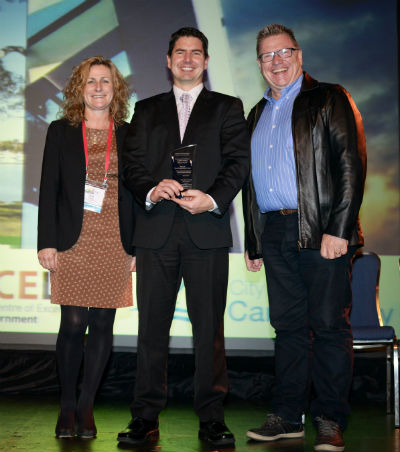
The Climate Change Adaptation Manual for Local Government won the top prize in the Climate Change Resilience Category at IPWEA’s inaugural Sustainable Solutions in Public Works awards.
Visit the ACELG website, to download the free manual
Want to find out more? Register for IPWEA's 'Building Climate Resilience in Your Council' one-day workshop now.
Photo (left to right): Stella Whittaker (RPS), Michael Kahler (IPWEA President) and John Osland (Canada Bay Council)