By Emma Green, NATSPEC Communications
In early July last year, a far north Queensland main road began to melt. The asset failure at Millaa Millaa-Malanda Road caused traffic chaos and left the road authority and contractors red faced. Here, we dig into what exactly went wrong and how using better design methods can avoid future sprayed seal failures.
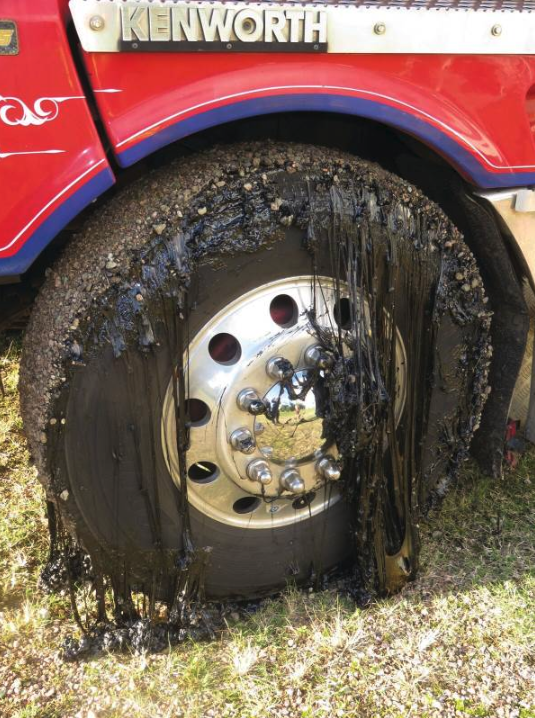 Tyres coated in melted tarmac from Millaa Millaa-Malanda Road, 4 July 2018. (Photographs by David Anthony, Tablelander newspaper.)
In June 2018, the surface of the Millaa Millaa-Malanda Road in the Atherton Tablelands started to deteriorate after a routine resurfacing procedure. The road surface first became loose and cracked, causing gravel to fly up and damage drivers’ windscreens. The Department of Transport and Main Roads (TMR) immediately took measures to fix this issue but by 4 July the situation was far worse. The road seal had become completely destabilised and drivers were forced to stop as melted tarmac stuck to their tyres. More than 60 affected drivers filed vehicle damage claims with TMR.
This well-publicised sprayed seal failure disrupted holidays, cut off residents in small towns along the road like Jaggan and Tarzali, affected transport to the upcoming Malanda Show and disrupted truck drivers’ work schedules.
What went wrong?
Several defects contributed to the Millaa Millaa-Malanda Road failure. After the previous resealing process in June, rain and below-average winter temperatures followed by a heatwave destabilised the road surface. The 14mm aggregate used over the existing 10mm aggregate was not suitable and the spray rates for the 14mm seal did not take into account the difference in traffic volume between the fast and slow lanes in the overtaking section. Poor traffic management allowing trucks to idle on the newly resealed road caused the binder to lift. The seal design did not follow TMR’s current methods and both the cutter and binder content were insufficient, causing the seal to strip.
Each Australian state takes a different approach to sprayed seal design and the implementation of specifications and Austroads guidelines. Queensland and New South Wales tend to use in-house staff designers, while the Victorian authority VicRoads engages contractors under quality assurance design contracts. Under their system, the contractor does the design with a two-year warranty and VicRoads must provide accurate traffic information.
Government departments recognise outsourcing work is often necessary, because specialised bitumen spray contractors have staff with technical skills for the task at hand. However, engaging external professionals does not mean all problems will be avoided. In this instance the Millaa Millaa-Milanda Road sprayed seal design was carried out in-house by TMR and not by the specialist contractor.
Failures do occur, but they can be avoided or minimised by making informed decisions.
To avoid sprayed seal failures, allowances for the binder application rate must be made for reasons such as surface texture, binder absorption, aggregate embedment, aggregate porosity, the use of polymer modified binders and different surfacing binder types to counter steeper vertical grades. The voids factor, which is related to traffic volume, is important – the traffic volume used in the design must be representative of the actual traffic on the area subject to the sprayed seal.
Aggregate particles tend to lie with their least dimensional vertical. Therefore, an aggregate’s average least dimension (ALD) is central to the volumetric design of a sprayed seal.
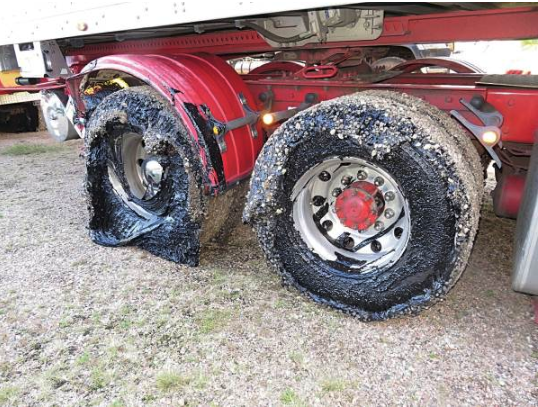 Tyres coated in melted tarmac from Millaa Millaa-Malanda Road, 4 July 2018. (Photographs by David Anthony, Tablelander newspaper.)
Again, however, many local councils rely on the aggregate supplier’s testing certificates and do not conduct tests themselves. Onsite ALD tests can be considerably different from supplier-provided tests. This can lead to an undersupply or oversupply of binder, resulting in bleeding or stripping of sprayed seals.
Suppliers know that many councils do not conduct testing and may therefore supply substandard or non-conforming materials. Without testing their base pit gravels, councils may not know whether they are working with porous or impervious gravel. This may result in primes being up to 50% in error with the binder quality.
Local governments can protect themselves from faulty sprayed seals by examining materials and processes and using AUS-SPEC documents.
Using AUS-SPEC to avoid asset failures
Asset failures like that seen at Millaa Millaa-Malanda Road can be prevented by making informed decisions at every stage of the project using AUS-SPEC. AUS-SPEC is an essential technical resource for managing local government assets. When this specification system is implemented, similar failures can be avoided on local roads.
AUS-SPEC has updated and released the 1143 Sprayed Bituminous Surfacing specification in line with recent Austroads guides AGPT04K, for sprayed seals and AGPT04F, for bituminous binders. This revised specification, released with the October 2018 AUS-SPEC update, will help local councils to deliver safe, durable and fit-for-purpose road surfacing.
Austroads, the peak organisation of Australasian road transport and traffic agencies, provides guidance on the design, construction and management of road networks and infrastructure. AUS-SPEC includes Austroads advice and requirements relevant to local government in its specifications that become part of the contract documents.
IPWEA developed AUS-SPEC in 1997. Since 2007, IPWEA has worked with NATSPEC to deliver the local government specification. NATSPEC manages AUS-SPEC specifications and releases an update to subscribers every October. A not-for-profit, government- and industry-owned organisation, NATSPEC maintains the National Building Specification for Australia. It has been a valued part of the construction industry for more than 40 years.
AUS-SPEC gives councils access to comprehensive technical knowledge and documentation for the delivery of successful projects. It provides a common language for contractors and local council staff members, facilitating collaboration and improving the safety and sustainability of local government assets. Each AUS-SPEC construction document provides a summary of hold points and witness points, which is a checklist for inspection, verification and programming sequential activities during construction.
Local councils and their contractors must keep the environmental conditions in mind when planning, executing and maintaining any project. AUS-SPEC specifications help local governments to make informed decisions and avoid asset failures. The AUS-SPEC system for managing local government assets emphasises the necessity of proper design, as well as the importance of specifications during the construction process. AUS-SPEC is an essential technical resource for managing local government assets and providing quality infrastructure to communities.
This story was first published in the March/April edition of inspire magazine. Read the original and more here. In the recent article titled ‘Meltdown’ published in inspire magazine, we would like to acknowledge that the sprayed seal design for the Millaa Millaa-Milanda project was done by TMR in-house and not by the contractor as previously mentioned in the article.