What do bike paths, roads, railways, pipes and horse tracks have in common? The answer is tyres, if Liam O’Keefe has any say in it.
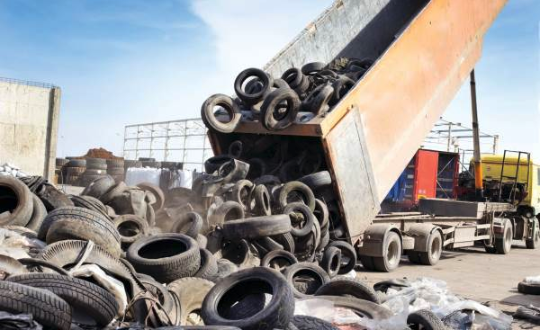
The Market Development Manager for Tyre Stewardship Australia (TSA) says these are just some of the applications either on the market or being trialled as a way to recycle the 56 million used tyres Australia produces each year.
“Recycled tyre product is a great material that has a lot of performance benefits and characteristics that are beneficial to a wide range of applications,” O’Keefe enthuses.
“It’s a huge resource – we generate 56 million equivalent passenger units of tyres in Australia every year, and about 1.5 billion world-wide. It’s a vast resource that provides good performance benefits and can support and enhance the job that you want to do.
“We talk about lack of resources and the challenges of getting virgin materials, but there’s a wealth of productive recycled material that is accessible. There’s a lot of really good material that’s there to be used, so why not use it?”
Formed five years ago, one of TSA’s goals is to promote the development of viable markets for end-of-life tyres. At the moment, only about 10% of Australia’s end-of-life tyres are being recycled. Crumb rubber asphalt has been used on Australian roads since the 60s and 70s – but even this widely accepted product encounters speed bumps.
“One of the core obstacles to greater take-up is that contractors are used to just working with standard asphalt mixes and have limited understanding of the formulations of crumbed rubber asphalt that work the best. Part of our job is to educate the industry on the benefits of the product and turn them into advocates for the superior performance that can be delivered,” O’Keefe says.
Australia has roughly 873,500km of roads, about 40% of which are sealed. That’s a lot of horizontal real-estate that could absorb a great deal of waste tyres – which is why TSA is collaborating with industry bodies and researchers to prove the reliability of tyre-derived products.
“The road sector’s been great, we’ve funded a lot of projects. We’ve done a lot of research and development in the sector around the specifications, in different states, for using crumb rubber in varying road types. Having done that we’ve created specifications for open and gap graded asphalt, which have been produced by the Australian Asphalt Pavement Association and readily available to road authorities across Australia,” O’Keefe says.
“Now we’re focusing on industry, to make products that meet that specification through demonstration and infrastructure projects.”
Real-world trials
For the first five years, TSA’s funding was focused on research and development. As of September 2018, that focus has shifted to funding real-world trials.
“There’s been a desire from funders and from other stakeholders like government and business to see action and outcomes now,” O’Keefe says.
“We’ve been going for five years and we want to see more Australian tyre-derived product used for productive outcomes.”
The latest innovation is a surfacing product called Equine Air, for use on horse tracks. Developer Flexiroc Australia – which already installs sports surfaces for human use – has installed 500 square metres of Equine Air, made from a mixture that includes 27 tonnes of recycled tyre rubber, on the Tynong Complex in Pakenham.
The product’s ability to drain rainfall from the track in a short time and the cushioning effect it offers both horses and jockeys, means it presents not only another avenue for recycling tyres, but better outcomes than conventional surfacing.
It has similar properties to a permeable pavement product currently being trialled at the University of Melbourne.
Permeable paving that allows water to pass through the surface and reduces storm water runoff is already in use. However, its flexibility traditionally means it is unsuitable for surfaces that need to carry heavy loads, like roads or bike paths.
A team of researchers from the University and systems engineers Merlin Site Services are working to solve that issue. They are trialling the use of recycled tyres to create the ‘optimum blend’ of permeable paving that provides some flexibility to reduce cracks caused by movement of natural ground or tree roots, but not so much that it becomes unstable under traffic loads.
“It’s a fine balance between recycled tyre particles, rigid rock aggregates and the binder,” says Dr Mahdi Disfani, the project’s technical lead.
The pilot trial of four different surfacing recipes is being tested and monitored for skid resistance, pavement movement, water infiltration and run-off and resilience of the pavement under load.
O’Keefe says the product trial has resulted in encouraging early results.
“Once we can verify this blend of permeable pavement and the value it provides, the next step is trialling it on a larger scale – one that can take thousands of tyres from landfill and have a dramatic effect on sustainability,” O’Keefe says.
“Currently permeable pavement is expensive, but if we can create the right cost effective product that is skid resistant, durable and with the right amount of flexibility, we can diversify the applications of used tyres.”
The university is also working on recycled tyre road barriers, hoping to utilise the material’s ability to absorb impact and – hopefully – save lives.
Another innovative project is being undertaken by a company called Polymeric Powders. They take crumb rubber, chemically and mechanically treat it to increase the surface area, then combine it with plastics to create a composite plastic material that is able to be extruded. Possible uses include flexible plastic pipes and as a 3D-printing material.
One area O’Keefe has his sights set on for future product development and testing is the rail industry.
“If you look at the performance attributes of rubber, it can offer vibration attenuation and absorption plus sound absorption. There are multiple applications for that type of product, in various forms, in the rail industry, whether it’s a sub-ballast or sub-rail or sleepers or the signal works around rail activities,” he says.
“We’re looking to become more involved in the rail industry, and we’ve funded a couple of projects in that space, but we are finding it more challenging to make the inroads that we have made in the road sector.”
O’Keefe says TSA’s first call for demonstration and infrastructure project funding applications received a strong response and expects future funding rounds will enjoy the same.
As an industry that necessitates the use of high volumes of tyres, O’Keefe encourages engineers to embrace and seek new productive outcomes once these tyres reach end-of-life.
“We increasingly believe that councils and contractors will lead the way in creating positive change. They are the types of organisations that we want to talk to, partner and collaborate with,” he says.
This story was first published in the March/April edition of inspire magazine. Read the original and more here.