Through its Round Mountain Reservoir, Logan City Council is the perfect example of how solar can ensure a high quality, cost-effective water supply even in developing and remote communities.
With a population set to explode by 480% by the year 2036 in the Logan South area, Logan City Council had to think creatively when upgrading its award-winning reservoir.
The council, as part of the Logan Water Infrastructure Alliance (LoganWIA), had the primary task of dealing with longer than desirable water age in a 20ML reservoir which held more water than the local community of 31,400 people actually used. When the reservoir was built in 2014 near Logan South, located 45km south of Brisbane, it was a forward thinking project ultimately aimed at supplying water to 150,000 people as the area grew.
Assessing six different setups, LoganWIA settled on a $3 million off-grid electro-chlorination facility powered by solar panels and a Tesla battery to ensure a safe water supply, Chris Pipe-Martin, Acting Wastewater Treatment Program Leader for Logan City Council, tells
intouch.“There was one clear winner in solar powered electro-chlorination in that it had the lowest NPV over the 10-year life of the project as well as having the highest reliability,” he says.
A far out solution
The location of the reservoir was a key factor in the off-grid system being selected.
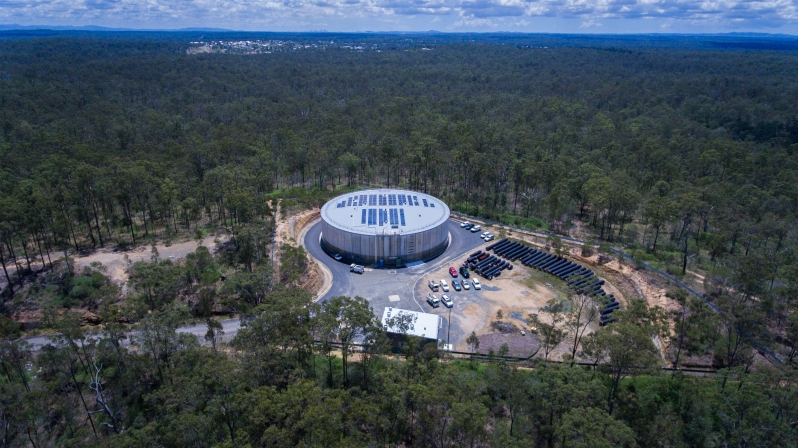
Situated 4km away from the closest residence, site access included a 3.1km stretch of unsealed road which became boggy during the wet summer months and, as such, was unsuitable for tankers transporting the disinfectant typically used, liquid hypochlorite.
This problem couldn’t be overcome by storing the liquid hypochlorite in large tanks at the reservoir for use during the summer as the chemical deteriorated over time, Pipe-Martin says.
“We couldn’t get chemical deliveries and we didn’t have grid power, so that’s why we’ve ended with the system we have.”
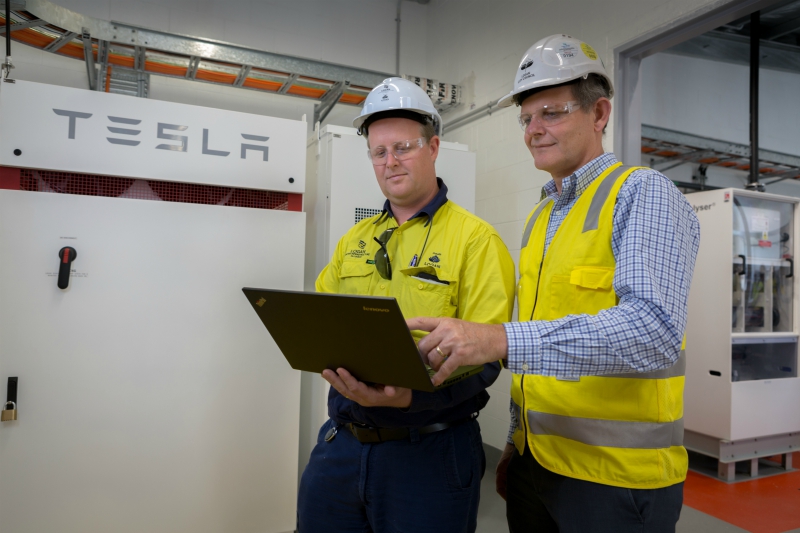
Powered by 323 solar panels and a 95kWh Tesla Powerpack battery, the electro-chlorination facility uses high purity salt to disinfect the water supply instead. The salt itself is safe enough to be stored in bulk onsite, Pipe-Martin says.
The system avoided $1 million in costs that would have been spent connecting the site to the grid and a further $1.9 million for sealing the access road. There are also ongoing savings from
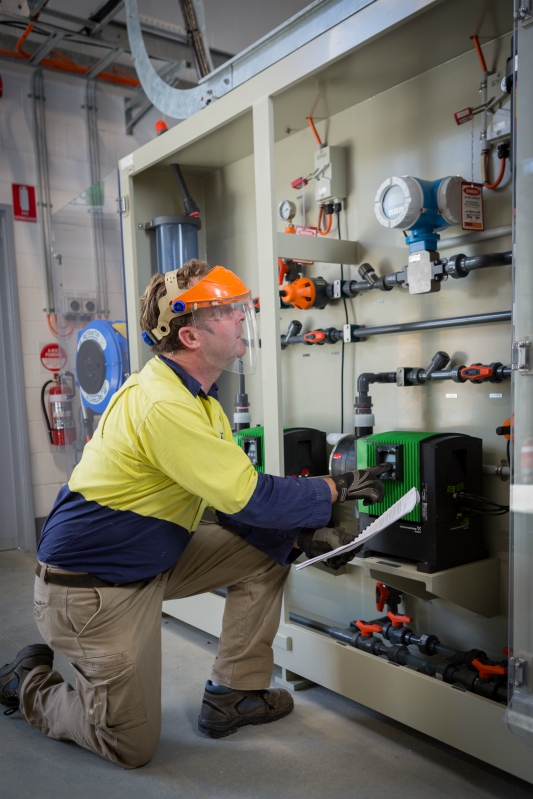
using salt instead of liquid hypochlorite, and the facility is mostly self-sustaining with a single operator inspecting the site weekly and refilling the salt solution once a month.
“The solar power system is working above expectations. Even on overcast days, it’s supplying more power than we thought it would, so we’ve got plenty of power onsite. The chlorination system has also run without any problems at all. It’s been very reliable,” Pipe-Martin says.
These results saw the reservoir acknowledged as the IPWEA Queensland Division Project of the Year in 2018.
“We learnt that an alternative technology like this can be viable in the right location. If we had another site which didn’t have mains power and didn’t have reliable road access to it, we would look at this solution again,” Pipe-Martin says.
Green, clean and efficient
On top of the cost savings, the reservoir also has advantages for the environment, says Pipe-Martin.
“It’s got side benefits that there are no greenhouse emissions from the site and it’s not responsible for any power generated from greenhouse emitting sources.”
Because of these qualities, the reservoir has attracted interest from communities around Australia, with Logan City Council already asked to advise on how the system could be applied elsewhere.
“The system is very reliable and requires a minimum of operator input so we can see that this type of setup would be suitable for remote or small isolated communities,” Pipe-Martin says.
With LoganWIA’s investigation into the most effective setup already concluded, these smaller communities could simply tap into that knowledge, he adds.
The force behind the project, LoganWIA, is a public and private sector enterprise involving Downer, Logan City Council, Cardno, and WSP Parsons Brinckerhoff.