Unbeknownst to motorists driving down Rayfield Avenue, Craigieburn, the asphalt under their tyres is hiding a secret: 200,000 soft plastic items, 63,000 glass bottle equivalents and toner from 4500 used printer cartridges.
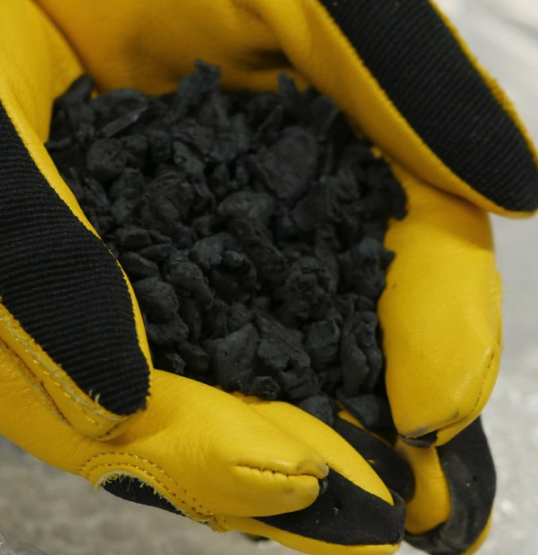
It’s all part of a joint Downer, Close the Loop, RED Group and Hume City Council pavement trial launched in May that gives new life to materials that would otherwise end up in landfill or as pollutants in the environment.
Although it’s labelled a trial, Dante Cremasco, Downer’s Executive General Manager for Road Services, is confident the surface will be a success.
“While we call it a trial, in reality it’s a demonstration of just how little the difference is between what we’ve produced, from a specification perspective, and the traditional ways of doing things,” he says.
“We got to the point where we know this works really well – it’s not such a big leap from what we’ve been doing traditionally with our approach to recycling and sustainability.”
How does it work?
Substituting recycled glass for virgin sand in pavement is a simple enough matter – the real challenge was how to combine the plastic and toner.
“The gradings are such that we can substitute glass for sand straight off the bat in the process. The plastics and the toner – that’s where the real science is required,” Cremasco says.
After five years of development Downer and Close the Loop perfected the specialised pellet technology, which was first used in an earlier product called TonerPave.
“What we’ve developed is a pellet that combines toner and the plastic into one,” Cremasco explains.
“The secret is to have the toner grab onto the plastic and then as soon as it gets subjected to a heat transfer cycle in the manufacturing process, that toner and plastic then combine with the binder to give you effectively a new homogeneous binder that goes into your finished asphalt.”
Only soft plastics are used to ensure successful homogenisation into the asphalt binder – essentially, anything that can be scrunched by hand, such as plastic bags and packaging.
“We picked our plastics for a reason, and that reason was to avoid the microplastic debate,” Cremasco explains.
“We’re aware that there’s a concern around microplastics and we are 100% confident in our technique for combining the plastic with the toner, and then combine that into our mix – we get a homogeneous product as a result of that. We’ve done our best to try and separate plastic from our binder, and we simply can’t get it to come apart.
“We can demonstrate that it’s not a problem, and we are extremely confident that this product using the soft plastics is a very good outcome for a problem that faces us right now.”
Cremasco likened the addition of the pellets to adding sugar to hot tea; once stirred in, there’s no separating them. The plastic was sourced from the REDcycle program, a recovery initiative for post-consumer soft plastic with collection bins in major shopping centres.
Superior performance expected
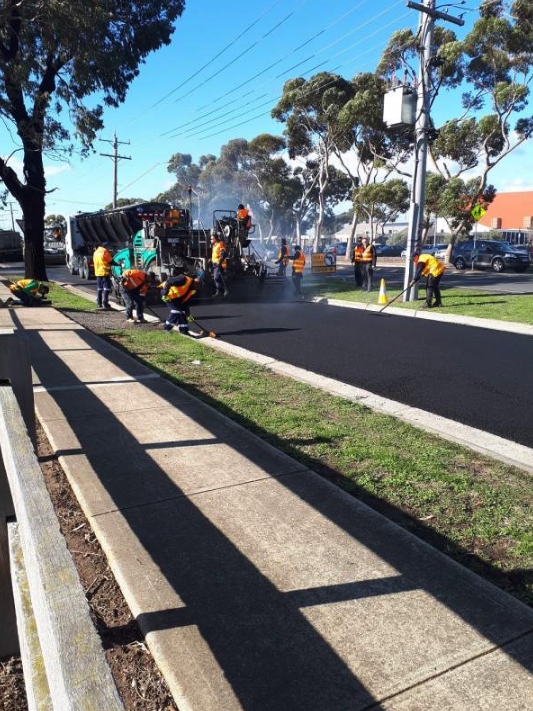
Having already undergone testing in laboratory conditions, the main source of testing on Rayfield Avenue will be visual assessment.
“It’s going to be predominantly visual assessment on a regular basis,” Cremasco says.
“These are low-volume traffic streets. We have the necessary samples and cores and slabs that we test to see how they perform. But now, it’s really just environmental and looking at how it stacks up over time.”
Not only is the pavement an ideal way to reuse post-consumer recyclable products, Cremasco says it’s also expected to perform better than traditional solutions.
“The technique itself actually enhances the virgin binder. On main arterial roads, you’ll find high specification works that require a polymer modified binder with properties not dissimilar to what we’re creating through the plastic soft binder,” he says.
“We see an additional opportunity to utilise this product on those high-volume roads.”
Cremasco passionately advocates for greater emphasis to be put on product performance, rather than heavily prescriptive standards that leave little room for innovation.
“There are standard specifications for the production of asphalt. A lot of these specifications were written at a time where it was said you couldn’t use high percentages of reclaimed asphalt pavement. Our asphalt plants today have evolved significantly and we’re confident in our ability to incorporate far higher levels of recycled asphalt materials than was previously contemplated. These specifications were written at a time where they didn’t contemplate changes in technology,” Cremasco explains.
“Virgin sand is quite a difficult product to source at the moment in a lot of areas across Australia. The sources are further and further away, so when you’re able to use glass as a substitute for sand, it ticks a lot of boxes environmentally and from a cost perspective.
“What we’ve done is effectively gone back to our clients and said, ‘Look, from a performance-based perspective, we can demonstrate that what we’ve created actually works better than a full virgin mix.’ And as a result, whilst they’ll tolerate some percentage of recycling, we’re able to manufacture a product that sits way outside of those bands, in some cases well in excess of 80% recycled content, and still make the performance requirements of the specification.
“Because the minute you try and regulate or have people work to a very tight standard, it really does prevent innovation and exploration of other ideas, because effectively they’re saying, ‘This is all you can do,’ and any time you want to innovate, it takes a lot of effort and a lot of time to move the dial.”
Nevertheless, it seems the dial is moving. Cremasco says he has fielded interest from around Australia since the trial was launched in May, and a
NSW-first trial was launched in Sutherland Shire Council in August.