Maintaining infrastructure can be a complex enough task for councils – adding climate change makes things more complex still.
This consideration hasn’t yet been properly attempted, says applied climatologist Dr Jacqueline Balston, Director at Jacqueline Balston and Associates and Adjunct Senior Research Fellow at the University of South Australia.
“I think that’s one thing councils struggle with, because it’s such a complicated area,” she tells
inspire. There are climatic, financial and maintenance schedule dimensions, as well as engineering considerations.
“To start with there is a design life for the various pieces of infrastructure, then you have to understand the individual materials and how they might react to climate change,” she outlines. “Wood is going to react differently to seawater than it would to fire, and it’s also going to react differently to how steel would react, and then concrete is different again.”
Rising sea level and coastal storms are something that Sydney’s Northern Beaches Council, which has partnered with IPWEA to produce
Practice Note 12.1: Climate Change Impacts on the Useful Life of Infrastructure, has reason to be concerned about.
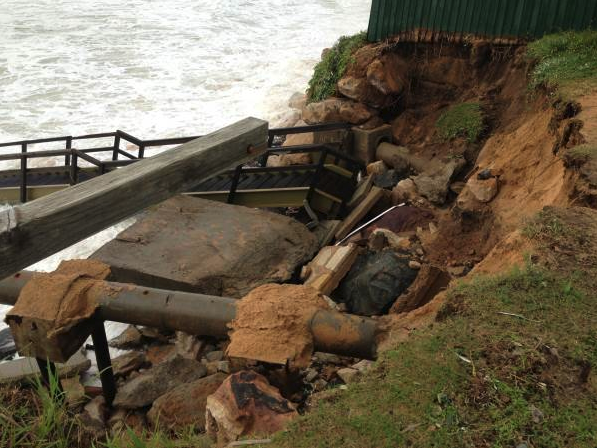
In June 2016, storms created waves of up to 8m in the Sydney area. Drone footage revealed the dramatic aftermath, with pools and parts of houses being swept away at Collaroy beach, the third-most at-risk area from coastal processes in Australia, and a well-known erosion hotspot.
“It caused a lot of damage to the beaches of Sydney and there was major erosion of beach sand and a number of residential buildings in Collaroy came very close to falling into the sea,” Dr Stephen Lees, project manager from IPWEA on the partnered project with the council, tells
inspire.Lees says the council has resolved to remedy this by building a rock wall to protect public infrastructure that will tie into works being undertaken by property owners to protect their buildings. Importantly, a number of other utilities will need to be incorporated or considered in these works including stormwater and sewer assets.
One of the four case studies in the practice note will highlight the impact of climate change on the useful life of a stormwater outlet at Collaroy Beach.
“The stormwater outlet was destroyed in the storm and is planned to be replaced with high density polyethylene pipes with limited useful life data, so will make an interesting case study moving forward,” explains Todd Dickinson, Executive Manager of Council’s Natural Environment and Climate Change Department.
“The objective is to increase resilience to inundation from storm surge, in particular as the sea level rises,” he added.
Outlets are designed to discharge freely, assuming there’s no water in the bottom of the pipe. As sea levels rise, explains Lees, it’s more likely a pipe outlet will be underwater, limiting how fast the stormwater is discharged, which can result in flooding in the upstream catchment.
“Coastal councils will start to want to know what the useful life of stormwater outlets are, and whether they’re going to have to plan and budget for major upgrades or modifications as the sea level rises,” he highlights.
Another case study used to demonstrate the methodology in the new practice note will be the rebuilding of the Mona Vale Surf Life Saving Club.
Todd Dickinson gives the explanation that the case studies on the Northern Beaches have tested the useability of tools developed as part of
Practice Note 12.1, which are aimed to assist asset managers to address climate change in asset management planning and valuation.
“We would like to see a product that can be used by our asset managers in business case proposals that consider climate change adaptation opportunities at the start of a project, when it’s easier to address, rather than an afterthought that’s usually much more expensive to include later on,” he says.
The new practice note is designed to be used in conjunction with IPWEA’s
Practice Note 12: Useful Life of Infrastructure. According to Lees,
Practice Note 12 is “quite comprehensive” and
12.1 will be there chiefly to deal with an omission: explicitly dealing with climate change.
Although the project was funded by an $80,000 Local Government NSW Building Resilience to Climate Change grant, the output will be applicable to councils throughout Australia and New Zealand.
“It will propose alternative designs in response to sea level rise and more extreme weather events for council assets like community facilities, roads, bridges and stormwater outlets,” Northern Beaches Council General Manager Environment and Infrastructure Ben Taylor says.
It is early days in attempting to calculate climate change’s impact on the useful life of infrastructure, Balston says.
“This is the first step and I think it’s a very valuable step to make sure that climate change is really on the radar as far as existing and future infrastructure developments go,” she says.
“We know that councils are responsible for huge amounts of infrastructure and financial management and maintenance of those is a significant part of their business. And, we also know that climate change is likely to affect a whole range of council assets: roads, water supply systems and coastal infrastructure – even street trees are going to be affected.”