Many pedestrian bridges around the world have experienced dramatic vibrations and dangerous wobbling when crowds of pedestrians have tried to cross them, with some bridges even collapsing. In an effort to combat this, a new model has been developed to predict the effect of large crowds of people on bridges.
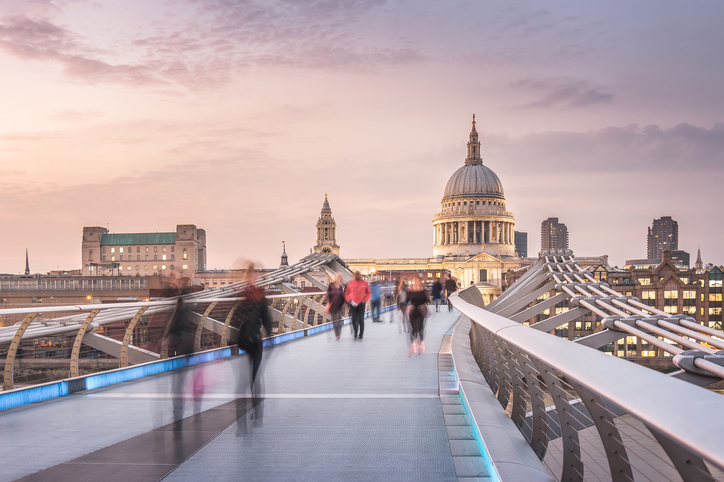
In 2000, the London Millennium Bridge began to sway on its opening day as thousands of pedestrians crossed it and the $32 million bridge had to be closed.
In 2003, the Clifton Suspension Bridge in the UK, originally designed as a highway bridge, had to be closed when it started wobbling sideways abruptly as a crowd crossed it during the International Balloon Fiesta. In 2014, the Squibb Park Bridge in Brooklyn, New York, bounced from side to side as pedestrians crossed the bridge and didn't reopen until early 2017. The Singapore Airport's Changi Mezzanine Bridge is another example of an unstable pedestrian bridge.
In a recently published paper, researchers from Georgia State University challenged the widespread view that increasing the crowd size will gradually increase the bridge wobble.
"The current view is the more pedestrians we add to the bridge, the wilder the oscillations will be. This is true, but only for crowd sizes above this critical size. There is an important threshold effect,” Dr Igor Belykh, professor in the Department of Mathematics and Statistics at Georgia State said.
"Our paper gives an explicit guideline and formula of how to estimate this critical crowd size, which can be used to limit the carrying capacity of an existing bridge and to help designers build better bridges. The biomechanical models we're developing are particularly important for understanding the role of crowd dynamics on a wobbly bridge because the US code for designing pedestrian bridges does not contain specific guidelines that account for collective pedestrian behavior.”
Previous studies have found a connection between critical crowd size and bridge wobbling. Engineers determined the London Millennium Bridge would sway if a critical crowd size of 165 pedestrians crossed the bridge at once, but under the critical size there were no vibrations.
In addition, engineers discovered a critical crowd size for the Clifton Suspension Bridge, saying that once the crowd reached the critical size, wobbling became noticeable and dangerous. This threshold effect is likely to be present for other bridges, Belykh said.
The paper finds that synchronisation of pedestrian foot movement might not necessarily be the main cause of the initiation of bridge vibrations, though it is necessary for the bridge to sway significantly. It is commonly believed that synchronisation among pedestrians initiated the wobbling on the London Millennium Bridge, but this paper argues otherwise.