Researchers are taking a page from Mother Nature’s book by identifying naturally occurring structures that could inspire the creation of stronger, more sustainable and more durable concrete.
In a paper published in the
Construction and Building Materials journal, a team from Massachusetts Institute of Technology contrasts cement paste — concrete’s binding ingredient – with the structure and properties of natural materials such as bones, shells, and deep-sea sponges.
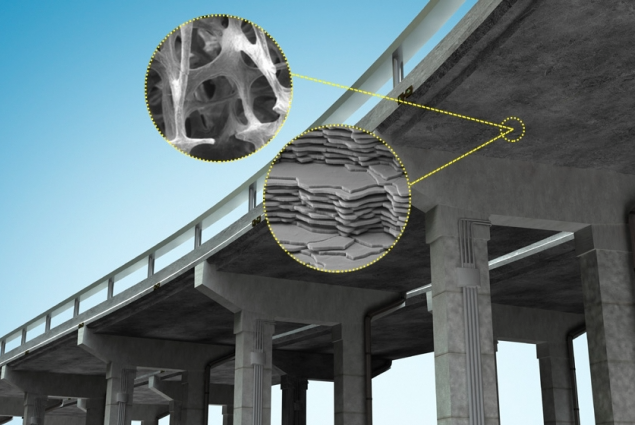
The researchers observed that these biological materials are exceptionally strong and durable, thanks in part to their precise assembly of structures at multiple length scales, from the molecular to the macro, or visible, level.
Ultimately, the team hopes to identify ‘bio-inspired’ materials that may be used as sustainable and longer-lasting alternatives to the widely-used Portland cement, which requires a huge amount of energy to manufacture.
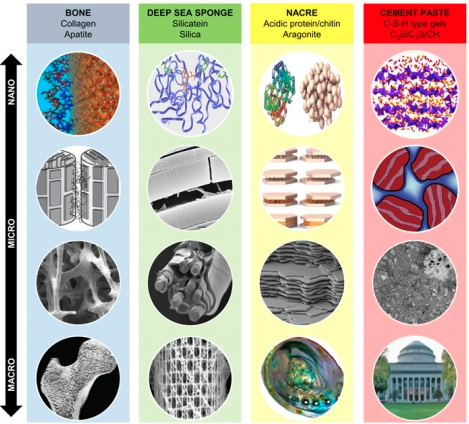
Research team leader Oral Buyukozturk, a professor in MIT’s Department of Civil and Environmental Engineering, and his colleagues looked to biological materials such as bone, deep sea sponges, and nacre (an inner shell layer of mollusks), which have all been studied extensively for their mechanical and microscopic properties.
They compared each biomaterials structures and behavior, at the nano-, micro-, and macroscales, with that of cement paste.
The researchers found that a deep sea sponge’s onion-like structure of silica layers provides a mechanism for preventing cracks. Nacre has a 'brick-and-mortar' arrangement of minerals that generates a strong bond between the mineral layers, making the material extremely tough.
Taking a closer look
Standard concrete is a random assemblage of crushed rocks and stones, bound together by a cement paste. Concrete’s strength and durability depends partly on its internal structure and configuration of pores; the more porous the material, the more vulnerable it is to cracking.
However, research team leader Oral Buyukozturk, a professor in MIT’s Department of Civil and Environmental Engineering, says there are no techniques available to precisely control concrete’s internal structure and overall properties – although he’s hoping to change that.
“It’s mostly guesswork,” Buyukozturk says. “We want to change the culture and start controlling the material at the mesoscale.”
Buyukozturk says the “mesoscale” represents the connection between microscale structures and macroscale properties. For instance, how does cement’s microscopic arrangement affect the overall strength and durability of a tall building or a long bridge?
Buyukozturk says understanding this connection would help engineers identify features at various length scales that would improve concrete’s overall performance.
From the bottom up
Applying the information they learned from investigating biological materials, as well as knowledge they gathered on existing cement paste design tools, the team developed a general, bio-inspired framework, or methodology, for engineers to design cement, “from the bottom up.”
The researchers hope the framework will help engineers identify ingredients that are structured and evolve in a way, similar to biomaterials, that may improve concrete’s performance and longevity.
“These materials are assembled in a fascinating fashion, with simple constituents arranging in complex geometric configurations that are beautiful to observe,” Buyukozturk says. “We want to see what kinds of micromechanisms exist within them that provide such superior properties, and how we can adopt a similar building-block-based approach for concrete.”
“If we can replace cement, partially or totally, with some other materials that may be readily and amply available in nature, we can meet our objectives for sustainability.
Buyukozturk predicts the way concrete is produced will drastically change.
“The merger of theory, computation, new synthesis, and characterization methods have enabled a paradigm shift that will likely change the way we produce this ubiquitous material, forever,” Buehler says.
“It could lead to more durable roads, bridges, structures, reduce the carbon and energy footprint, and even enable us to sequester carbon dioxide as the material is made. Implementing nanotechnology in concrete is one powerful example [of how] to scale up the power of nanoscience to solve grand engineering challenges.”
Images: Christine Daniloff/MIT