For many, a cup (or three) of coffee is the foundation of their morning routine. But now, engineers have found a way to utilise used coffee grounds as a unique foundation for roads.
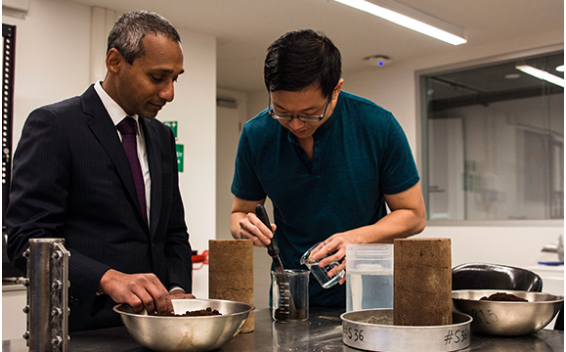
Swinburne University of Technology’s Professor Arul Arulrajah leads the geotechnical group in the Centre for Sustainable Infrastructure, and has been investigating the use of recycled materials, such as crushed brick or glass and concrete, for use in road construction.
Arulrajah also happens to be an avid coffee drinker, and got to thinking about alternative uses for used coffee grounds over his morning espresso.
“I see the baristas throwing away the used coffee grounds and I think, ‘why not look at this as an engineering material?’” he says.
There's certainly no lack of used coffee grounds – researcher Roy Morgan found the average Australian adult drank 9.2 cups of coffee per week in 2014.
To test the whether used coffee grounds would be a suitable roading material, Arulrajah and PhD candidate Teck-Ang Kua collected grounds from cafés surrounding Swinburne’s Hawthorn campus.
They dried them in a 50°C oven for five days, then sieved the grounds to filter out lumps.
They then mixed seven parts coffee grounds with three parts of slag. A liquid alkaline solution was added to bind everything together.
The mixture was compressed into cylindrical blocks that proved strong enough to use as the subgrade material that sits under a road surface.
“On average the cafés we collect from dispose of about 150kg of coffee grounds per week," Arulrajah says.
“We estimate that the coffee grounds from Melbourne’s cafés could be used to build five kilometres of road per year. This would reduce landfill and the demand for virgin quarry materials."
The research has been published in Construction and Building Materials. In the report abstract, the authors state:
“When compacted under optimum liquid content, all the material combinations investigated meet the structural strength requirement for subgrade materials in road embankments specified by various road authorities.”
The researchers claim the findings have the potential to transform the construction industry in the sustainable usage of waste by-products in future road subgrades.
This research is a collaboration with Suranaree University of Technology, Thailand; Southeast University, Nanjing, China; and Shanghai Jiao Tong University, China.
Image: Professor Arul Arulrajah and PhD candidate Teck-Ang Kua compressed a mixture of coffee grounds and slag with a liquid alkaline solution to create a product as strong as common cement. From Swinburne University.