Although emerging technologies mean an exciting new future for street lighting, they are also forcing governments to ask some serious questions about the fairness of current electricity distribution pricing.
LED lighting and smart controls represent some of the new, disruptive technologies that are swiftly making legacy analogue technology obsolete. LED luminaires (the French term accepted for the whole light assembly) provide lower energy consumption, reduced environmental impact and a longer life than their traditional counterparts. Smart Lighting controls – now being discussed as an integral part of a ‘smart city’ – include the integration of “intelligence”, with sensors and communications capabilities within each luminaire. 
IPWEA recently made a submission on electricity distribution pricing for street lights in response to a New Zealand Electricity Authority review on the effects of new technologies.
IPWEA commissioned lighting consultants Strategic Lighting Partners (SLP) to conduct research for a submission to the review – the results of which challenge the current system.
The IPWEA submission states that distribution companies who charge for the transport of electricity – as opposed to the cost of the electricity itself – in New Zealand need to be more transparent with their charges and costs for street lighting.
IPWEA NZ President Peter Higgs explains that, under the current regime, councils and local authorities pay the bills for the competitively priced electrical energy used by street lights, but are provided little to no information to justify the monopoly pricing of the charges for the transport of that electricity. Because street lighting accounts for only 1% of a distributor’s income, it is naturally not considered a priority area for distributors.
“In New Zealand Councils spend between 40% (rural) and 76% (metropolitan) of their total electricity bills (energy and transport) on road and public lighting, so electricity charges are important as councils are always under pressure to provide more services with less money,” Higgs says.
What is wrong with the current pricing situation in New Zealand?
SLP Managing Director Godfrey Bridger warns that a lack of transparent pricing for electricity transportation costs appears to be delaying investment in efficient new technologies.
In Australia, most street lighting is owned by these electrical distributors, meaning they charge councils for the transport of the electricity, the maintenance of the street lighting and the cost of the capital used to own the street lights. However, this is not the case in New Zealand.
“In New Zealand street lighting is not owned by the distributors, so New Zealand distributors only charge for the cost of transporting the electricity to the street lighting, and not maintenance and capital charges,” Bridger says.
“Since electricity distributors – whether Australian or New Zealand – are monopolies, the government carefully regulates these companies to ensure they don’t charge too much or charge too little and run the assets down.”
Bridger explains that governments require these regulated monopolies to charge exactly what it costs to transport electricity, plus a small profit. The key issue however, is that their charges must be cost reflective – which the IPWEA research suggests is not always the case in New Zealand.
“The evidence shows that electricity distributors in New Zealand – with some notable exceptions – either do not know, or are not disclosing costs for street lighting and therefore cannot be shown to be cost-reflective,” he says.
“The regulator requires the electricity distributor to provide documentation to allow customers to understand the reasons for the distributor’s pricing and the extent to which this is provided varies significantly between the 29 different electricity distributors.”
The diagram below supports this where the range of $/GWh for the total electricity transport costs shown in the horizontal axis is narrow, compared to the wide range of $/GWh charges for street lighting on the vertical axis. The size of the circle is related to the amount of transparent information provided by the distributor.

�Why are LED lighting and smart controls so important?
With these new technologies also comes the ability for cash-strapped councils to earn additional revenue; in Los Angeles, for example, street lighting has been installed that also performs as a cell-phone tower.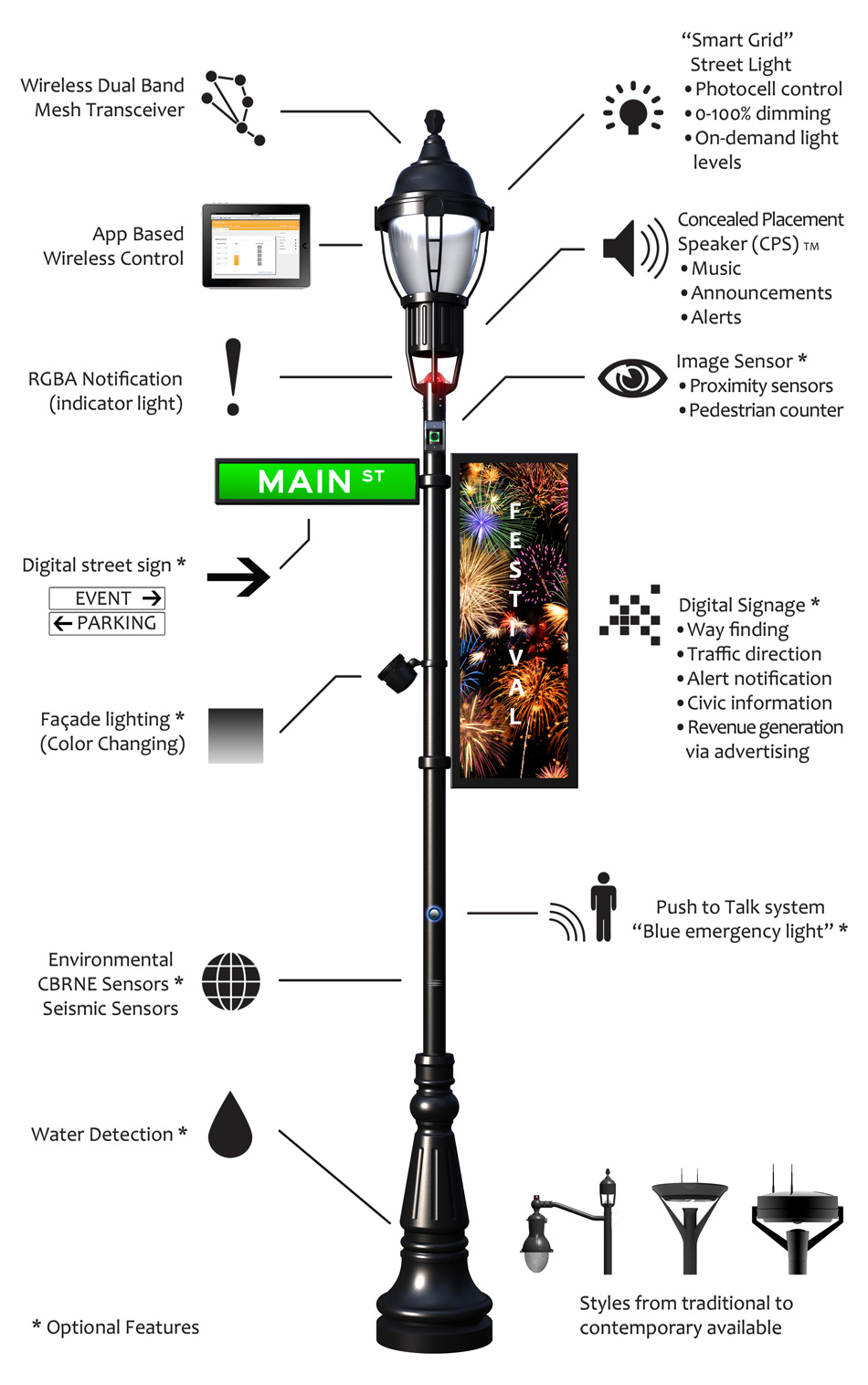
Bridger explains the potential for doing much more with less public investment is even greater if councils innovate in other ways as in Europe and Canada, where a commercial company finances and manages road lighting, in ways that deliver better outcomes for communities and councils.
“By using ‘digital lighting’ including LEDs, these ‘lighting performance contracting companies’ take full responsibility for delivering ‘lighting as a service’ which they then charge a council on a regular basis,” he says. “The big advantage of this model is that these companies take on all the risk for the delivery of road lighting to better match the needs of the community – and will not get paid if they do not meet predetermined standards. This is a bit like stopping the payment for a house mortgage if the heating, lighting, and other services did not work.
“The large investment in new LED lighting and controls is recovered in the regular monthly lighting charge which is at risk if the lighting isn’t delivered!”
Why is this Electricity Authority review important?
The review of how emerging technologies are affecting electricity distribution pricing is important because: “If the Electricity Authority does nothing, people and businesses and councils will invest in the wrong things and the economy will suffer needlessly,” Bridger says.
“With the increased opportunities for road lighting to provide increased safety, controlled lighting where and when it's wanted, and provide sensors and smart city/town services, it becomes much more important that the cost of street lighting is absolutely correct so that the right investment decisions can be made based on robust costing and pricing."
If the wrong charges are being levied, investment into new technologies will be inefficient. “If distribution charges are too high and do not vary with the energy use, then no matter how much investment is made into better, more efficient LED lighting, no financial reward for investment into this new technology will eventuate from reduced electricity distribution charges,” Bridger continues. “This hinders councils in New Zealand from investing in LED lighting. In Australia, it hinders the distributors themselves from investing in LED lighting.”
“For example, LED lighting and controls will not be as an attractive investment as it should be, or solar photovoltaic cells will reduce the cost of electricity only for those economically well off that can afford the investment, and cause the price of electricity distribution to rise for those that cannot afford to invest in solar panels.
What will the ideal outcome of the review be for street lighting?
Bridger says that an ideal outcome from the review would see distributors become robustly and transparently cost-reflective, and service-based resulting in a reduction of the cost of electricity distribution for street lighting for many councils.
“This will require distributors to realistically value their overhead and underground cable assets for street lighting in the face of increasing competition from the Solar PV technologies which make distributor wiring unnecessary” he says. Capital charges for these network distribution assets at risk from solar PV competition will need to reduce and should therefore result in lower street lighting distribution charges.
Although true cost reflectivity may result in small cost increases for some councils, Bridger believes it will at least give councils and the street lighting sector the confidence that they are being charged correctly and their investment decisions are based on correct information.