In light of last year’s successful Paris climate agreement, the need for vehicle manufacturers and fleet managers to reduce product emissions has never been greater.
The international climate negotiations in Paris last December saw almost all of the nations of the world agreed to hold the global average temperature increase to well-below 2 degrees Celsius, and pledge a voluntary emissions reduction, to be reviewed at five-year intervals.
In the light vehicle world, hybrid electric vehicles represent a well-established and profitable share of the market. Toyota launched the latest reincarnation of its “eco-warrior” Prius this year, which remains the world’s best-selling hybrid vehicle, despite a recent sales slump.
Although the take-up of fully electric vehicles has so far been limited by a lack of readily-available charging points, there are other initiatives that show promise. Earlier this year, New Zealand Post announced it would invest $15 million in 50 electric delivery vehicles from Norwegian manufacturers Paxter AS. The four-wheeled battery powered vehicles, which are small enough to be used on footpaths, will be used for the combined delivery of parcels and mail in residential areas in larger centres nationwide starting in parts of Auckland, with delivery of the vehicles scheduled for mid-2016.
Off-road, fleet managers are using hybrid technology to reduce both emissions and operating costs. While there are several types of hybrid drives in the earthmoving vehicle market, they are all set up to capture energy from the ‘swing’ motion of the upper body of an excavator, which is traditionally where a great deal of diesel is used, and energy wasted. Caterpillar’s 336e H hybrid excavator accounts for one in three Caterpillar machines sold in each market it serves. Hitachi is also a player in the hybrid earthmover market, offering its ZH200-5B hybrid model. .jpg)
The first manufacturer to offer a hybrid excavator was Komatsu, with the launch of its 20-tonne model in Japan in 2008. The design was awarded Japan’s Society of Mechanical Engineers Medal, and received a Good Design accolade at the 2012 Australian International Design Awards.
In 2014, the 35-tonne HB335LC-1 was launched in Australia to a global audience. To date, there are more than 3500 Komatsu Hybrid excavators operating around the world with more than 80 units sold in Australia and New Zealand.
According to Komatsu National Business Manager, Construction Amber Rickard, a recent evaluation has shown the Australian Komatsu hybrid excavator fleet saved approximately 560 tonnes of C02 emissions in one year. “From a demand standpoint, customers worldwide are seeking reduced operating costs along with searching for operational efficiencies,” Rickard says.
With more than 90% of C02 emissions of construction equipment generated by fuel usage during machine operation, Rickard says the chief goal in the development of the hybrid excavator was to reduce fuel consumption.
“Emission savings correspond directly to fuel savings, so an average of 25% savings on the 20 tonne Hybrid excavator and 20% on the 35t Hybrid excavator,” she says.
The 20-tonne excavator class was initially selected for hybrid development as it is the most popular size machine in both the Japanese domestic and global markets, with 15,000 units sold annually. At the time of the Australian launch, there was in excess of 700 Komatsu Hybrids working around the world that had collectively clocked up more than 1 million operating hours. Rickard says the initial response in the Australian market was one of very high interest and confidence, given the accumulation of preceding operational data from Komatsu hybrids working overseas.
For the past two years, the HB335LC-1 has been exclusively available to Australian and New Zealand customers, although Rickard says Komatsu is preparing to release the model to other countries around the world.
How the hybrid technology works
Rickard explains a standard Komatsu diesel engine is combined with a generator and electric motors, allowing engine output to be converted into both electrical and hydraulic energy.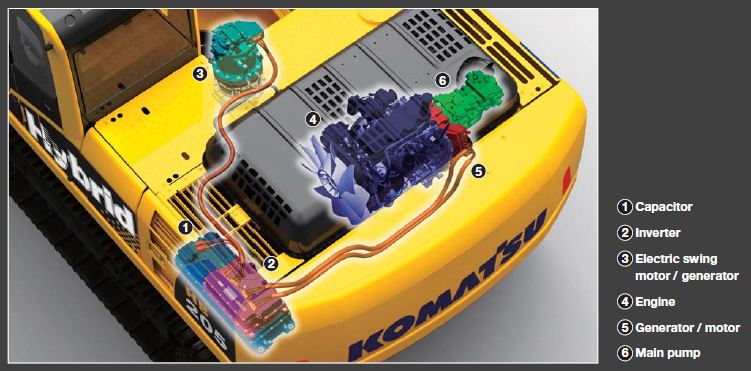
“The result is that energy conversion and transmission losses are reduced, while kinetic energy developed by the machine’s upper-structure during slew braking operations is regenerated,” she continues. “This is achieved through a Komatsu-designed ultra capacitor to store electrical energy. Using electrons and ions for charging and discharging, it allows for instantaneous discharge of electricity and hence very efficient recovery and storage of regenerative power.”
The Komatsu Hybrid electrical system consists of three main components:
- An electric generator motor;
- An electric swing motor generator; and
- A Komatsu-designed Ultra Capacitor with inverter.
The generator motor is positioned between the engine and hydraulic pumps, the electric swing motor generator is used in place of the hydraulic swing motor and the inverter/ultra capacitor is used to rapidly convert and store electrical charge.
The electric swing motor generator uses electrical power from the inverter/Ultra Capacitor or the generator motor to drive the upper-structure during the swing function.
During the deceleration or swing-braking phase, the electric swing motor generator converts kinetic energy back into electrical power and returns it to the ultra capacitor via the inverter. The generator motor generates electric power with engine torque to drive the swing motor or to charge the capacitor when necessary.
The inverter rapidly converts electricity from either the electric swing motor generator or the generator motor from AC to DC for storage in the ultra capacitor and from DC to AC to supply the swing motor or generator motor for engine assist as required.
The engine assist function of the generator motor gives the Komatsu hybrid excavator the ability to provide power on demand utilising only the engine RPM required for the operation. It also enables an ultra-low idle speed of 700 rpm.
The hybrid system is separate from the conventional excavator electrical system, is double insulated and contains numerous in built safety devices to protect the user and also the system from damage.
What is the fuel economy of the hybrid models like?
Rickard says while fuel savings will vary depending on sites and conditions, Komatsu have seen fuel savings of up to 41% compared to the non-hybrid equivalent model. “Across the board we have amassed data showing a holistic average of 25% less fuel use on the 20-tonne hybrid excavator and 20% less fuel use on the 35-tonne hybrid excavator,” she says.
“The actual application and working mode settings come hand in hand with the fuel reduction as applicable. For maximum fuel savings, a combination of high swing, lighter engine loads and low travel such as loading loose material from a stockpile into a crusher or a truck are ideal.”
Are there any sacrifices in the functionality or power of the machines?
“There is no reduction in the unit’s performance or functionality,” Rickard says. “The Hybrid matches the conventional excavator in terms of digging performance, working range and lift capacity.
“The hybrid is also operated in exactly the same manner as the conventional machine – it doesn’t require any special operating techniques to function effectively. The electric swing is much more powerful than a conventional hydraulic excavator but has been designed to behave similarly to a conventional machine. The engine assist function and ultra-low idle also means that the engine sounds quieter at times but performance is absolutely un-compromised.”