The world’s first underwater compressed air energy storage system has been launched in Toronto, Canada, with its developers promising the system will make renewable energy more accessible.
Startup company Hydrostor Corp has developed a system which utilises off-the-shelf technology that stores energy while producing zero emissions.
The system is hooked up to utility host Toronto Hydro’s grid, where its performance will undergo two years of pilot testing.
The system is designed to store electricity during off-peak hours when demand is low, and return the stored electricity when demand is high or during short-term power outages. 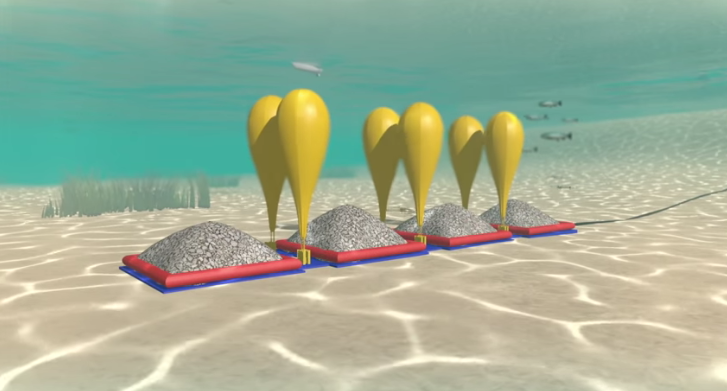
Electricity is run through a compressor and converted into compressed air in a “land station” located on Toronto Island. The air is then piped 3km offshore into six large balloons, anchored 60m below the surface on the lake bed. The weight of water keeps the balloons pressurised.
When electricity is needed, a valve is opened and the weight of the water pushes the air to the surface through an airline to an expander, which converts the air back into electricity.
At peak output the pilot storage unit is capable of powering approximately 330 homes (660kW).
Depending on how much power is drawn, the system can currently run for a little over an hour, although future expansion of the underwater air cavity will increase this duration.
Hydostor say the system returns between 60% to 80% of the electricity throughout the cycle.
Hydrostor CEO Curtis VanWalleghem says the company will initially focus on developing projects in coastal cities, island nations and microgrids.
Although solar photovoltaic cells and wind farms are being increasingly rolled-out around the world, a perceived limitation of these technologies is their intermittency – when the wind stops, or there is a cloudy day, they do not produce energy.
Hydrostor believe their system will solve this issue.
“Achieving this [pilot] demonstrates Hydrostor’s ability to assist utilities in addressing peaking and reserve power requirements, as well as integrating intermittent renewable energy,” VanWalleghem says.
“Hydrostor’s storage system combined with renewable energy provides an economically sound alternative to fossil fuel generation.”
Cost-wise, Hydrostor say the system is less than half the price of competing lithium ion batteries, with twice the lifespan.
IPWEA Director Sustainability Stephen Lees says the Hydrostor pilot highlights, “the rapid advances currently being made in energy storage devices which, together with on-site renewable energy generation, offer the prospect of householders eventually being able to disconnect from the power grid”.
However, Lees says he has a number of concerns about the new technology.
“Although marketed on the basis of its acknowledged environmental benefits, the technology is not specific to electricity from renewable sources,” he notes.
“It could equally be used to store cheap off-peak electricity generated by burning fossil fuels – and later retrieve the electricity to sell during periods of peak demand when its price is higher."
Lees says his main concern is that only 60% to 80% of input electricity is recovered - meaning that between 20% and 40% of the input electricity is "lost".
He also questioned how suitable the system would be in the Australian context.
“There is deep ocean water close to Sydney, but most other Australian capital cities have only relatively shallow water nearby,” Lees says.
“This is important because electricity ‘losses’ could rise sharply with increasing distances between the land station and the ‘underwater station’ if deep water is not nearby.
“New technologies like this often become cheaper and available ‘off the shelf’ over time,” Lees continued. “But, at least in the near future, the significant capital costs and effort involved (waterfront land, environmental approvals etc.) suggest that the technology will only be practical for electricity distribution utilities, as in Toronto, that deal with large amounts of electricity, whether from renewable sources or not.”
Despite these concerns, Lees says the technology is worth watching.
“The underwater compressed air storage system is a significant innovation that should be followed closely, as operational data from the Toronto prototype is published and the technology is refined,” he says.