WHAT: Australian War Memorial
 WHERE:
 Canberra, ACT
WHEN: Constructed 1928 – 1941
The Australian War Memorial and Anzac Parade in Canberra are icons for Australia where people come to pay their respects to Australians lost in armed conflicts around the world.
It was the idea of an Australian war correspondent during the First World War to build a national war memorial to commemorate the sacrifices of Australians lost in war. At the heart of the proposal was the creation of a place where people could come to mourn the loss of friends and relatives buried overseas.
The man behind the idea was Australia’s official war correspondent Charles Bean who served at Gallipoli. It was when on a visit to Pozières in France, where Australia suffered 23,000 casualties in less than seven weeks in 1916, that Bean came up with the idea for a war museum and memorial.
In 1917 the Commonwealth Government gave its support to Bean’s idea of a national war memorial in Canberra and a budget of $250,000. Henry Gullett was appointed as director of the newly formed Australian War Museum Committee (AWMC) and a prime spot opposite Parliament House was allocated for the project.
Bean’s concept for the memorial was that it shouldn’t be “colossal in scale, but rather a gem of its kind” and the building should be “in the nature of a temple surrounded by a garden of its own”.
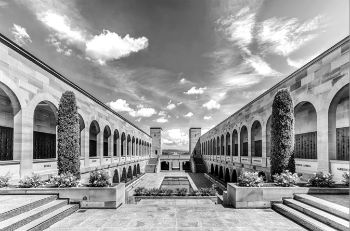
Architects from all over the world were invited to compete to design the memorial, but none of the entries were named a winner. Instead, two competitors Emil Sodersteen and John Crust were asked to collaborate on a new design and construction began in early 1928 – including a commemorative courtyard for the Roll of Honour.
A foundation stone for the project was laid on Anzac Day 1919, but construction officially began nearly a decade later in 1928. The onset of the Depression stopped work for some time before being resumed in 1934 by builders Simmie and Company.
Construction was stilted over the 14-year period and even weathered the resignation of Sodersteen in 1938.
The memorial was officially opened on 11 November 1941, while the Roll of Honor was completed in 1967 and contains the names of more than 120,000 Australians killed in combat.
Decades later Anzac Parade was opened on 25 April 1968 to coincide with the 50th anniversary of the Anzac landing in Gallipoli. A number of additional memorials have also been added over the years and a total of 11 now line the parade.
Today more than one million people visit the Australian War Memorial each year.