Three tiers of government have backed the Moreton Bay Rail Link project. PWPro speaks to the people responsible.
Plans for the addition of a spur joining the main North Coast Rail Line at Petrie in Queensland date as far back as the
1800s. The first known reference to the addition of a rail link leading east through the suburbs to Redcliffe can be attributed to a local alderman who proposed that a new line be built to the peninsular at an estimated cost of 200,000 pounds.
Although land for the project was acquired in the late 1970s, it wasn’t until 2003 that the Queensland Government’s study of the Petrie to Kippa-Ring Public Transport Corridor provided the foundation for the project and determined heavy rail was the best option.
In July 2010, an intergovernmental agreement was signed between the Australian Government, Queensland Government and Moreton Bay Regional Council to build the project. What particularly set the project apart was that all three levels of government committed funds totalling $1.147bn.
“Although plans have been in place for the Moreton Bay Rail Project for more than a century, the partnership of the Federal and State governments and Moreton Bay Regional Council was crucial to making construction a reality in a region consistently recognised as one of Australia’s fastest growing urban areas,” says Lindsay McLeod, Manager Major Projects (Moreton Bay Rail Link) from Moreton Bay Regional Council.
The federal government committed $742m, the Queensland Government committed $300m, and Moreton Bay Regional Council committed $105m.
Strategic case
Moreton Bay Regional Council is the third largest local government in Australia with a population exceeding 400,000 people, which is expected to grow to more than 530,000 by 2031.
More than 40 per cent of regional growth in the area can be attributed to the areas surrounding the proposed railway corridor. The business case for the Moreton Bay Rail Link took into account the potential for transit orientated development and other investment in areas in proximity to the project's new stations.
“The delivery of fast, sustainable and accessible public transport will alleviate pressure on the Bruce Highway with every full train removing up to 600 cars from the road network,” says Mayor Allan Sutherland.
“Our Intergovernmental agreement with Canberra and George Street also delivers upgrades to local roads serving the six new train stations, new road bridges and shared use pathways along the full length of the corridor.”
The project team includes representatives from the Department of Transport and Main Roads, Queensland Rail, Moreton Bay Regional Council and the contractor Thiess.
Delivery
Lobbying the state and federal governments for funding commitments for the Moreton Bay Rail Project was among the first infrastructure priorities for Moreton Bay Council Mayor Allan Sutherland upon becoming Mayor of the newly amalgamated Moreton Bay Regional Council in 2008.
“My council’s unwavering commitment to providing sustainable public transport for some of Australia’s fastest growing urban areas ensured funding support from the state and federal governments remained, despite changes to political representation and a renewed focus on reducing the cost of government.”
Council activities have included land use planning, transport planning, flood modelling, tender evaluation, environmental assessment, design reviews and asset inspection. McLeod believes local government involvement in this project, while somewhat unique, has had significant benefits.
“Local government involvement in state infrastructure projects can and will ensure enhanced infrastructure delivery, improved coordination with land use planning, better transport integration outcomes and effective environmental management,” he writes in his conference paper titled: ‘Moreton Bay Rail Link – Local Government’s Role in State Led Infrastructure Projects’.
“Political support is essential not only to secure project funding, but also to facilitate community engagement and mobilise the social and economic growth activities necessary for sustainable regional development.”
PWPro spoke to a Department of Transport and Main Roads spokesperson
Q. What is the Moreton Bay Rail Link?
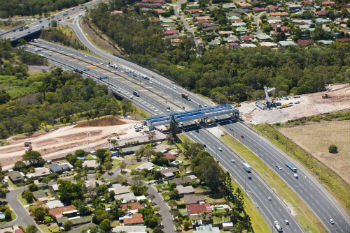
The Moreton Bay Rail project will be a focal point for the local community, and will include a number of features, including:
• 14km of double track rail from Lawnton to Kippa Ring.
• grade separated rail connection to the Caboolture Line.
• 22 bridge structures to provide grade separation of road and rail, including over the Bruce Highway.
• 6 new rail stations including bus interchanges and bike storage.
• 2850 carparks.
• Stabling (including train crew facilities) for 10, six-car
trains in the vicinity of Kippa-Ring Station.
• 3m wide concrete shared path for cyclists and pedestrians along the entire length of the corridor.
The Lawnton to Petrie Upgrade project will also be delivered as part of the Moreton Bay Rail project. The 1.5km new quad track bridge between Lawnton and Petrie and additional work within the existing rail corridor is required to integrate the new Moreton Bay Rail service.
Q. Who is delivering the project?
In August 2013, Thiess Pty Ltd was awarded the contract to design and build the Moreton Bay Rail project and the Lawnton to Petrie upgrade. The Department of Transport and Main Roads (TMR) is the lead agency for the delivery of the Moreton Bay Rail project.
The project operates under a collaborative framework with TMR, Queensland Rail, Moreton Bay Regional Council and Thiess working as one embedded team to deliver the project. Thiess is working with designers AECOM, Aurecon and Hassell, and geotechnical subcontractor Golder Associates.
Q. What is the status of the project?
Major construction started in January 2014 and the new rail line in taking its final shape. Works are well underway on all 22 new bridges and construction has started on all six new stations. Major works recently started on improving connectivity to the new stations, including the upgrade of Dohles Rocks Road.
During 2015, the majority of earthworks will be completed along with the continuing works on all six new stations and the Kippa-Ring stabling yard. The team will ramp up works on local connecting roads and the much anticipated rail track will start being laid. By late 2016, trains will run on the new rail line connection between Petrie and Kippa-Ring with six new stations along the way.
Q. What innovations have been used?
The Department of Transport and Main Roads has engaged Endeavour Veterinary Ecology to undertake a koala tagging and monitoring program as part of the project. The tagging protects koalas from harm during vegetation clearing and construction works and informs rail design of fauna crossings and important habitats. No koalas have been injured during the clearing and construction activities.