PWPro talks to an inventive Tasmanian council that has created a remote-controlled car equipped to inspect stormwater pipes.
By Jill Park
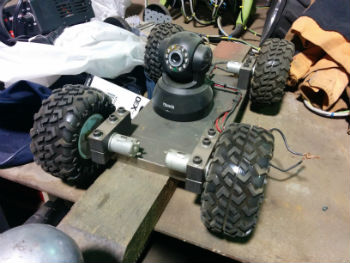
In 2003 NASA’s Mars Exploration Rover Mission sent two robots out into space in search of water on the red planet. George Town Council (GTC) in Tasmania took a similarly novel approach when faced with the task of inspecting stormwater pipes by creating their own ‘Rover’.
GTC is a small port town 50km north of Launceston that services 5000 residents so asset management budgets are tight. Therefore, GTC Civil Engineer James Lio had few options available to him when collecting stormwater asset information.
“Stormwater pipes are not evaluated yearly due to the cost of inspection,” Lio tells PWPro. “One of my tasks as a project engineer is to update the GTC asset register while keeping the cost under control.
Choices, choices
The first option considered was to hire external contractors at a cost of $300 per hour. The distance and cost meant that it would be unfeasible to call out the contractors for ad-hoc work, such as blockages after heavy rainfall, so this option was ruled out.
Secondly Lio considered purchasing CCTV equipment. His research showed that a ‘bare-bone’ pipe inspection apparatus would have set the council back $10,000, an unjustifiable cost for GTC in light of the fact that the equipment would only be used once a year or during a callout.
That only left one option: to build an inspection tool himself. Lio was confident that he could build his own ‘Rover’ inspection machine at a competitive price using off-the-shelf equipment.
Lio turned to IPWEA’s Ask Your Mates forum for advice from members about how best to approach the project. His questions sparked one of the most popular comment streams on the forum last year.
Building the spec
Armed with his feedback from Ask Your Mates, Lio and his team created a list of key requirements @for the Rover. The machine would have to be able to: inspect pipe diameter of 300mm and above; capture video in the dark or equipped with an LED torch light; reverse and steer remotely; be compact and easily maintained; be water resistant, if not waterproof; record video footage within the pipe and cost less than $5000, and therefore not be recorded as a Capital purchase.
“Armed with these specifications, I scouted for parts from major electronic stores while putting them together mentally,” says Lio.
Iteration one used an off-the-shelf remote controlled car with a Pan Tilt Zoom mounted camera. Upon testing, the remote controlled car did not have enough torque to drag a CAT5 cable. The wireless signal also proved unable to penetrate through stormwater pipes.
Next Lio and his team decided to custom build a remote controlled car with a mounted camera. He had tried to avoid this option as the steering mechanism of a remote-controlled car can be hard to reproduce. However, a ‘Eureka’ moment while watching a TV program about kayaking made it feasible – he could control the vehicle by manipulating which side of the motor got turned on.
“After going through some test runs, the four high torque motors held up beautifully well, but the Rover stopped moving due to loss of traction.”
Mark two taught Lio that he would have to replace the plywood chassis for a heavier one and change the hard plastic wheels.
And so mark three was created: a custom-made steel chassis car with a PTZ mounted camera. The third iteration is the same configuration as the previous, but with the addition of a 16mm steel plate chassis and four rubber wheels. Assemblage of the pieces is slightly more technical to construct – a normal drill bit doesn’t cut it – but the resulting machine has proved robust.
“Two switches control the Rover: when two buttons are pushed it moves forward, pressing the left button will steer the car left and vice versa,” says Lio.
“Reverse can be done by reversing voltage polarity and throttling can be done by increasing and decreasing voltage.”
Measuring how far the Rover has travelled along the pipe was discussed at length on the Ask Your Mates forum. Lio followed his peers' advice.
“Travel distance is measured by reading tags installed onto the cabling," he says. "The operator is required to key in distance onto a notepad, which is captured by the video recorder.”
Rover mark three is only partly water resistant, so the equipment has to be handled (and operated) with care. Regardless, spare parts are readily available and cheap to purchase so the GTC does not have to bear the full brunt of the cost of replacing the Rover.
GTC is in the process of testing mark three, but the Rover has proven to be an efficient and cost effective way for a small council on a tight budget to inspect stormwater pipes. NASA would be proud.
The Rover
The Rover system has been designed and built by James Lio at George Town Council in Tasmania from items that can be bought off the shelf and easily fitted together. These items include:
1. A Laptop Computer
2. Wireless Router
3. Tenvis PTZ camera with infrared vision that is capable of night vision and is able to capture 640x480 resolution video
4. 12 volt reversible gearhead electric motors (12kgcm torque)
5. A hose wheel for cable management
6. 100m CAT 5 cable
7. 4xD cell holder powering the camera
8. 4x100m high amperage cable (2 pairs of cable to control each side of the car allowing it to turn right and left)
9. 16mm steel plate measuring 300x400mm (depending on the pipe diameter)
10. 12 Volt inverter
11. Switchmode laboratory power supply (1–36 volt)
12. Hot glue, cable tie, electric connector, switches and electric drill
Please note:
The machine featured is not associated with the Rovver, manufactured by iPEK and marketed by SECA in Australia and New Zealand.