In 2018 the Gold Coast will host the Commonwealth Games. PWPro talks to the team responsible for delivering the Games about the public works legacy that will be left behind.
by Jill Park
In November 2011, Queensland’s Gold Coast won the bid to host the 2018 Games. While Australia has hosted the Games five
times, 2018 Commonwealth Games (GC2018) will be the first time the event has been held in one of its regional cities.
The Department of State Development Infrastructure and Planning (DSPIP) has been appointed the Queensland Government’s Games venue delivery agency.
The City of Gold Coast Council, meanwhile, has established a dedicated Commonwealth Games Unit. The Unit includes a venues and infrastructures team that co-ordinates the city’s brief for permanent venue works and for venues that will become council assets.
Project scale
The Gold Coast Games will be hosted across 18 venues. Eight existing venues will be upgraded and a further three venues will be built specially for the event (see page 24). These brand new venues will include the Carrara Sports and Leisure Centre, the Coomera Sports and Leisure Centre and the Queensland State Velodrome.
In addition to the new and upgraded venues, a further seven venues will be fitted with temporary event overlays so they can be used for specific events. Southport Broadwater Parklands, for example, will be decked out to host the start and end of the marathon event, race walks and triathalon (see page 24).
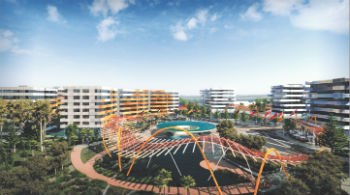
In addition to the sporting infrastructure, the Commonwealth Games Village project will provide accommodation and services to 6500 athletes and officials during GC2018. The development includes 1200 units and townhouses across 30 buildings.
Executive Director – Project Delivery, Major Projects Office at the DSDIP, Kerry Petersen, talks to
PWPro about the department’s role in delivering the 2018 Games.
“Multiple Queensland Government agencies and asset owners are providing input into the design of the venue infrastructure across areas of transport and security, services (water, power, sewerage) and venue operations,” she says.
All venues will be designed to comply with the Building Code of Australia (Section J), which includes natural ventilation, thermal insulation, natural light, and minimisation of water usage.
Sustainability initiatives were included as part of the Gold Coast’s bid to host the Commonwealth Games, with budgets for these outlined in its Candidature File (Bid Book), according to Kristine Marshall, Coordinator Venue Design and Infrastructure in the Commonwealth Games Unit.
Glasgow 2014
The Senior Project Manager from the Major Projects Office and nine officers and executives from Gold Coast City Council attended the Glasgow 2014 Commonwealth Games.
The delegation brought back valuable information that will be incorporated into the venue designs to ensure the best possible legacy outcomes from the infrastructure that is being built.
“A key learning taken from the Glasgow 2014 Commonwealth Games was the importance of delivering the venues well in advance to ensure adequate time for testing the facilities,” says Petersen.
“This also has the benefit of providing the community with early access to the venues and the legacy benefits of the Games.”
The Queensland Government released a Venue Delivery Program in mid-2014 and the DSDIP is on track to deliver all new and upgraded venues at least 12 months ahead of the Games.
The total cost of delivering the Gold Coast Games has been estimated at $2bn. Accordingly, an extensive tender process has already been opened to engage suppliers across the state and beyond. All public works projects are included in the tender
process (see box).
Leaving a legacy
“Legacy is the single-most critical Commonwealth Games objective for the City and securing long-term legacy benefits is the cornerstone that guides all our planning,” Marshall tells
PWPro.
Top of the list of the Gold Coast Council’s goals in terms of providing a public works legacy from the 2018 Games is to ensure there are “no white elephants”, says Marshall.
“As one of the fastest growing regional cities in Australia, we are committed to ensuring that all infrastructure delivered for the Commonwealth Games is designed and constructed fit for purpose for legacy use.”
The goal is two-fold, to create world-class new and upgraded facilities that will attract elite athletes to compete in the Games and, secondly, to entice the community to continue to train at the facilities after the Games close.
Petersen gives the example of the Coomera Sports and Leisure Centre, which will host the netball finals and gymnastics competition.
“In the long term the Coomera Sports and Leisure Centre will accommodate a wide range of community facilities and indoor sports such as netball, soccer and gymnastics, which will be great for this growing community,” she says.
Communicating the Games
Gold Coast City Council is working in conjunction with the state on communicating activities around the Games infrastucture.
A strong emphasis has been placed on communicating the long-term social and economic benefits that will be derived from new and upgraded infrastructure. A Venues Legacy Strategy is currently being developed by the city for its GC2018 assets.
Following the Games, an independent body will be commissioned to compile a Triple Bottom Line Assessment of the Games.
Olympic legacy
Sydney’s Olympic Park has gone from strength to strength since the Olympics in 2000. The Aquatic Centre, for example, attracts a million patrons a year.
“The infrastructure and expertise built up at Sydney Olympic Park has allowed Australia to bid with confidence for major international events such as the Rugby World Cup, the World Masters Games, the World Netball Cup, the Youth Olympics and the Football World Cup,” an Olympic Park spokesperson told
PWPro.
“In addition to sporting events, the Park hosts major business events, including acting as the venue for the 2014 Rotary International Convention, attracting 18,000 delegates from across the globe and injecting $60m into the NSW economy.”
Australia has a long history of delivering top quality sporting events and, as both the Melbourne Commonwealth Games and Sydney Olympic Games prove, the facilities have gone on to become an integral part of the elite and local sporting communities. The Gold Coast Games has a lot to live up to, but it is a challenge the organisers are rising to.
Tendering for the 2018 Commonwealth Games
A total expenditure budget of approximately $2bn has been allocated for the delivery of the 2018 Gold Coast Commonwealth Games. This will be one of the most significant procurement programs for the Queensland Government over the next decade.
The Queensland Government released a Forward Procurement Plan in June 2014 that includes opportunities for infrastructure work, goods and service requirements from now, right through until the event. Design teams and Managing Contractors have been appointed for many of the venues already, including the three new venues that will commence construction between late 2014 to early 2015.
“Businesses interested in tendering for Commonwealth Games projects are being encouraged to register their details on the ICN Gateway,” says Executive Director - Project Delivery, Major Projects Office at the DSDIP,
Kerry Petersen.
“Collaboration will be the key to many small businesses gaining access to large scale contracts.”