Big city lights can eclipse the starscape, but not in New Zealand’s Southern Alps where judicious council lighting strategies are protecting the night sky as a valued natural asset.
By Paul Wilson
Queenstown, New Zealand, is renowned for the brilliance of its night sky – so much so, that stargazing tours receive equal billing with the plethora of other sporting, scenic and adventure experiences that this lake and alpine resort city has on offer.
However, while much effort had been applied to protecting the daytime vistas and outstanding natural landscape of the city and its surrounds, it wasn’t until recently that serious thought was given to protecting the night sky.
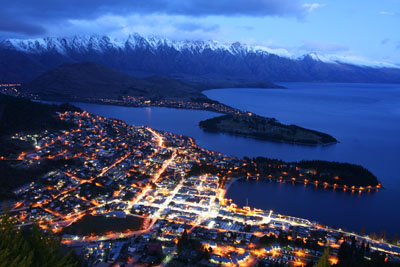
Facing a period of rapid growth in early 2000, the Queenstown Lakes District Council decided that a strategy to manage public and private lighting was needed. Sadly, little attention had been paid until then to the district’s night-time vistas and the effects development was having on them.
While most townships still had relatively low levels of light, the impact of the existing lighting was disproportionate to the benefits gained. And, as growth continued, previously dark rural regions were being transformed into bright urban centres.
Through a community-planning process, the council identified that both urban and rural communities wanted a level of lighting that provided safe and comfortable night-time travel, while protecting the night-time sky and rural character of the district. Communities wanted both the day-time and night-time appearance of lighting to be simple, unobtrusive and subtle.
Quality, not quantity
The council was facing a number of challenges to improving public lighting. These included:
• �An emphasis on providing sufficient light quantity to meet standards (primarily to enhance traffic safety);
• �Ownership of street lighting being generally held by a utility company and leased to the council, with no incentive to reduce energy or improve the quality of light and performance of the existing lanterns;
• �A lack of standards and guidelines, with lantern and pole choice being primarily driven by aesthetic considerations of individual developers; and
• �An emphasis on street lighting with little thought to quality lighting in parks and other public places.
A council strategy adopted in 2006 placed emphasis on improving light quality, rather than quantity, in order to enhance the visual comfort and safety of the district’s residents, while protecting Queenstown’s outstanding natural values.
The strategy’s most significant step was regaining control of the public lighting network. This enabled the council to set new standards for the type of luminaires in the streets. Six years on, ‘full cut-off’ (to avoid upward light spill) and IP65-rated luminaries are standard, and a program of replacing inefficient lamp types and poor-quality fittings is largely complete.
A new lighting maintenance contract was developed to focus on better stewardship of assets, with an emphasis on luminaire orientation, cleaning and lamp replacement to improve the efficient operation of lighting.
Improved lamp technology and the better optics available in modern luminaires has enabled the rationalisation of some lights and provided savings in energy consumption and maintenance.
The council has generally adopted a strategy of continuing with high-pressure sodium lamps in rural and residential streets and advanced metal halide (and in some cases LED) in town centres and public spaces. In all cases, warm light (generally 3200K) is used to enhance the appearance of warmth and the visual comfort of inhabitants. A clear lighting hierarchy has been established to set lighting levels, colour and visual appearance.
Saving energy, and lives
LED technology is judiciously used, with trial sites still in operation since installation in 2008. Particularly good results have been achieved on pedestrian crossings, where there are substantial energy savings over some of the older lighting technologies used, and where the reduced outages provide a safer crossing.
The strong contrast between the appearance of LED sources and HPS lamps also highlights the crossing for drivers and pedestrians. Some installations of LEDs have also been undertaken in parks, in particular in in-ground up-lights, where reducing the need to access the luminaire for lamp changes decreases the opportunity for water ingress and eventual failure. Care is taken, however, when using LED sources in parks as the sharp cut-off decreases the amount of spill-light surrounding paths and can lead to a perception of reduced safety.
Overall, taking a strategic look at the district’s lighting and having a clear place for the improvement of lighting with an emphasis on quality over quantity has helped Queenstown maintain its reputation as a beautiful destination – at night as well as in the day.
Paul Wilson is a Senior Consultant at Xyst Ltd, and was formerly General Manager Community Services at Queenstown Lakes District Council. He holds a Graduate Certificate in Science and Technology (Lighting).
 |
Comment below to Continue the Conversation!
|