Parks strengthen the social fabric of a community, but tight budgets are putting pressure on their sustainability. Here’s how one innovative parks department is meeting the challenge.
By Brian McCormack
Decades of rate pegging, price rises and cost-shifting by state and federal governments alike have made it increasingly difficult for many council departments to sustain service delivery.
Not least among those are parks departments, which attract high levels of community expectation when it comes to the trees, ovals and playgrounds that make a place ‘liveable’. However, many are finding ways to trim costs, commercialise services, improve productivity and reduce service delivery to community-acceptable limits.
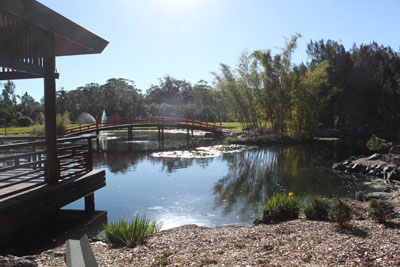
One such innovator is Coffs Harbour City Council’s Parks Department, which plays a key role in the council’s recently formed Resourcing Strategy, aimed at tackling the widening gap between expenditure and revenue.
At the recent IPWEA International Public Works Conference in Darwin, the council’s Manager of Recreational Services, Frank Soltau outlined several strategies to provide sustainable parks, maximise resources and enhance community life.
One has been to form a ‘Friends of Park’ volunteer program to gain community input and acceptance of new projects. Volunteers participate in horticultural and landscape activities such as mowing, reserve improvements, minor tree pruning and garden bed maintenance. At the local Botanic Gardens, they also boost income generation by helping to stage events and run a café and kiosk.
“Sustainable principles are more achievable if locals take ownership and pride in their environment, work together and connect through mutual interest,” says Soltau.
Soltau says the program has reduced the burden of maintaining low-use/low-profile parks and freed up council resources for deploying in higher-profile parks. However, he points out that changes to workplace health and safety legislation have made managing more than 80 volunteers quite a challenge.
“They are now treated like staff,” he says. “They have formal inductions, fill in attendance and incidence sheets, attend awareness sessions about council policies, and are provided with personal protective equipment.”
Going commercial
Another initiative has been to commercialise some services, in line with the council’s Private Works Policy, which conforms to the National Competition Policy whereby government-owned businesses turning over more than $2 million must be able to demonstrate that they are not subsidising prices for private works using public funds.
Apart from generating revenue, private works have obviated the need for council to make some employees redundant or dispose of certain plant items.
The tree services team, for instance, has a 22-metre elevated platform and has been contracted for ‘dead wooding’, crown-reduction work and tree-health monitoring for energy companies, schools and the NSW Roads and Maritime Services. And, as many from the mowing team have farming, building or other trade experience, they have helped lay a fibre optic network which the council’s Telecommunications & Technology Business section has worked on. This has kept the mowing team in full-time employment in off-seasons.
The department also runs plant and tree nurseries for its own use, with some stock sold to large customers including landscapers, developers and schools. In addition, much of the team’s grinded mulch from logs and stumps is on-sold, while timber from suitable hardwood logs is milled for use as seats, bollards and steps – at a fraction of the commercial cost of sawn hardwood.
Roundabout rethink
Savings have also been made on the city’s street roundabouts, renowned for their vivid displays of flowering annuals three times a year.
In order to reduce the high cost of maintaining these annuals, two-thirds were replaced with long-flowering perennials, leaving only narrow rows of annuals at the perimeters. By skilfully mixing perennials with annuals, the changes have gone largely unnoticed by the public, but the need for mulching has been reduced and rotary hoeing of the garden beds has ceased.
Further maintenance savings have been achieved by introducing low-growing street plants to eliminate regular back pruning, and by replacing hedges with more suitable plantings. The department is also prioritising native and endemic plants to ensure a higher survival rate and suppressing weed incursions by closer planting schemes and making more use of strappy leafed plants that will eventually cover the ground completely.
The council’s IT department has developed an in-house mapping program for weed spraying at far less cost than commercial options. In addition, a ‘Weed Awareness’ campaign was launched with other coastal councils via radio, TV and online. The campaign prompted the public reporting of several threatening weed sites, which resulted in prompt containment of new weed incursions of high-risk species. Within the first 35 days, the website was visited 2047 times, 6123 pages were viewed and more than 500 new ‘Weed Warriors’ were registered.
 |
Comment below to Continue the Conversation!
|