Upgrading to LED lights can slash a council’s electricity bill, as the City of Sydney has shown. As the cost of LEDs rapidly declines, the incentive to switch has grown nationwide.
By Brian McCormack
Street and public domain lighting is poised for its biggest global transition since electric lighting replaced gas lamps in the 19th century.
Driven by light-emitting diodes (LEDs), this illumination revolution is already making its mark in forward-thinking early-adopter municipalities throughout the world, and LEDs are tipped to reach a global penetration of 64 per cent across new general lighting applications within seven years.
Not only do LEDS offer energy savings of up to 70 per cent compared with conventional lamps, they also last 50,000 hours or more, which means they only need replacement about once every 12 years. Moreover, their lifespan can be extended for up to 100,000 hours when coupled with ‘dimmable’ (adaptive) smart controls. This is because the LED product’s lifespan actually increases when the average current flowing through it is reduced.
HOW THEY WORK
The key to LEDs superiority is that they are illuminated solely by the movement of electrons in a semiconductor material. So, unlike incandescent bulbs, they don’t have a filament that will burn out, and don’t get especially hot. Because of the way they produce light, LEDs offer many other benefits apart from their lifespan, energy saving potential and low maintenance. For instance, colour can be finely controlled for architectural lighting, entertainment and other aesthetic applications by embedding elements in their semiconductors. In fact, the newer white range of LEDs is facilitating the illumination of public spaces with light that mimics daylight.
In addition, LEDs offer high directionality, meaning they shine light only where it is needed. In the case of street lighting, this can prevent light from intruding into residential windows or the night sky.
With lighting responsible for a fifth of global electricity use, and cities consuming 70 per cent of the world’s energy supply, the potential savings from switching to more economical forms of lighting are significant (about eight per cent of global demand).
SYDNEY LIGHTS THE WAY
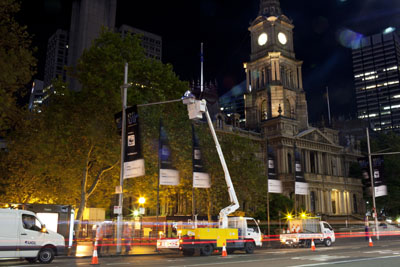
In Australia, the City of Sydney is at the vanguard of the LED lighting revolution. In March 2012, it became the first city in Australia to embark on a roll out of new energy efficient LED lights across its streets and parks. The lights are produced by GE and are being installed by UGL Limited. The $7 million, three-year project will see 6500 conventional lights (75 per cent of the city’s lighting stock) replaced with LEDs.
According to Sydney Mayor Clover Moore, this means that, by early 2015, the City of Sydney will have slashed carbon emissions by about 40 per cent from street lighting it owns and maintains, saving ratepayers up to $800,000 a year in electricity bills and maintenance costs.
The City of Sydney is one of the largest users of street lighting in NSW, with 22,000 lights, of which Ausgrid (formerly Energy Australia) maintains 13,500, while the rest are maintained by the council. Public lighting accounts for a third of the City’s annual electricity use and 30 per cent of its greenhouse gas emissions. The new LED lights will slash these emissions by about 3000 tonnes a year – the equivalent of taking 1000 cars off the road.
STATE GOVERNMENT SUPPORT
In August this year, the NSW government announced a grid-wide roll-out of LED lighting in 41 councils across Sydney, the Central Coast and the Hunter regions. A total of 250,000 lights are owned and maintained for these 41 councils by Ausgrid, with an agreement in place for a significant proportion of the new LEDs to be assembled and supplied by Central Coast company, Sylvania Lighting Australasia.
“When a standard light on a suburban street fails and cannot be fixed, it will now be replaced with a super-efficient LED,” says NSW Minister for Energy Chris Hartcher.
As Australia’s first large-scale adopter of LED lighting, the City of Sydney’s initial trials, procurement and project deployment procedures have generated plenty of interest among public works professionals throughout the country. At the IPWEA 2013 International Public Works Conference, the City’s Manager of Infrastructure and Traffic Operations, George Angelis, presented a paper on ‘The Delivery and Benefits of Sustainable Lighting’.
One of the most useful phases of the project was the City of Sydney’s participation in an international trial of LED lighting with cities including London, New York and Hong Kong, coordinated by The Climate Group – a globally renowned not-for-profit environment organisation.
The Sydney trials took place over 18 months in highly trafficked areas and, when public feedback was sought in early 2011, 90 per cent of those surveyed found the lighting appealing and three quarters said it improved visibility.
THE GLOBAL CONTEXT
According to a report issued by The Climate Group, a full switch to LED lighting could reduce energy consumption for lighting by 40 per cent worldwide. This translates to approximately 130 billion euros in running costs and 670 million tonnes of avoided greenhouse gas emissions per year.
Furthermore, the switch to LED lighting could cut back the need for capital investment in new electricity-generation capacity of over one trillion euros – or some 640 power plants.
So, if LEDs are so promising, why are they not yet installed in every house, skyscraper and city street? According to The Climate Group, the key barrier right now is up-front cost. The good news, however, is that as global uptake gains momentum, the price of LEDs is expected to progressively fall by 80 per cent by the year 2020.
 |
Comment below to Continue the Conversation!
|