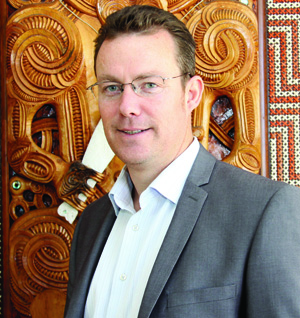
Former INGENIUM president Neil Cook spent seven years at Wairoa District Council in New Zealand before moving with his family to Fiji where, as CEO of Fiji Roads Authority, he will be responsible for rebuilding the country’s road network after decades of neglect.
By Gemma Black
What originally drew you to a career in public works engineering?
I went to engineering school, and ended up in a consultancy, primarily working for local government. I started off in environmental engineering and then moved across to the local authority, Wairoa District Council, where I managed infrastructure and community facilities.
I suppose what has kept me in the industry is the interest that comes from genuinely helping the community achieve good outcomes.
You worked at Wairoa District Council for seven years. How formative was that period?
I was managing all infrastructure, including parks and reserves, as well as roads and water and wastewater infrastructure. We had a lot of really interesting projects and, for a small local authority, we were going through quite challenging issues.
Some of our smaller communities needed water supply upgrades and a better standard of drinking water supply, but there was a lot public opposition and in particular cultural opposition to wastewater disposal. The Maori worldview tends to oppose any disposal of wastewater – however well treated – into water, and when you’re in a coastal community, that’s a challenge in and of itself.
We went through processes to accommodate those views, and ended up with a number of land treatment options, for example through forestry disposal. There were a number of positive outcomes through that direct community engagement.
What was your most important achievement as president of INGENIUM?
There was a lot of government policy and reform going on during those two years I was president, and I think the board I chaired did a lot of good work advocating for our members and communities.
I suppose one of the most significant events, which I guess was also one of my final acts as president, was the joining of INGENIUM with IPWEA.
How did the merger with IPWEA come about?
We had the better part of two years assessing INGENIUM’s place and its future in a changing world for membership organisations. We were looking at how we could continue to be relevant to our members, how we could continue to serve our communities through our members, and working through the various issues we were facing and the different options available for achieving long-term sustainability, we came to the conclusion that a closer alignment with IPWEA would be the best way forward for INGENIUM
What are some of the unique challenges of your work in Fiji?
After seven years in a small local authority, I was reasonably complacent in my job – I could do it with ease. However, I’m certainly in an environment now where you’ve got a lot happening, a lot of balls in the air, and everybody here is working very hard.
This government’s mantra is “we deliver”, and that’s the absolute challenge for all of us – to deliver. They’ve made the political commitment, they’ve made the funding commitment, so it’s our job to deliver on that. But in an environment with not very sophisticated supply chains or very robust quality standards, it’s a real challenge.
We have had some really great moments. For example, where we’ve restored access to people where maybe five years ago a storm brought down a slip onto their road, and we’ve gone in and cleared it for them. We’re upgrading roads after years of neglect and providing vital access for people.
When you have roads, you don’t always realise how fundamental they are. Access is social connectivity; it enables people to be part of a community, to get produce to markets, to get their kids to school, to get to government services such as health clinics. It’s fundamental. That’s what we’re here providing and it’s been good so far – and it’s going to get better. •••
 |
Comment below to Continue the Conversation!
|