A potential solution to the problem of landfill emissions, and a step towards a green energy future.
In 2006-07, Australians generated 43.8 tonnes of waste, 48 per cent of which ended up in landfill – up 12% from 2001, according to the Australian Bureau of Statistics.
As the world’s third largest source of methane emissions (a potent greenhouse gas), landfills are under the spotlight when it comes to tackling climate change. In 2012, three per cent of Australia’s greenhouse gas emissions came from waste – up to 8%, when including the embedded energy of waste products.
A paper exploring a potential solution to this issue was presented at the IPWEA 2013 International Public Works Conference in Darwin by Graeme Alford, CEO of Landfill Gas and Power (LGP) – a privately owned West Australian company.
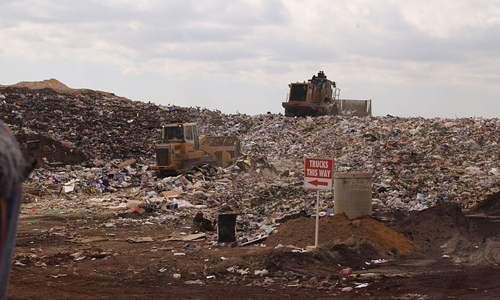
According to Alford, there are three key government mechanisms that will enable landfill managers to make the most of this seemingly bad situation.
1. Under the Federal Government’s Carbon Pricing Mechanism introduced on 1 July 2012, landfill managers must purchase carbon permits when emissions exceed 25,000 tonnes of CO2-equivalent (which includes methane).
2. At the same time, the Carbon Farming Initiative enables methane destruction projects on approved landfill sites to accumulate carbon credits, which can be sold on the carbon market.
“The capture of methane created from the breakdown of the rubbish in our landfills and its controlled burning will be up to 21 times less damaging than letting the gas escape into the atmosphere,” explained Alford in his paper.
3. On big enough landfill sites, instead of destroying methane emissions, the greenhouse gas can be captured and used to produce ‘green’ electricity – with income generated both from the sale of this electricity, and from Large Generation Certificates under the Government’s Renewable Energy Target.
On landfill sites where gas is not used to generate electricity, a flare is used to destroy emissions. “The engineered landfill gas capture system works silently in the background operating under a vacuum to draw the gas out of the landfill,” Alford explained.
The waste from a population centre of 150,000 people would be required for electricity generation to be economically viable, Alford said – adding that the cost of a typical grid connection for electricity export is $500,000-plus. “For smaller landfill sites, it may be possible to generate some electricity for internal use only or to flare the gas, thereby reducing its environmental effect,” he added.