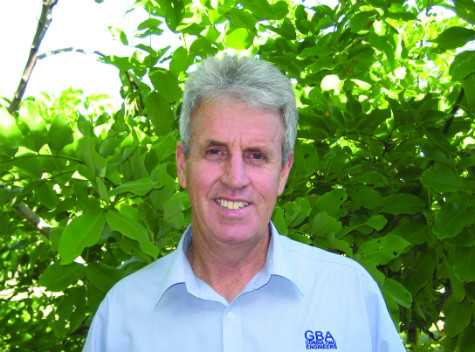
Graeme Wills is a Senior Civil Engineer and Partner at George Bourne & Associates, based in the remote Queensland town Barcaldine. He explains how working in a regional community has shaped his career and outlook on life.
By Michael Mills
How did you get involved in engineering?
I’ve always liked the blend of indoor and outdoor work. I was very much a hands-on kid, building things like billy carts. I didn’t want a career that was totally indoors. I also wanted to be part of the inception of a project, but then have the opportunity to see it through to disposal. It’s very rewarding to work right through a project’s full life. Public works engineering provided me with that opportunity.
Your business covers a vast chunk of Queensland. How do you manage the long distances you have to travel and working in remote areas?
Over the past 30 years, technology has made things much easier. When I first started here, we made telephone calls over a party line and we had a manual exchange. Somebody once said to me: “The fax removed the ‘out’ from the outback”. Since the fax, technology has progressed even further with email and satellite communication, which allows us to communicate readily with our projects.
Our main method of travel is via light aircraft. Some of our engineers double as pilots and fly themselves out to projects.
What do you enjoy most about flying to work on regular basis?
Practically, flying gives us an opportunity to get to our projects efficiently and respond to our clients within about two to three hours.
Aside from that though, flying provides a wonderful perspective on the scale of this country, as well as its vastness and remoteness. I think of the first Australians and how, for 40,000 years, they survived in these remote and arid regions and survived well. I live in awe at how they were able to live with their environment.
When I fly at an altitude of 8500 feet and survey this remoteness, I think of some of my mates who are bogged in traffic on Parramatta Road in Sydney and I realise how lucky I am.
What are some of the key lessons you’ve learnt in your career?
There is an incredible wealth of information and knowledge in old heads. In our work, this knowledge rests in the heads of overseers and foremen. You must be willing to take advice from these old heads as they have navigated the road before you.
If you make a mistake, take it on the chin and learn from it. If you’re lucky, you’ll find you’ve made a mistake before any serious consequences. Otherwise, just be humble and own up to it.
I’m not only talking about professional lessons either, there are lots of life lessons to take in and use to guide your decision making. The people around us also shape the way we make decisions.
One of my biggest life lessons was when I tried to rescue two people in the surf when I was about 18. I was so focussed on getting them back to the shore that I didn’t consider taking them beyond the breakers. We might have been able to save them had we taken them beyond the raging surf. That was more than 40 years ago, but I still remember it clearly.
My father said to me that there are often several solutions to a problem. Too often we go for the first solution that pops into our head. We have to think broadly and consider other possible solutions to the challenges we face.
What do you love about working and living in a remote area?
The people you work with and live with are truly genuine. They have a different focus on life. For many projects, a lot of the workers are locals and we help train them. The reward comes from seeing them learn and be able to apply those lessons to their work.
We don’t survive in the outback unless we look out for one another. There is a strong sense of community in small towns. The people Iwork with inspire me, but the collective sense of community is one of my biggest inspirations. We encourage our staff to become part of the communities they work in so they too can be inspired.