Having trees in an urban setting can have numerous benefits for the community – and not only aesthetic benefits. However, these benefits have been difficult to measure. Treating trees as assets, however, can change this.
By Noel Corkery
Ever since the first cities sprang up, urban communities have placed a high level of importance on having trees in areas where they live, work and recreate, due to a combination of aesthetic, cultural, environmental and economic factors.
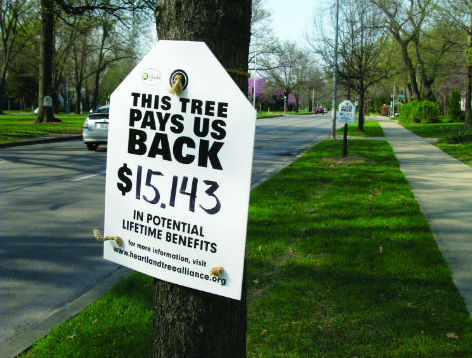
But there is also a growing realisation that these ‘urban trees’ are valuable assets that not only contribute to the liveability of cities but are, in fact, one of the few assets that increase in value over time. The trees found in modern cities include trees in streets, public plazas, parks and open spaces.
Until recently, however, the true value of urban trees had not been fully measured. Although costs associated with their establishment, maintenance, removal and replacement are generally well documented and commonly included in budgets, there was no credible method to value the full range of benefits provided by urban trees.
That situation is changing with tools now available to quantify all the values associated with urban trees in a similar way to other urban infrastructure. Urban trees can now be incorporated as a discrete category in asset management systems, such as the one developed by the IPWEA.
Applying an asset management approach to urban trees will put them on a comparable footing to pavements, pipes, pits, culverts, bridges and services. Decision-making in relation to urban trees can now be based on costs and benefits that allow them to be aligned with overall asset management objectives.
The benefits of urban trees
Because trees absorb carbon dioxide and release oxygen, they act as useful carbon sequestration and storage assets, as well as improving the air quality by absorbing pollutants through the leaf surface. This can help reduce health problems caused by air pollution and the associated costs to the public health system.
They also lead to reduced energy consumption by providing shade to buildings, cars and pavements as well as mitigating the ‘urban heat island’ effect. Furthermore, the shade can provide improved public health benefits by reducing exposure to UV light and associated incidences of skin cancers – as well as increased walking and cycling along tree-shaded paths.
Trees can also reduce the cost of constructing and maintaining stormwater infrastructure. By having a tree canopy to intercept rain, there is less incidence of stormwater runoff and an increased infiltration to groundwater. There are also increased biodiversity and wildlife habitat values.
Finally, urban trees improve the emotional health and sense of well being in the community, as a result of the aesthetic values, together with increased value of properties in areas with significant tree cover.
Treating trees as assets
Taking an asset management approach to urban trees can result in a number of benefits for councils and infrastructure organisations. Asset managers can optimise the costs and benefits in a strategic way and then demonstrate the return on investment. They can therefore build a wider understanding of and support for the value of trees within the organisation.
Furthermore, by using best practice to articulate the need for resources, councillors and other decision makers can understand that they are voting for a resource allocation with a known quantity and value.
There is a range of methods for estimating the value of urban trees, each with a different perspective on defining value. The valuation methods include considering the replacement costs only to a holistic approach that captures both the structural (intrinsic) values and functional (use) values associated with the social and environmental benefits of trees.
The availability of new tools to evaluate the full range of benefits now allows them to be valued and incorporated as a discrete category of urban infrastructure within asset management systems.
The most widely used tree valuation methods include:
- Depreciated replacement cost (DRC), which determines the value of trees on the basis of their removal and replacement cost;
- Helliwell, which is based on a number of factors, such as location, size, conditions, form, etc. which are given numerical values and multiplied by an indexed baseline monetary figure;
- The capital asset value amenity trees (CAVAT) method, which is based on replacement costs as well as the community value of the tree that is determined by use of a community tree index that considers the number of people that interact with the trees as well as the crown size of the tree; and
- i-Tree Eco, is a software program developed by the USDA Forest Service, which accounts for both the structural value of the trees (based on replacement costs) and the value of the environmental benefits that trees deliver, such as carbon sequestration and storage, air pollution interception and removal and stormwater quality improvements.
In practice
The City of Sydney currently applies the DRC method, basing it on average costs of $2000 to remove a mature tree and $1000 to plant a replacement tree that typically has a root ball of 200 litres.
By applying an average value of $3000 per tree to the 30,000 urban trees throughout the City of Sydney, the current asset value would be in the order of $90 million. However, this figure does not capture any of the environmental, energy or public health benefits associated with the urban trees.
Newcastle City Council has recorded 90,000 street trees with another 19,000 trees growing in parks. A study conducted by Adelaide University in 2006 estimated the value of annual net benefits from these trees to be $11 million per year.
The City of Melbourne has valued its 60,000 trees at $650 million, using the Burnley Method of determining the amenity value of trees. In London, the Victorian Business Improvement District has applied the CAVAT method to estimate the value of their 1225 trees as £27 million, which equates to an average of £22,000 per tree.
Nevertheless, having these tools and methods is one thing, applying them effectively is another entirely. This will require a multi-disciplinary approach, involving asset managers, engineers, parks managers, landscape architects, arborists and others.
Professional organisations, such as IPWEA, AILA and Arboriculture Australia, can play a key role in encouraging and facilitating collaboration between the various disciplines to effectively manage urban trees as a growing asset.