Improving public spaces is an item on every local government’s to-do list. Through a marriage of practicality and creativity, councils attempt to not only beautify their cities, but increase tourism, economy, safety and community pride. It’s a big ask, especially when beauty is subjective and budgets alone don’t always go the distance.
Every council tackles the task differently and each encounters diverse challenges along the way. Public Works Professional highlights six examples of how councils have rejuvenated their public domains.
By Simone McClenaughan
On ya bike
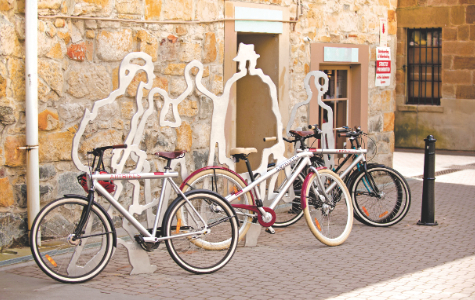
In Tasmania, a collaboration between different groups resulted in bike hoops with a personality. The Cultural Development team and Infrastructure Services department of Hobart City Council, as well as the Tasmanian State Government, through Arts Tasmania, teamed up for the project.
“The council’s Infrastructure Services department approached the Cultural Development team and asked about reinventing the traditional bike hoop structures around the city,” says Jane Castle, Cultural Programs Coordinator for Hobart City Council.
Together, the local and state government, through Arts Tasmania, set about developing the Artbikes project. “The project had three aims,” says Castle. “To support sustainable transport in the city; to make people more aware of our cultural institutions; and to develop unique pieces of public art.”
Local artist, architect and urban designer, Ken Betlehem, was commissioned to design the new-look bike hoops. In addition to Betlehem, traffic and structural engineers, as well as an engineer who specialised in Australian Standards, planners, assessors, project managers, an archaeologist (many of the project sites were heritage areas) and fabricators were involved making Artbikes a reality.
“For a relatively small project, there were many people involved in it,” says Castle. “This was perhaps the biggest challenge because there were so many stakeholders and numerous approvals required.” Another test the project faced was the subjectivity of art. “Everyone has an opinion,” explains Castle. “This can prove challenging when trying to get a consensus on an artistic element.” However, Castle also says without the collaboration of the groups, the final outcome wouldn’t have been as significant.
The financial collaboration is also what made the project possible. Hobart City Council allocates $100,000 annually to public art. The Artbikes project cost around $60,000. “If commissioning and maintaining all public artworks in the city came down to the Cultural Development team, $100,000 wouldn’t be enough to maintain Artbikes and establish new projects,” explains Castle. Despite the bike hoops being designed to be robust, they still need maintenance. In this instance, they are maintained by the council’s Infrastructure Services department.
Betlehem designed a series of human characters for the new bike racks, each of which would be permanently installed outside six of Hobart’s cultural institutions.
The government also established a fleet of 15 free bikes along with helmets, bike locks and touring maps so visitors and residents alike can use the racks and visit the museums and art galleries.
Artbikes blurs the line between art and infrastructure. Technology played a big role in this. Betlehem drew the bike hoop concepts by hand, which were then translated into CAD. The fabricators then used these to create the aluminium pieces, which throughout the process had design tweaks so they were the right size for strength, durability and accessibility.
Community involvement during the project development wasn’t large; however, since the installation of the aluminium character bike racks, the community have taken to them with gusto. “They are definitely well used,” says Castle. “Children in particular like them a lot and tend to have a chat with them or compare how tall they are to the characters. From a council perspective, we’ve also had very few complaints about the racks, which is a very good sign for any project located in the public realm.”
Walk this way
Earlier last year, Botany Bay City Council Landscape Architect Scott Champion was tasked with turning a vehicular road into a pedestrian public space.
Champion undertook the role of landscape architect and project manager for the project, leading a team of five, including town planners, landscape architects, civil and structural engineers.
The street in question, Laycock Street, provides a vital pedestrian link between Mascot train station and the surrounding commercial, residential and industrial areas. “The project aimed to provide local residents and the surrounding working population with a safe, attractive and usable space,” says Champion.
The space is divided into two sides: an active side for thoroughfare and a passive side with seating and trees. Since trees were an important part of the project, Champion needed to find a way where large trees could coexist with the pavement. The trees’ root systems had to develop without compromising the pavement. City Green’s Strata Cell system, a structural soil cell unit, worked perfectly because it supported the trees and maintained the integrity of the pavement.
Champion believes the ultimate success of public domain improvements can be measured by comparing how much use the space receives before and after the improvement. “Laycock Walk was opened in September 2012 and to all reports has been received very positively,” he says.
“The commercial and residential area around the precinct will increase significantly over the next five to 10 years.
“In today’s society, there is pressure to put a monetary value on every resource to help decision makers comprehend their importance. This is very difficult to do for the public domain.”
Transformed by paint
For Gold Coast City Council, putting a price on how much graffiti was costing their city was easy. The bill was up in the millions for removal alone, not to mention the potential impact it was having on tourism.
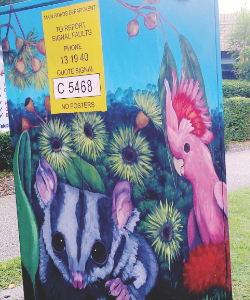 Graffiti is an issue that all public spaces encounter. An item constantly targeted is the humble traffic signal box. Not known for their beauty, the traffic signal boxes become an eyesore when covered in graffiti. “Graffiti can lower property values, affect businesses, decrease visitor numbers and also detract from the beauty of the Gold Coast,” explains Chantal Watt, Community Safety Officer and manager of the ArtBox project at Gold Coast City Council.
In 2008, the Council introduced the ArtBox project, whereby local artists, schools and community groups were given the opportunity to enhance the local streets and traffic signal boxes with beautiful and vibrant artwork.
“The trial was so successful and received a significant amount of positive feedback from the media, community and local businesses that the Gold Coast City Council has implemented the painting of more than 140 traffic signal boxes across the city,” says Watt.
The ultimate aim of ArtBox is to cut graffiti incidence and costs to the city. “The project has reduced graffiti removal costs for the city, which is currently in excess of $1 million per annum,” advises Watt. ArtBoxes have cut graffiti on traffic signal boxes by 80 per cent, with undecorated boxes three times more likely to be vandalised.
Life’s a beach
In early 2012, the Cronulla Esplanade and seawall were in need of an upgrade. “The old structure had reached the end of its useful life,” explains Mario Sherrie, the Manager of Infrastructure Planning and Services at Sutherland Shire Council. “The Esplanade was looking rather tired and dilapidated.”
After about a century of use, the old wall had eroded and the concrete paving of the Esplanade had been disturbed by trenching for utility service works and then patched using both concrete and asphalt.
The aim was to reinvigorate the area while maintaining its general look and feel. Andrew Urio is the designer and landscape architect for the project. “We didn’t want people missing the old,” he says. “We wanted to maintain a connection with what was there and to respect people’s affinity with the space. We’re modernising it, but not changing the feel.”
Harald Strutzenberger, a landscape architect, is the project manager. Two design landscape architects, a civil designer, structural designer and structural consultants are also involved in the project, which is still underway.
Before starting the project, council staff interviewed the general public about the proposed development. “Everyone was receptive to the area being improved and the provision of more leisure and seating areas,” says Sherrie. The council has kept the public abreast of the project by displaying information posters at the construction site.
The council was mindful that the area still needed to be used by the general public during construction. There are a number of businesses along the Esplanade, but Strutzenberger says they’re aware the “long-term gains will outweigh the short-term pain”.
The Cronulla Esplanade and seawall upgrade is estimated to cost between $3-4 million. “Our council is fortunate in that we have access to significant Section 94 funds collected from property developers for the provision and upgrade of community infrastructure,” says Sherrie. The council also secured state government grants totalling $900,000 for the Cronulla Esplanade and seawall upgrade.
The key is to have the right project. “This area [the Cronulla Esplanade and seawall] is the jewel in the crown as far as Sutherland is concerned, so everyone is happy to see it improved,” says Urio. “It’s important to remember that if you produce a good project, council will receive a favourable response from the public and other projects are likely to follow.”
Form meets function
Whereas traders aren’t overwhelmed by the impact the Cronulla Esplanade and seawall upgrade is having on them, traders in Rundle Street in Adelaide are very excited about the developments the Adelaide City Council is making to improve the city.
“In creating The Rundle Project, local trader representatives were consulted, along with artists and a variety of stakeholders,” says Janice Lally, Public Art Officer in the department of City Design and Character for the council. “There is a very enthusiastic group of traders who played a part from the outset.”
Landscape architects Warwick Keates and Tanya Court, along with Craige Andrae, an artist and fabricator, produced the award-winning Integrated Public Art Masterplan for Rundle Street.
The Rundle Project is a key outcome of the Adelaide City Council 2008-2013 Public Art Policy and Five Year Public Art Plan. The main aim of the project was to improve the city streets and public spaces through art and architecture.
“There is a spectrum of reasons as to why it’s valuable to enliven public domains through public art,” says Lally. “It helps with marketing and tourism, has an economic flow-on for trade, and it reflects on the quality and innovation of the creative community.”
For Adelaide City Council, time is the major challenge inherent with improving the city’s public spaces. Other challenges include budget restrictions and competing budgets.
“Unfortunately, there is no obligation to keep the money in the public art budget or have funds strategically linked to urban development budgets,” says Lally. “Money also doesn’t buy a lot these days, so you need timely, creative, collaborative solutions to producing great public spaces and art.
“We need a commitment at the development control and planning levels that recognises that public art is as valuable as traffic management, roads and drains.”
Coast and culture
Public ownership and pride is a crucial part of the enhancement of public areas in Marion, South Australia. It’s these elements that not only help reduce the incidence of graffiti along the 7.2-kilometre Marion Coastal Walking Trail, but also encourage a high level of community access.
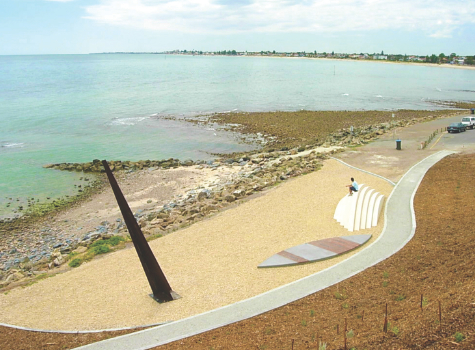
“The trail highlights the natural and cultural significance of the area,” says Marg Edgecombe, the Unit Manager of Arts and Cultural Development at Marion City Council. “It follows part of the Tjilbruke Dreaming Track, an important cultural story for the local Kaurna people.
“Our marine and coastal environment is diverse and the council and community want to protect and promote it utilising a range of design approaches,” says Edgecombe.
To do so, the council collaborated with local artists Marijana Tadic, Barbary O’Brien and Michael Tye to develop the boardwalk trail with interpretive signage, artworks and seating.
 |
Comment below to Continue the Conversation!
|