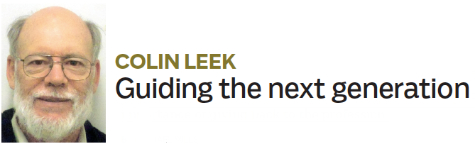
Colin Leek has worked in the Western Australian public works industry in both local government and the private sector since 1971. He is also now a lecturer at Curtin University. He reflects on his career and the importance of giving back to the profession.
By Michael Mills
You’ve been involved in the public works profession for around 40 years. What are your proudest achievements?
The projects I’d regard as my proudest achievements are the constructed wetlands creating habitat in Perth. There are a few main projects in particular: the ‘Black Creek’ Station Creek Wetlands, the Wharf Street Wetlands, the Liege Street Wetlands, the Anvil Way Wetlands and the Living Stream project on Bannister Creek.
The rest of work I’ve done has been more technical. These projects are dear to my heart because it’s enabled me to participate with very dedicated community members and recreate habitats for species other than humans. Humans are so well represented in everything we normally do as engineers, so it’s a privilege to do something for other species and try to rebuild damaged environments, clean up storm water and overturn some of the damage we’ve done in the past. We’re still learning a lot about wetland construction and discovered that we’re not as clever as Mother Nature, so we’ve had to revisit and sometimes revise our original design assumptions.
Who have been you’re biggest inspirations?
There are a number of people who have inspired me in the course of my career, such as Karl Karu, Jo Stone, Helen Barnes and Julie Robert. They are all community volunteers who put an enormous effort into environmental issues. They do it without pay because they’re absolutely committed to the environment.
Having worked on both sides of the industry, what is the biggest difference between working in local government and the private sector?
The biggest difference is that, in local government, you tend to work to achieve the best possible outcome. In private industry, you tend to work within the budget limitations of what you’ve quoted. I found that very difficult to come to grips with. In private industry, I was constrained by billable hours and not able to put in whatever time the work would take.
You now work as a lecturer at Curtin University. What experiences are you able to share with your students?
I think I’ve got a unique ability, compared to people who have been in academia all their lives, to blend the theory with practical knowledge.
I’m able to explain that sometimes the theory and practice don’t align very well – particularly in the geotechnical field. It’s a challenging role. Juggling the workload is tough, but the rewards are great. When you sit down with students one-on-one to explain a concept and you see them grasp it, it’s a very rewarding experience.
What are your hopes for the next generation of public works professionals?
My biggest hope is that engineers embrace the concepts of sustainability and working with the environment, rather than against it. If the climate change predictions are correct, the current engineers entering the workforce now may not have a planet to work with. We must be far more environmentally conscious in everything we do and recognise that engineering is trying to achieve an outcome with the minimum of environmental damage. That’s what I’d like to instil into new engineers.
You’ve given up a lot of time to sit on IPWEA committees. How important is it to get involved with professional associations such as IPWEA?
I think that it’s important that everyone contributes to knowledge. We shouldn't be asking what we could get out of organisations such as the IPWEA; we should be asking what we could contribute to them. Engineering knowledge is infinite; we will always be learning and we need people to put in that little bit extra, through institutions like the IPWEA, to work towards the attainment of knowledge and to do things better than we’re doing now.
 |
Comment below to Continue the Conversation!
|