The development of Australia’s first full-size synthetic AFL and cricket field at Saltwater Reserve means Wyndham, Victoria, is now a key destination for Australia’s sporting best.
By Stephanie Hollebrandse
Saltwater Reserve, located in the City of Wyndham, Melbourne, features a sporting complex with six separate fields and eight tennis courts. In late 2011, the precinct also became home to Australia’s first full-size synthetic turf AFL and cricket oval.
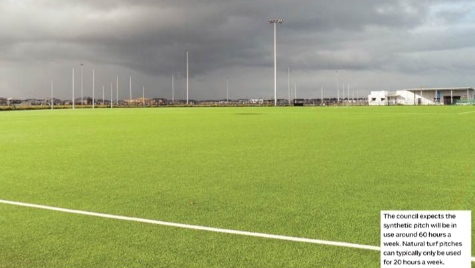
Endorsed by the AFL as fit for play, the oval came about from the need to meet community requirements for a drought-proof oval and excessive use of ovals throughout the municipality.
John Hajko, Senior Project Engineer from Wyndham City Council, oversaw the development as Project Manager and says the synthetic pitch has many advantages.
“Compared to a natural turf, the benefits of a synthetic oval include a resilience to weather, in particular drought, free draining and consistency of playing characteristics, so there are no hard or soft spots,” says Hajko.
“There is also significantly less maintenance involved: no irrigation, no weeding and no fertilisation. As a result, the synthetic pitch is available for use three times more than natural turf.”
Maintaining natural turf also comes at a significant cost to Council. Approximately $25,000 per annum covers irrigation, top dressing, fertilising, weeding and mowing alone.
“The Council has an ongoing renovation program on its natural turf ovals and would replace regular turf at 10-15 year intervals,” adds Hajko. “The cost of replacing natural turf senior ovals range from $100,000 to $500,000 depending on the type of replacement method used – from sprigging to instant solid turf.”
In comparison, it will cost the Council around $6500 per annum to maintain the synthetic turf.
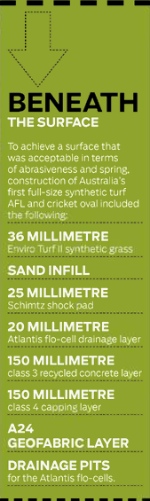 The design and construction of the oval presented a number of challenges that had not been experienced before. It was also crucial that the project adhered to set conditions imposed by the AFL, in order to achieve certification for AFL level of play to be allowed on the oval.
To ensure the safety of football players, the oval was tested against the ‘Australian Football League and Cricket Australia Handbook of Testing for Synthetic Turf, May 2009’.
“Extensive research and testing was carried out on grass lengths, shock pads and suitable sand medium infill,” says Hajko. “The oval now complies with all specifications outlined in the Handbook.”
The need to have flexibility in the change of sporting codes from football to cricket season was a key challenge taken into consideration during the construction process.
“Our contractor has developed a synthetic cricket wicket overlay system that allows rapid change from football to cricket mode within five hours, and from cricket to football mode in approximately eight hours,” explains Hajko.
“Changing to a football pitch takes longer due to the extra time required to lift and insert wedges, and top up and evenly spread the sand infill over the synthetic turf overlay.”
Changing the pitch from football to cricket mode involves a number of steps. First the synthetic turf overlay sections, of which there are 42, are removed and stacked on pallets.
“You then need to remove wedges from around the cricket wicket – this drops the outside turf level to the synthetic cricket level, and then transport both the sections and wedges into a storage area,” says Hajko. “Sweeping any sand off the synthetic cricket wicket surface completes the transformation.”
It’s expected the oval will be in use approximately 60 hours a week, in comparison to a natural turf’s use of up to 20 hours a week. “The synthetic turf has a warranty period of up to eight years and will perform the same way as a natural oval in terms of its hardness, critical fall heights, traction, ball roll and ball rebound for both football and cricket,” says Hajko. “Then there are the added benefits of better drainage and no soft spots, especially around the goal squares and centre circle areas.”
Ballarat University will monitor the surface performance as to its abrasiveness, durability and stability. This will provide the data required for any further developments, including the possibility of future AFL competition being conducted on similar surfaces.
 |
Comment below to Continue the Conversation!
|