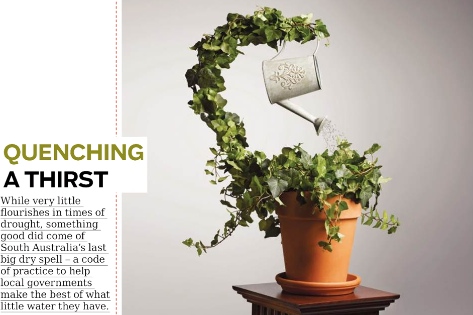
While very little flourishes in times of drought, something good did come of South Australia’s last big dry spell – a code of practice to help local governments make the best of what little water they have.
By Frances Sacco
Thanks to a severe drought period in 2003, the South Australian Government decided to implement the ‘Water Proofing Adelaide Strategy’ to ensure water sources could be well managed in the future.
So, in one respect, the drought could be seen as a blessing in disguise for those charged with keeping the state’s sporting fields and parks useable.
As part of the strategy, the Irrigated Public Open Space (IPOS) Code of Practice was developed by IPOS Consulting in collaboration with a reference group of relevant bodies, including SA Water, the SA Local Government Association, and Parks & Leisure Australia.
The Code was released in 2005 – just in time for summer. It gave local governments a succinct set of guidelines to assist them in becoming as efficient as possible in their water use.
The IPOS Code deals with irrigation system design, installation and maintenance, plant and turf selection, the required turf quality, horticultural practices, technology, weather data and water budget.
The City of West Torrens took up the strategy in 2003 when it was still in its draft form and horticulture services coordinator Lisa Kirwan says they have never looked back.
Since they started reporting in 2008, the council has seen water efficiency jump to 94 per cent as of the end of the 2011/12 watering season.
“We don’t necessarily use less water (on a day-to-day basis), but we’re using water more efficiently,” she says.
“We might have to water one week but if we get rain the next week, we don’t have to.”
One of the key elements of the code of practice is the ‘fit-for-purpose’ concept.
It divides turfed areas into four categories ranging from elite sport to passive recreation, allowing local government workers to easily determine how much water is needed for each.
The City of West Torrens has also used these categories to help prioritise upgrades to their equipment central control systems.
“Our turf and irrigation work group leader, David Ward, can run it from the desk in the office or remotely,” Kirwan says.
“It has rain sensors and flow sensors and can tell if there has been a break in a system. It can shut that line down so we don’t waste any water.”
Starting with premier and local sports fields, the city has been upgrading several of its parklands to central control systems with each annual budget and are about two thirds of the way through.
“We had the Glenelg to Adelaide parkland water reuse scheme, and we were able to put a fair amount of the high water users onto the re-use scheme, including a couple of sporting fields and a few large parks,” Kirwan says.“We also trial new ways of saving water, such as sub-surface irrigation.”
In implementing its IPOS, the City of West Torrens makes no distinction between bore, reclaimed and mains water, treating all water as a precious resource.
It took a single watering season of working with the code for the City of West Torrens to streamline its systems and work methods as well as managing its own and the public’s expectations of the changes.
“I would definitely recommend IPOS, especially from an operational point of view,” Kirwan adds. “It’s commonsense and, although it’s done from a South Australian point of view, someone from interstate could take the ideas on board.”
Six steps to implementing IPOS
- Implement a strategic approach to irrigation management
- Ensure systems are functioning properly with periodic system audits and regular maintenance
- Implement a horticultural maintenance program to maintain soil structures and turf nutrient requirements
- Use long-term climatic data to set the monthly base irrigation schedule
- Amend the base irrigation schedule on a regular basis to account for climatic variance from the long-term average in any given season
- Monitor irrigation consumption against requirements and report on irrigation efficiency and turf quality
How the water is allocated
The allocation of water under IPOS is determined by undertaking functional assessments of irrigated turf (Turf Quality Visual Standards), which is divided into four categories:
- Elite sport (national-level sports, such as AFL and A-League soccer)
- Premier sports (state-level sports, such as SANFL and premier league soccer)
- Local sports
- Passive recreation, parks and reserves
 |
Comment below to Continue the Conversation!
|