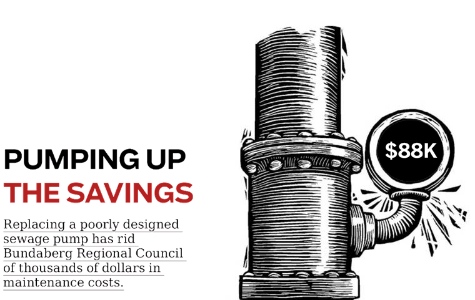
Replacing a poorly designed sewage pump has rid Bundaberg Regional Council of thousands of dollars in maintenance costs.
By Jo-Anne Hui
In 2009, Kevin Harris, a Technician with Bundaberg Regional Council, was faced with a maintenance nightmare. The old sewage pump at the Council’s Woodgate Vacuum Sewer Station was barely plodding along and prone to regular breakdowns.
According to Harris, the system had been designed with some basic flaws. As time went on, changes were made without consideration of the impact they would have on other parts of the system. At the time, a positive displacement lobe-style pump was being used.
“One major failing was extending the length of the system without having extra pump stations along the way,” Harris explains. “This meant, to operate effectively, the system had to operate at a much higher vacuum: negative 80 kilopascals (the plant was designed to operate at approximately 65 kilopascals).
“This had a major impact on the system as a whole, especially in the vacuum tank, which was not designed to operate at such vacuum. This resulted in the tank imploding.”
Every six to eight weeks, various parts would wear out and need to be replaced, but major overhauls would then need to be conducted every three to four months, recalls Harris. Silt was building up in the system because the pumps were not generating enough flow to move the sewage.
Some months, it would cost the Council $2000 to $3000 to maintain the sewage pump, but every so often, bills would skyrocket up to $15,000.
“If you take into account breakdowns, the efficiency was troublesome,” Harris says. “[Efficiency levels were] dropping off fairly dramatically as the pump was wearing out.
“When a pump is brand new, it pumps 20 litres a second. But after awhile, it might only pump five litres a second, so it takes four times longer to pump out the same amount. The running costs are expensive.”
At the end of 2009, it was decided that something had to be done and Harris began looking at alternate solutions to improve matters. However, this proved to be quite difficult, due to some of the sewer station’s unique features.
Bundaberg’s vacuum sewage system incorporates a network of sewage lines that come from houses and businesses, which all lead back to a collection point. A vacuum tank is located here and the sewage flows towards the tank with the aid of vacuum pumps.
The vacuum system works the opposite to a gravity system. Whereas a gravity system flows downhill, some systems cannot be designed to do this, so vacuum systems allow the sewage to ‘travel up-hill’ to the collection point.
The sewage then needs to be drawn out of the tanks and sent to the sewage treatment plant. Because this tank is under vacuum, it’s hard for pumps to pull against it, so the pump needed to pull against that and create 73 metres of head.

Unfortunately, there are not many pumps available to cater to these needs.
After several months of searching, Harris met Garry Grant, General Manager of Hydro Innovations. Together, they discussed the problem and spent several months exchanging information and designs. The final design was not only cost effective, it was also customised to suit Woodgate Station.
“When assessed on a whole of life cost, including installation, maintenance and annual running cost of the units, their pricing was very competitive, which is also something that local government must consider,” adds Harris.
It was eventually decided that Hydro Innovations would install the Gormann-Rupp Ultra VS3A60-B, a two-stage self-priming sewage pump, which creates extra pressure. Each of the stages of the pump develops 45 metres of head.
The new pump was a purpose-built sewage pump and can also handle all manner of solids, which was a problem for the old pumps. According to Grant, scraps of clothing are a big problem, as people tend to dump all sorts of debris in their toilets.
“Things like matted hair cause problems for the mechanical system, including the pump,” he adds. “The selected pump handles tin cans and stringy materials like underwear and shirts.”
Since the installation of the Gorman-Rupp pumps, maintenance costs have been dramatically reduced. In fact, Harris and his team have barely even needed to go back to the pumps and work on them.
“They’ve been in for about 18 months and we haven’t had to do anything apart from general maintenance,” he says.
“There’s been no work done on them at all. We just check the belt tensions to make sure they haven’t frayed and check the bearings are greased and there are no leaks.
“Basically, we were previously spending between $30,000 and $40,000 a year on maintenance costs. Now, we’re spending about $2000. The total installation of the pumps was somewhere in the vicinity of $88,000, so now we can pay the two pumps off in two years.”
 |
Comment below to Continue the Conversation!
|