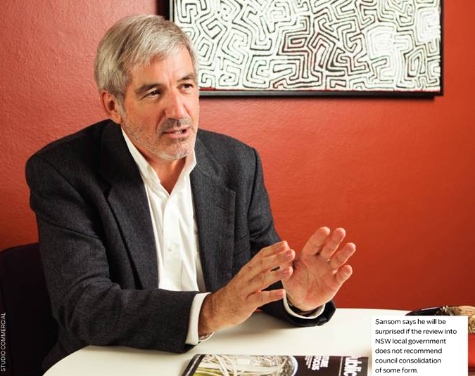
Professor Graham Sansom, the Director of the Australian Centre of Excellence for Local Government (ACELG), is chairing the review of NSW councils conducted alongside the ‘Destination 2036’ program. He explains how the sector can navigate the challenges ahead.
By Michael Mills
Sansom has more than 30 years’ experience in local government, holding senior positions in councils and working as a consultant for all levels of government.
He has also served on various agencies and bodies, including as CEO of the Australian Local Government Association and as a board member of the Commonwealth Local Government Forum. Alongside all that he has taught at a tertiary level.
While he will leave ACELG at the end of the year, he will still have a guiding hand in the sector’s future. He was recently appointed to chair the NSW Government’s Independent Local Government Review to help steer councils towards ‘Destination 2036’.
What are your proudest achievements at ACELG?
First and foremost, the fact we’ve successfully put the consortium together and achieved such a high level of collaboration among the five partners. Working with a consortium, there were obviously issues that had to be resolved to get the show on the road and keep it there. One of the things I’m very proud of is the way the five members [UTS Centre for Local Government; University of Canberra; Australian and New Zealand School of Government; Local Government Managers Australia; and IPWEA] have developed a lot of trust in each other and supported the broader ACELG agenda.
The Centre is now well established and well recognised around the country. Our research program is a great success.
Among our many other achievements, the work we’ve done with the IPWEA on asset management, long-term financial planning and the national assessment framework have been headline projects. They really represent world class in local government.
What were the initial reasons for forming the Centre?
It was announced almost out of the blue by former Prime Minister Kevin Rudd and the then-Minister for Local Government, Anthony Albanese, at a meeting of the Australian Council of Local Government in 2008. There had been a lot of concern about skills shortages in local government and Local Government Managers Australia had convened various forums to look at that. They suggested a ‘virtual centre of excellence’ that would showcase best practice in local government.
At the same time, it was obvious when talking with Minister Albanese that the Federal Government was becoming increasingly concerned about the underlying financial and infrastructure maintenance and renewal issues in local government. When the Prime Minister made the announcement, he put a lot of emphasis on that. He said: “We know you have some serious problems. We are happy to contribute financially to dealing with those problems, but we want local government to be stronger, more effective and more professional.” Setting up the ACELG was part of that package.
How much is the skills shortage affecting the sector?
 It’s difficult to nail it down, because local government functions in a very complex labour market. The skill areas that are defined as being in shortage do change from time to time. But there’s no doubt that in core areas – and certainly engineering is right at the top of the list – local government is struggling to attract the people it needs to handle the full range of local infrastructure and service delivery issues. Some places are in need of urban and regional planners, while others need health and building inspectors or finance professionals. It tends to vary.
The mining boom is sucking all kinds of people out of the workforce and into highly paid jobs. Local government is struggling to deal with that.One of the often-overlooked issues is that local government is becoming an increasingly complex sector. It needs ever-higher levels of professionalism to do its job properly. We certainly do not put enough emphasis on improving the skills of our workforce and really looking ahead and saying: “what skills are we going to need in 10-30 years’ time? Where are we going to get those people and do we have to do more to grow our own?
The tendency to cut back on apprentices and cadets due to financial constraints is only storing up problems for the future, not resolving them. ACELG is just finishing off a national workforce strategy for local government, which will highlight those issues and plan for the kind of skills and workforce local councils will need in 30 years’ time.
How exactly have the tasks become more complex?
Anyone in local government will say that over the last five decades, the range of things that councils do has increased considerably. But councils have also had to operate at an increasingly sophisticated level, especially with long-term strategic, financial and infrastructure planning. The days of just bringing down the budget once a year have long since past.
Community engagement is another big change. People now have a much greater expectation that they will be consulted regularly and will be able to have their say on the big picture decisions that the council is considering. The need for councils to learn to talk to their communities and really listen to what they are saying has become a major issue. They of course need new skills and techniques to do this properly. For example, some councils are now using internet-based panels of residents to get regular feedback on issues.
What is the most optimistic future you can forecast for local government and what is the most realistic?
I’ve been in local government a long time, and I would love for every local council in Australia to be financially robust, to have enough staff with the right skills and experience so they can deliver a full range of services and infrastructure facilities to meet their community’s requirements.
That would be the ideal and we need to have an ideal in the back of our minds whenever we are thinking about the future.
Realistically, however, it’s hard to see large numbers of councils reaching that ideal on their own. So we have to be look at a number of questions. Do we need different types of local government in different parts of the country? Is it realistic to expect a council in far-western NSW to deliver the same as a council in inner Sydney? If that’s not realistic –and it almost certainly is not – then what can we reasonably expect these rural and remote councils to deliver? How can we support these councils with grant funding? Can we do more to encourage regional collaboration between councils to make resources, whether it’s money or skills, go further?
I’m anticipating a big change in the way we think about local government, specifically that different models and functions suit different places. We have to have federal, state and local government talking to each another about providing the best possible mix of services to communities around the country, with the mix and the responsibilities varying from place to place.
You’ve recently been appointed to chair the NSW Government’s Local Government Review. What outcomes are you hoping to see come out of the review?
The review will look at various forms of governance, structures, and possible boundary changes in order to produce a more effective and stronger system of local government. Financial sustainability and the issues of infrastructure backlogs and asset management are core items embedded within the terms of reference.
We want the review to promote new ideas and fresh thinking about the future of local government. So one of our starting points is that it won’t be a one-size-fits-all set of recommendations. We are expecting to recommend different approaches for different places so we get that best possible fit
I mentioned earlier.
What are your views on the calls to consolidate several council areas, particularly the metropolitan ones, into larger local government bodies?
The amalgamation issue is a very sensitive one and the Government’s policy at this stage is that there should be no forced amalgamations. We’ve been asked to look at possible incentives for voluntary boundary changes, which would include amalgamation. As far as metropolitan areas go, there is a lot of evidence to support larger local government units. However, we also have to make sure there is effective representation of communities at a neighbourhood and suburb level.
We will have a close look at the Sydney region. We have not received any instructions and will develop our ideas by balancing those factors I’ve mentioned.
I will be surprised if there wasn’t some move towards consolidating local government in the metropolitan region. But consolidation can take different forms. It doesn’t necessarily mean wholesale amalgamations into ‘super councils’. For example, some councils might amalgamate, while others could share services and collaborate more closely.
However, if it is going to be a shared services approach, it has to be serious. They must be long-term, binding agreements. You’re trying to capture the benefits of increased scale, so it’s no good if councils opt in and out every few years.
 |
Comment below to Continue the Conversation!
|