By 2050 Australia’s population will have grown to 36 million and the majority will be aged between 64 and 84 years. The population will be more than ever concentrated on the coastal fringe, because climate change will have made inland Australia increasingly uncomfortable to live in. Furthermore, the incidence of extreme weather events and natural disasters will have noticeably increased.
These forecasts aren’t new, but how public works professionals deal with these changes will be. However, according to experts in the industry, many lessons have already been learnt and it’s now a matter of revisiting the past to cope with the future.
By Keeli Cambourne

Building resilient communities
Five decades ago Australia’s demographics were startlingly different than they are today, according to the Intergenerational Report published by the Federal Government in 2010. It follows then that the expectations of the population were also different.
In 1970-71, 31 per cent of the population was aged 15 years or younger. By 2001-02 this proportion had dropped to 22 per cent. Those aged over 65 in 1970-71 accounted for only eight per cent of the population. The Report predicts that over the next 40 years that figure will reach around 25 per cent.
Baby boomers in the 1970s made decisions based on the times, which were all about reaping the rewards of Australia’s prosperity. Fast-forward to the 2000s and today’s decision makers are coping with global financial crises, an ageing population and a change in attitude that puts the individual first.
Consequently, the ways communities are managed has also changed, says Athol Yates, Executive Director, Australian Security Research Centre.
“Fifty years ago there was greater self-reliance and a culture of self-responsibility in communities,” he says. “If there was a disaster, it was the local community that responded.
“From the 1970s onwards, a culture of ‘learnt helplessness’ has evolved. It’s the idea that if you dial 000, a government service will rock up and fix everything. The government is now trying to reverse that.”
This shift is likely to have a great impact in public works and strategic planning. Fifty years ago there was more strategic planning to ensure developments were generally located out of harm’s way.
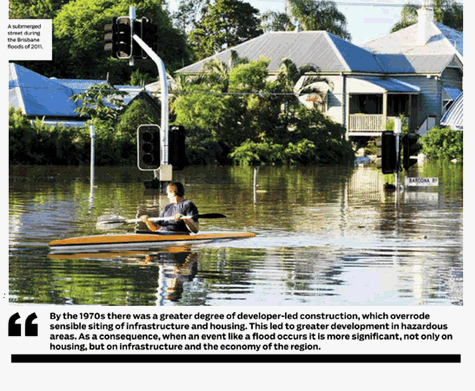
“There was plenty of land available, so building on flood plains wasn’t an issue,” Yates says. “By the 1970s there was a greater degree of developer-led construction, which overrode sensible siting of infrastructure and housing. This led to greater development in hazardous areas. As a consequence, when an event like a flood occurs it is more significant, not only on housing, but on infrastructure and the economy of the region.
“Increased urbanisation along sea fringes and the sheer increase in the number of people means disasters are now bigger and more expensive. So what we have seen in the past 10 years is a push from the government to try and mitigate the impact of events by providing more development based on risk assessment.”
Yates says there is a push towards a greater ownership of problems by the people who live in areas that are impacted by natural disasters, rather than encouraging a culture of blame.
“Historically, towns were built on rivers and, to prevent flooding, levees were built,” he adds. “The problem today is that the size of the base to be covered is so large that that isn’t practical anymore. The same with coastal erosion or large storm surges. The only options now for governments are to retreat, accommodate or protect, but all these are politically and financially expensive.
“Generally, the shift from the 1970s has seen building in more vulnerable areas and has been a result of developers challenging the expertise of professionals like urban planners or engineers, but in the last five years the government has changed tactics. They are now pushing that every dollar spent in prevention will save $5 in recovery.”
Although State and Federal Government have gradually withdrawn from the responsibilities of urban planning, Yates believes there must be more macro-level planning instruments in place to force local governments to make more rational decisions.
“For example, there must be something like a national sea-level rise planning guide,” he says. “Presently there is a lack of guidelines for developing on flood plains, although there are suggestions that infrastructure and mitigation costs now be shared by developers as well as government.
“A lot of infrastructure already in place will continue to be there in 50 years, although there still needs to be a major boost in funding for more. There is a massive backlog in improving what we have or to just maintain the service levels expected, so we can expect a relative decline in the levels of service provided by infrastructure over the next 50 years.”
Re-evaluating asset strategies
Managing service levels with ageing assets, expanding populations, increased environmental standards – and with limited increases in funding – will require great ingenuity, and it will be one of the biggest challenges facing public works in the next five decades.
That’s the view of Dr Penny Burns, the Editor of AMQ International’s Strategic Asset Management and a veteran of asset management in Australia and overseas.
She is currently writing a book on the development of asset management in Australia over the past 30 years.
“Looking back we see that, ‘we have been here before’, as few problems are entirely new,” she says. “However, it would be unwise to assume the solutions that worked before will be successful now, or indeed, that solutions that didn’t work before should be ignored now. This is because we have changed, our knowledge and our capabilities have changed, and the social, political and economic environments within which we operate have changed.
“The message is therefore that we must seek to adapt, rather than merely adopt. Once we sought to find out what others were doing so that we could do the same – that will not solve the problems we are facing now.”
Burns points out that the 1960s and 1970s were years of rapid growth in Australia and state and local governments were supported by large capital grants from the Federal Government. By the mid 1980s, those grants were beginning to dry up and treasuries looked at replenishing funds by selling their assets.
“Unfortunately the driver for these sales was not the disposal of assets surplus to requirements but the disposal of those that could raise the most revenue – and it set the tone for what would happen in the future,” Burns says.
According to Burns, asset management has experienced three distinct stages. In the mid 1980s to the late 1990s, asset managers focused on discovering whatever facts they could about government assets: what and where the assets were, what condition they were in and what they were worth.
The second, from around the late 1990s to about 2010, focused on using asset data to improve asset productivity and reliability and the major concern was securing funding for renewal of ageing assets.
“Recently something has started to change,” says Burns. “During the second stage we paid lip service to the fact that assets ‘were there to serve a purpose’, but now we have started to focus – and try to measure – these services and service levels and question whether we have got it right. We've also started to ask the question that will dominate the coming decades: is it affordable?”
This is stage three and Burns says it is starting now. She calls it the ‘new awareness’ stage and the key issue will be the affordability of assets.
“The solution to the affordability issue will involve new and very different attitudes in all fields, from design to construction to management,” she adds.
“Whereas, in stages one and two, the key players were engineers and accountants, in stage three there are a host of new players, from economists, lawyers, architects, regulators and the community, each with their own values and their own agendas.”
Affordability is becoming a big issue because of the average age of any agency’s asset portfolio. Few portfolios would have an average economic life of more than 50 years and with increasing computerisation, asset complexity and changing demands and technology, it is likely to get shorter rather than longer.
“If we, therefore, take 50 years as an average, asset sustainability translates to being willing to put aside the funds or renew our asset base at the rate of about two per cent of its current replacement cost,” Burns says.
“Few agencies are doing, or are prepared to do, even a fraction of this. Yet, the desire for new assets, increasing the size of the portfolio, continues year by year. Costs for maintenance and operations increase along with the number of assets.
“It is important that we not only correctly assess life cycle costs but that we understand the significance of them.”
Burns says public works engineers can design longer living assets, but physical life is rarely the issue in a world that is changing so fast.
“Perhaps we need to rethink the use of assets, the type of services we provide and the way we provide them,” she says. “This is where the new ideas of the new players will become important.”
Sustaining Higher Standards
The concept of whole-of-life costing has been a slow but sure shift in government policy, says Dr Stephen Lees, National Director Sustainability for the Institute of Public Works Engineering Australia.
“Frequently, councils have often not had the funding to maintain buildings or assets and that has been a problem. Sometimes, things have been patched up and run down,” he says. “That high cost of maintaining these assets has been highlighted as a major problem for future generations Australia-wide.
“The expectations on public works are rising and we now have to work across a broad range of areas, particularly in local government, all with funding constraints.”
Although sustainability in infrastructure and assets has become a catchcry of the new millennium, Lees says there has actually been a pull-back in sustainability initiatives within government.
“Standing back from that, however, there have been changes in last few decades in what local governments have done,” he adds. “We have gone from having a narrow focus on projects to now taking into account the context upstream and downstream of that project.
“Back in the 1960s and 1970s, projects were built in isolation. But in 1979, the Environmental Planning and Assessment Act came into force in NSW and that changed the way things were done. Overall, there is now more formal scrutiny of projects than there was going back 40 years.”
Lees says ratings schemes such as the Australian Green Infrastructure Council’s new IS rating scheme should start to have a positive impact on public works over the next decade, similar to the effect of the National Australian Built Environment Rating System and the Green Star rating scheme on commercial buildings.
“These rating schemes are forcing builders and developers to address sustainability and demonstrate measurable improvements,” he says. “Assets that have higher ratings will have better market place value and that consideration will in turn create financial attractiveness because governments are ultimately the purchaser of most infrastructure in Australia. So in this way it is the governments’ position to not just set standards, but set better standards in the market place.”
This standard setting is becoming especially crucial for local councils near coastal areas.
“With the sea-change movement, there is greater pressure for these councils to develop and then there arises the issues of abandonment or protection as sea levels rise,” says Lees.
“It means there will need to be greater emphasis on protection in the planning regime, because one wrong decision now means successors will face even more difficult decisions in the future.
“This is set to become one of the great debates in next few decades and it is already happening in places like northern NSW – do we leave it or protect it? When we are using public money to protect assets – public and private – it is a difficult decision to make choosing one over another, so fundamental decisions will have to be made about who ultimately bears the cost of climate change.”
 |
What are your thoughts on the impacts that will change the way we live over the next 50 years?
What does today’s Public Works Professional need to change in order to future-proof our communities?
Comment below to Continue the Conversation!
|