Adelaide City Council Program Manager of City Design and Transport Daniel Bennett foresees a future where electric vehicles are the city car of choice.
Q. How many electric vehicle charging stations do you have in Adelaide?
Adelaide City Council has four electric vehicle charging stations in the city: two at the Central Market UPark and two at Grote Street UPark. There is also a charging station for electric motor cycles in the Light Square UPark.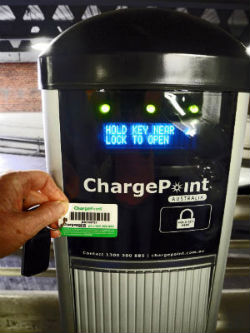
These days, most electric vehicles can easily come to the city and return home without needing to charge as technology advances and efficiencies are improved.
The four vehicle and one motorcycle charging stations continue to be maintained by Council and are available to the community at no cost. The locations of the charging stations were chosen for convenience, as they are centrally located and housed within Council owned UParks in the CBD.
Q. How does the charging system work?
Any electric vehicle with a compatible plug can use the charging stations within the UParks in Adelaide.
The charging system works in a similar way to a domestic electricity socket:
• Each vehicle is allocated a key card, which enables them to activate charging (this is available through Council Customer Service Centre).
• Each vehicle has a charging cord, which is plugged into a socket at the charging station.
• The key card is then swiped and charging begins and a digital display shows ‘charging’.
• Once fully charged the vehicle owner will receive an SMS or email notification alerting them to the completed charge.
• When the driver returns to their vehicle they swipe their card, unplug the cable and drive off.
Click here to read a case study about the charging units used.
Q. Why did Adelaide City Council decide to invest in electric vehicle chargers in the first place?
One of Council’s Strategic Directives in its Strategic Plan 2012-2016 is to ensure ‘Low emissions and other sustainable travel options prevail’ and to improve urban air quality. This directive forms part of Adelaide City Council’s Smart Move Strategy developed to encourage people to think about alternative ways of travelling to, from and around the city including seeking out public transport, cycling, walking, car-pooling and electric powered vehicles.
At the time of installation 39 per cent of community greenhouse gas emissions were related to transport.
Q. How many people do you estimate use the charging stations?
Electric vehicle chargers provided Council the opportunity to lead by example in demonstrating the way an important aspect of transport future in Adelaide could look.
Currently there are very few electric cars in South Australia, but Council recognises that there is likely to be an increase in the future – particularly with interest in projects such Autolib, the electric vehicle sharing program that is installed in Paris – and is expected to be part of the public transport systems of Indianapolis in the USA, London UK and Singapore in the next 12 months.
Between late October 2010 and early December 2013 there were 449 connections to the Central Market Charge Point.
Given the size of Adelaide and the spread of suburban residents who might access the city, travel range was identified as a barrier to large scale uptake of electric powered vehicles and initially the basis for installing the charging stations, however this has largely been overcome by rapidly improving technology.
Q. What advice would you give to other councils looking to do a similar project?
We would advise other Councils to do their research and expect use of the charging points to steadily increase over time.
As mentioned previously, a number of cities across Europe, Asia and America use electric hire cars and electric car charging stations as a convenient way to travel in and out of the city. People can subscribe to the service and pay a fee for ‘renting the vehicle’ for the time they are using it. This encourages less petrol reliant vehicular traffic in and out of the city and is proving quite efficient.