Sebastian Lees, Technical Officer for Plant and Supply at Tamworth Regional Council, NSW, recently completed the IPWEA Fleet Management Certificate from which he says he gained valuable insight into working in the public sector as well as the importance of Service Level Agreements.
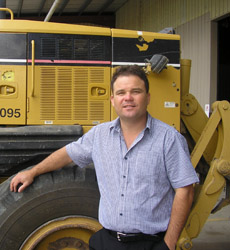
How did you get into a career in fleet management?
I started my career working with Marubeni Pty Ltd who were then overtaken by Hitachi Construction Machinery in the mining industry. I worked in the warehouse as a store person, and then moved up to parts interpreter.
Due to personal circumstances, I eventually got out of the mining industry and moved to Tamworth. I worked at Caltex here for about five years as a depot manager – running fuel up and down the Eastern Seaboard – and from there I was lucky enough to get a job at Tamworth Regional Council in our hire office as a Plant and Systems Officer – basically coordinating the hire of all plant and equipment. I did that job for about five years before I became Technical Officer for Plant and Supply, which I’ve been doing for two years now.
You recently completed the IPWEA Fleet Management Certificate. Was that a valuable experience?
It is valuable and extremely relevant, because it provides an insight into the way the public sector works and how things are identified or understood in this sector, as opposed to private enterprise, having spent most of my career in the private sector before joining Tamworth Regional Council.
Another important lesson I took away from the Certificate was about Service Level Agreements. In the private world, when you’re in charge the decision lies with you, but when you’re in the public sector, and it’s public money, you really do need that agreement in place. If you have a service level agreement with a supplier or workshop, for example, it’s actually their money; they’re paying the rates – it’s a two-card trick. Having that service level agreement in place – or guidelines and rules, if you like – makes the process more straightforward, and negates issues or arguments.
What are some of the biggest challenges facing fleet managers at the moment?
At the moment one of the biggest things we're facing here at Tamworth is the sheer size of our organisation. We have multiple items of plant across a number of different divisions and basically to try to get it to a pinpoint is very hard. We might have a Zero Turn mower with our parks and gardens crew, and another one at the airport and at one of the pools, and the lifecycle of those items is calculated to be completely different. To do the calculations individually to get the optimum time out of each item is obviously labour hungry and time consuming, so that’s one of the biggest challenges at the moment: labour resources. At present I average lifecycle calculations across each discipline, which isn’t ideal but given the size of the organisation and the resources available, that’s currently the only way for us to do it, otherwise it becomes too time consuming and it’s all you’d ever do. As a result, some machines spend a lot longer in the workshop while others are replaced a lot earlier.
How big is Tamworth Regional Council?
We have approximately 790 items of plant – we basically class anything that has an engine (petrol, two stroke etc.), an hour meter or an odometer as an item of plant.
Is there anything Tamworth Regional Council is doing in fleet that other councils could learn from?
One of the things we’re doing at the moment is running a long-term replacement program, projected for 25 years, which enables us to monitor expenditure, budgets, and the like. Whereas the way that I understand some other smaller councils work is purely on a reactive basis; probably because budgets are limited or small, these are allocated on an annual basis where they find out year-on-year how much money they’ve been allocated. Given the size of Tamworth Regional Council and with the funding that’s available, we’re in a position to make longer-term plans and forecasts.
What other important lessons have you learned in your work in fleet management at Tamworth?
Attention to detail is critical. Fleet or asset management is only as good as the data that’s entered most of the time. You can run spreadsheets and databases, but it can just be a matter of one digit in the wrong place and your calculation of the lifecycle of an item of plant, for example, can be thrown out by five years.
I’ve also come to realise how specialised fleet management is. It’s a very specific field in it’s own right, which is where I think the IPWEA Fleet Management Certificate comes in. It’s one thing to think you have an understanding of fleet or asset management, it’s another to actually be able to put that into practice.
Find out more about IPWEA's Fleet Management Certificate here.