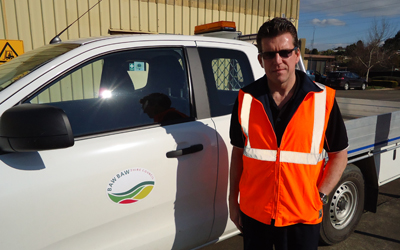
Jeff Collinson, Fleet Coordinator at Baw Baw Shire Council, Victoria, discusses the challenges of being his council's first dedicated fleet manager in six years; the potential impacts of the proposed Fringe Benefit Tax (FBT) changes; and his 21 years spent in the Australian Navy.
How long have you worked in fleet management?
I’ve been with Baw Baw Shire for almost 12 months. Previously, with two other guys, I co-founded a fleet management company called Webfleet, where I stayed for 10 years before we eventually sold the business. We started in the early days giving customers, particularly the government and not-for-profits, strategic fleet management advice. We also provided some tracking of their vehicles through a very rudimentary software system that we then developed, and we created the first true online tendering system for vehicles.
What was the most common advice you were giving to your customers through Webfleet?
It was mainly doing analysis and whole-of-life costs – so, the optimum amount of time to hold and move vehicles. But the key difference that we had was that we wouldn’t set an optimum time across a whole fleet, we would look at different makes and models separately. So, if you had light commercial vehicles, with whole-of-life costs on those at the time, you were better off holding them longer and getting more use out of them because there was usually special equipment and fitting to those vehicles, and they would hold their value. We looked outside a one-policy-fits-all approached, and provided recommendations for each individual vehicle.
How has the situation for fleet managers changed since then?
The used car market has been impacted by cheap imports, the GST, fringe benefit tax and the removal of tariffs through the Button Plan, which meant there as a lot of cheaper vehicles and the second-hand values of cars plummeted over the last 10 years. So, organisations that had short-term hold policies – like two years and 40,000km – weren’t necessarily getting the best value out of their cars. So things have changed now – hold policies are greatly extended. Which is part of what I’m looking at here at Baw Baw Shire.
What are some of the unique challenges you face working at Baw Baw Shire Council?
The biggest challenge at Baw Baw is that they hadn’t had a fleet manager for six years before I started a year ago. Previously, other people had been doing bits and pieces tacked on to their role. So the council had a complete and independent review carried out by a contractor, and the independent review found that the fleet was not being run as well as it could be, mainly because there was no dedicated person doing it.
One of the first changes made as the Fleet Coordinator was to put in some authority processes so that I could better track where money was being spent, especially around vehicle servicing and repairs. The management of where cars were repaired and serviced needed tightening so that vehicles were not taken here and there ‘willy nilly’ without monitoring what it was actually costing Council.
The other challenge is looking at the types of vehicles purchased in the past. The main focus then was on going green, on the environment. That ended up costing the council, because it didn’t look at what the up-front costs of those vehicles were, the service and maintenance costs. Now I’m looking at the types of vehicles that we should be buying and using based on discounts – and the great thing is that Australian manufacturers have caught up with overseas manufacturers in terms of fuel efficiency.
Do you try to buy locally made vehicles?
Absolutely. The policy I’m writing at the moment is to focus on Australian-made if we can. If there’s an Australian-made vehicle that is fit for the purpose and it’s competitively priced, that’s what the council will purchase.
What IPWEA tools do you use in your work and find most valuable?
I use the Plant & Vehicle Management Manual. I have a background mainly in passenger and light commercial vehicle management, so I’ve had to brush up on plant and equipment – the risks associated with plant equipment, OH&S issues, etc. – so that’s been a big challenge. The management manual has been extremely helpful in this area.
Also, we haven’t had a fleet management policy update at Baw Baw since 2006, so I’ve now just about completed a new fleet management policy and guidelines for the council. The IPWEA and the forums have been really helpful for me in developing those policies.
You have previously spent 21 years in the Australian Navy. What skills from that period have been most valuable in your new role?
Mainly time management and organisational skills. In the navy, we were always taught the latest technologies in computers and software programs. I was a staff officer in electronic warfare, and I managed budgets in excess of $10 million – so having large budgets and managing multiple projects across communications and electronic warfare, that experience has helped me to manage smaller budgets as a fleet co-ordinator.
Also, another slightly left-of-centre one is learning to touch type at 65 words per minute! Touch typing has been such a valuable skill and saves so much time, I would definitely recommend to any professional taking a couple of weeks to learn to type properly!
How have the recent changes to fringe benefit tax (FBT) legislation affected your council and your work in general?
The main impact has been to hold off on any new vehicle purchases for those staff on Salary Package arrangements. This means holding vehicle longer than we may have wanted before trading and replacing with new vehicles. It will also mean a rethink on what we offer new staff in terms of vehicle packaging going forward.
Our Council is located in Gippsland and in order to attract and retain staff we use vehicles and vehicle packaging as an incentive. This option may not be as viable going forward as dropping the Statutory Formula Method of calculating FBT means we must use the Operating Cost Method of calculations. This usually means an increase in FBT liability when the driver has a relatively high personal use to business use ratio.
The other major impact will be the reporting of FBT under the Operating Cost Method, this adds another level of complexity and a higher administrative burden on staff. It also requires data collection and input of all the operating costs associated with fleet vehicles subject to FBT liability. Fortunately the Council uses the current Smartfleet system which has the capability of capturing all this data through automatic fuel uploads, CityLink feed, and other functions that capture data without a lot of input from Council staff. However, this still needs to be verified and collated into ATO approved reports.
The other thing is we need to look carefully at what types of vehicles we provide to our staff that are not salary packaged – that is, commuter-use vehicles. Utes – single cabs, dual cabs, space cabs –provided they’re not used for private purposes, are exempt from FBT. So we will be looking at more of those vehicles across the organisation. So how does that impact the policies? It means that what the car manufacturers are saying is correct – this is going to hurt the Australian car industry because none of those vehicles are made in Australia.
If the changes to FBT do come in we will be forced to look even more critically and the number of FBT liable vehicles we operate, who uses these vehicles and how do we set our internal charges to cater for the increased FBT liability. We will question the value of Salary Packaging even more than we do currently since the government changed the FBT rules a few years ago.
What do you like most about working at Baw Baw Shire?
The culture here and the people around me. Everyone is a professional and together as a team we are focused on providing a great service to the community.
I feel like I am making a real difference which is very rewarding.