The Safe Road Trains for the Environment (SARTRE) project, a European Commission-funded research collaboration to develop electronic car ‘platooning’ technology, concluded in September.
A consortium of scientific institutes from Spain, Germany and Sweden and the Volvo Corporation conducted the project to develop a method of electronically linking cars into road trains known as platoons.
The linked vehicles would automatically follow the lead vehicle in the platoon, meaning the drivers in the trailing cars could relinquish control. The consortium said this would lead to lower variations in speed and therefore greater safety, lower energy use and improved traffic flow and congestion.
“The road train is the best of two worlds. You can enjoy all the multi-tasking possibilities of public transportation behind the wheel of your own car. It’s the perfect complement to the true pleasure of driving a Volvo yourself,” said Erik Coelingh, Technical Specialist, Volvo Car Corporation.
“The basic principle is that the following vehicles repeat the motion of the lead vehicle.”
 Grant Andrews, of Uniqco International Vehicle Management, said the
 technology has significant implications for long-distance travel in Australia.
"One can envisage a car train leaving Melbourne for Sydney on the hour," he said. "With a professional driver in the lead vehicle, participants can sit back and relax in their own vehicle as technology takes over control of their car. It gets even better as you could join or leave the train at any point in the journey while the train is in motion. The principle can be applied just the same for trucks."
A trial was successfully held on a motorway near Barcelona, Spain in May this year.
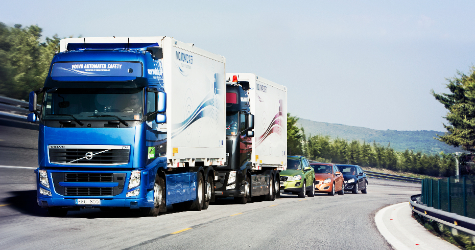
The road train comprised two trucks and three Volvo vehicles platooned together. The lead truck was driven by a professional driver and the trailing truck and cars used upgraded safety cameras, radar and laser scanners to monitor the lead vehicle and the others in the train.
The train moved at a speed of 85 kilometres per hour and featured a six-metre gap between each vehicle.
The vehicles were also fitted with a prototype human-machine interface that displayed important information and allowed the drivers to join and leave the platoon. They also featured a prototype vehicle-to-vehicle communication unit.
To view an animated demonstration of a SATRE road train, please visit
www.sartre-project.eu/en/press/Documents/Volvo_Train720.wmv