Collaboration was key to the success of the Regional Outback Water Alliance (ROWA) in Central West Queensland.
Out of sight and too often out of mind when policy and funding decisions are made, a group of small and remote communities in Central West Queensland have joined forces to supply essential water and sewerage services to a region that covers 21.1 per cent of the total area of the State but houses less than 1 per cent of its population.
At the heart of this Outback collaboration sits the Central Western Queensland Remote Area Planning and Development Board (RAPAD), a unified local government organisation that has been successfully assisting and facilitating the growth and development of the Outback region for almost two decades.
A need for change
Regional collaboration was strongly called into focus in early 2011 with the release of three national reviews of the urban water industry calling on the Queensland and NSW State Governments to review institutional arrangements to seek greater economies of scale for water service providers.
The Local Government Association Queensland (LGAQ) and Queensland Water Directorate (qldwater) already had programs encouraging regional collaboration and responded by developing an industry-led review of potential collaborative arrangements. With funding and support from the Queensland Government, the Queensland Water Regional Alliance Program (QWRAP) was set up to examine alternative models for management and governance of the urban water industry in regional Queensland.
The RAPAD group of Councils was the first to sign up to the program, establishing the Outback Regional Water Group (ORWG) comprising the six local government areas of Barcaldine Regional Council, Longreach Regional Council, Barcoo Shire Council, Boulia Shire Council, Diamantina Shire Council and Winton Shire Council to take a leadership and coordination role in urban water. The region covers an area more than one and a half times as large as the state of Victoria and includes 16 urban communities.
Formalising the arrangement
Following a detailed review of risks, gaps and strengths, governance arrangements and alternative business models, it was clear that a Regional Alliance was the optimal collaborative model for the Region. All Councils in the ORWG, apart from Winton Shire Council, agreed in June 2014 to proceed to trial the Outback Regional Water Alliance (ORWA).
Figure 1: Structure and Governance of the Outback Regional Water Alliance
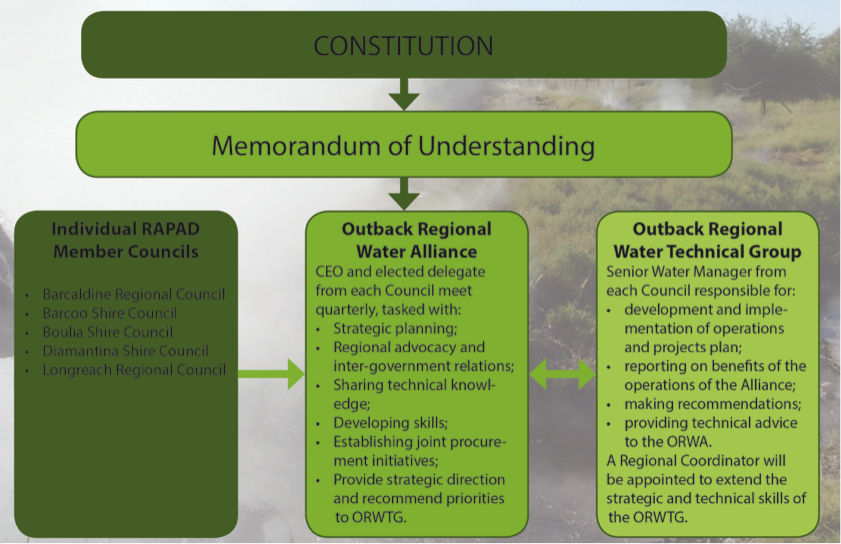
The administration and operations of the ORWA will be self-funded from its members with cost sharing arrangements as agreed in a Memorandum of Understanding. A Constitution has been developed to guide the governance of the Alliance and its Technical Advisory Group and an annual project plan provides details of the specific projects being undertaken each year. A part-time coordinator will be appointed to oversee the activities of the Alliance.
In June 2014 the Minister for Energy and Water Supply, The Honourable Mark McArdle, selected the ORWA region to promote the release of Water Q at a showcase event in Longreach, reinforcing regional alliances as a key element of the State’s 30-year strategy.
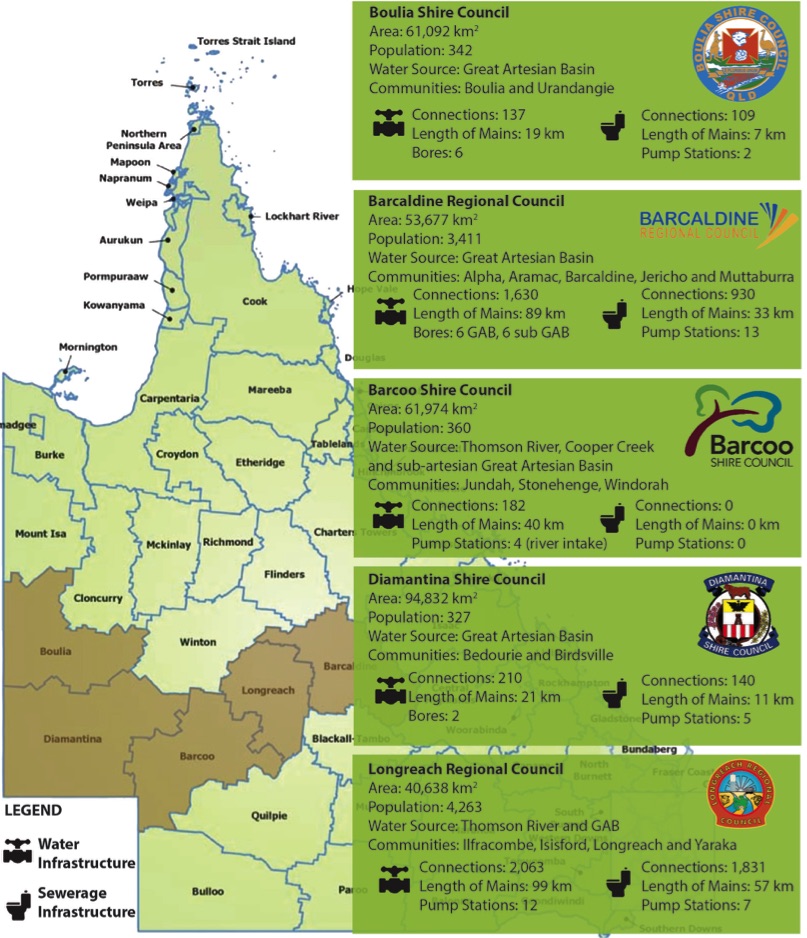
An overview of the region
Figure 2: An overview of the region
Start-up projects
Joint training initiatives
In 2013, the ORWA councils participated in a program convened by the Queensland Water Directorate (qldwater) that provided an external review of water operations in several of their communities. The project was partially funded by the State and was aimed at identifying skills gaps and training needs across the region.
The outputs from the independent operational investigation was reviewed by the ORWTG and found to be useful for identifying – and addressing – critical needs for systems in each community. This information added to and improved the operational plans for each scheme and assisted in meeting the regulatory requirement under the mandatory Drinking Water Quality Management Plans.
Attracting qualified operators and tradesmen is an ongoing challenge in remote locations, and retaining and developing staff with appropriate qualifications can be difficult. The diversity of services across the region also requires a range of specialist expertise. To overcome these issues, the councils in the region have developed strong partnerships and processes for sharing knowledge across the region, including joint training programs coordinated through the Alliance to build skills of staff in each of the communities represented.
Apart from training, Councils also need to look at succession and contingency plans for key roles, mentoring of less experienced staff and peer support networks. This process is being developed across the region, ensuring that staff can link with other highly skilled operators when needed. The collaborative approach has also attracted State funding to support skills development.
Planning and Reporting
Recent State red-tape reduction initiatives have resulted in removal of several Asset Management Planning requirements under water legislation that were once required to obtain subsidies. The rationale for this change is that council utilities are now capable of managing and planning for water and sewerage assets, but the rapid removal of legislative requirements can actually leave a vacuum of information and advice for such planning in small communities.
An opportunity therefore existed to combine existing expertise and plans that have been developed for schemes across the RAPAD region and create a coordinated approach to future Asset Management Planning that is fit-for-purpose for each participating council. This approach takes advantage of the regime of asset management required under Local Government legislation and the evolving Queensland water and sewerage KPI reporting framework that has replaced the raft of statutory plans previously required by the State.
This new framework has been developed with strong industry input to reflect the reporting that is undertaken internally by Queensland utilities and mirrors the NPR framework for large businesses. The formation of the ORWA prior to formal commencement of this new regulatory framework provided an opportunity to develop (and negotiate) a streamlined approach across the entire region through the new SWIMLocal KPI reporting system. A group rate was negotiated, timelines aligned, and centralised coordination planned for future reporting.
Drinking Water Quality Management Plans (DWQMPs)
Introduced in 2009, DWQMPs have become the primary regulatory tool for the State Water Regulator and require significant expenditure on monitoring, reporting and potentially future infrastructure upgrades. Each of the participating Councils have developed a DWQMP and are now in the position of assessing joint programs for ongoing monitoring and reporting, improving facilities and meeting regulator requirements such as regular audits. Costs savings are projected from these joint activities and the safety and reliability of water supplies across the region has been reinforced for all communities.
Price Benchmarking
While the provision of water services in Western Queensland has numerous hidden costs, it also has some poorly communicated savings (for example the use of artesian water under pressure). The ORWA is conducting a price benchmarking exercise to review different approaches to pricing within each community, comparing pricing with others in the region, State and nationally. Where possible, differences in levels of service and other relevant parameters such as operating footprint will be identified. The aim is to increase transparency about cost recovery pricing.
The future is what we make it
Where larger utilities can rely on economies of scale, greater income and growing population, many small providers including those in the Outback Region must provide safe and reliable services with fewer revenue sources and the added costs of remoteness. The QWRAP investigation showed that in this region, some of these costs can be mitigated through joint activities, bringing together the strengths of the diverse RAPAD councils.
The collaboration demonstrates that, even when economies are not possible through increasing density or networking distant communities, regional models can provide some benefits of scale and provide improvements for customers. This has been a common finding of QWRAP across all four study regions.
Although the regions vary markedly in population size and density and have widely separated communities, collaboration has yielded benefits in each. The ORWA is the first region to complete their QWRAP investigation and others will complete their reviews early in the new year.
The strong history of public-private partnerships in the RAPAD region must also be acknowledged as a key driver of innovation and regional collaboration.
Councils too small for full-time engineering staff have developed long-term relationships with consulting engineering companies who sometimes provide semi-permanent staff sited within a council’s offices. Much of the development and innovation in water and sewerage operations in the region has been driven by this model in the past.
As can be expected from an area so vast and with so many differing sources and treatment processes, there is no ‘one size fits all’ strategy for safe, secure and sustainable urban water services in the region. But through innovative processes and the will to make things work for their communities, the councils now working jointly through the Outback Regional Water Alliance are proving that great things do happen – even in small and remote places.
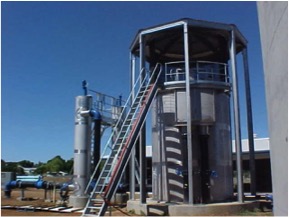
Pictured above: Infrastructure planning is a long term commitment, and the new water treatment plant at Longreach will serve the community for years to come.