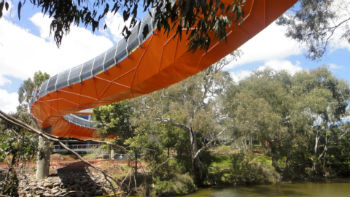
Known as ‘the snake bridge’, the Wedge Street Pedestrian Bridge in Victoria was built to link Werribee CBD and Wyndham Park with minimal impact on the land and animals below.
The striking orange structure opened in 2013 and was one component of the development of Werribee City Centre as the capital of the new West.
Last year, the project won Wyndham City Council the Capital Projects over $1m category at IPWEA Vic’s 2014 Awards.
The chosen location for the bridge on the banks of the Werribee River posed a challenge for the council due to the flora and fauna (such as platypuses) located in the vicinity, as well as the access restrictions for heavy equipment such as cranes.
Restrictions were placed on construction activities within 35 metres of the riverbank during October through to April during the platypus breeding and nesting season. Low-level lighting was also used to ensure minimum impact on platypuses inhabiting the area.
The bridge was therefore designed to weave through the canopy to protect the old river red gums and minimise the impact on the established vegetation below.

“The project was an extremely complex structure to construct because it varies in form along its length and twists through the tree tops," said Wyndham City’s Director of Infrastructure, David Suder.
“We knew it would be amazing but we were blown away with the end result. The integration of the bridge in its environment is outstanding.”
Group GSA was the appointed architects and BMD Constructions won the project management tender, although Wyndham City Council retained a project management role.
Specifications:
• The bridge was built from 100 tonnes of steel and 450 cubic metres of concrete.
• It is supported on 26x750mm and 4x900mm bored concrete piles constructed on balsatic rock and the riverbank.
• At its longest, it spans 37 metres.
• The bridge deck comprises six steel girder sections weighing up to 45 tonnes.
Construction of the bridge’s components was undertaken off site as access to the site was restricted. Components were floated to the site upside down and lifted into place using two cranes.
“Winning the IPWEA Vic award was great recognition for all the effort that had gone into delivering the bridge," said Sudder. "Many people in our engineering team are members of the IPWEA and to receive the recognition of your peers is always something special.”
The project was first conceived in 2006 and brought into being in 2013.