Expert support technicians will have 24–7 access to new water treatment plants recently delivered to three remote Victorian towns as part of an $18.1 million project.
Water Infrastructure Group (WIGroup) delivered the sewerage scheme works to Smythesdale, Gordon and Waubra in country Victoria under a contract with Central Highlands Water, under the State Government’s Partnerships Victoria Policy.
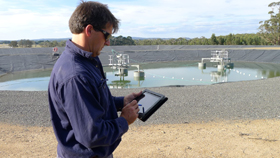
General Manager Peter Everist said WIGroup’s Virtual Control Room technology was a key innovation for providing sustainable community infrastructure.
“With WIGroup’s Virtual Control Room, we’ve found a tool that allows us to optimise and automate treatment process technology,” he said. “We can streamline the way we operate treatment plants and pipeline networks are operated to improve reliability and reduce the whole-of-life cost of water infrastructure.”
Rural communities often lack local access to the expertise required to troubleshoot problems with the high-tech instruments and processes of today’s water treatment plants. “It is expensive to fly technology specialists from capital cities or even overseas,” explained Everist. “With our Virtual Control Room, specialist technicians can remotely access instruments to calibrate and reset them, and access the process control system to troubleshoot and optimise treatment processes.”
“As well as saving travel and accommodation costs, the technicians have 24–7 access to keep the plants running smoothly. The remote technicians also work with local operators in real-time using webcams, Skype, mobile phones and iPads to troubleshoot problems. This provides a high level of training for the local operators who can then share this knowledge with their colleagues using the Virtual Control Room,” he said.
At a community celebration in April, Minister for Water Peter Walsh said the new sewerage schemes would provide benefits for current and future residents and foster growth and development in the towns. “Replacing inefficient or ineffective septic tanks with sewerage systems will improve public health and environmental conditions in the townships, as well as waterways and creek systems,” he said.