When he started at Meander Valley Council, Ted Ross inherited asset management plans containing little more than lofty aspirations. But four years on, this Director of Infrastructure Services is in the midst of a radical reassessment of AM objectives and strategy. In this interview he talks about ‘the journey’.
Why do you refer to your asset management activity as ‘the journey’?
Because it began from a standing start and has developed into a stimulating process of constantly learning and fine-tuning. When I got here four years ago, I found a number of backdated AM plans gathering dust on the shelves. They had plenty of motherhood statements and good intent, but they didn’t really reflect what was happening on the ground. In the main, they had been put together by consultants and were rather cut-and-paste. In fact, they were so generic that the names of other councils kept popping up in the text. So I knew back then that a lot of work was needed and that we had to have the necessary tools and skills to handle the challenge. So in a way, it was like embarking on a journey.
How did you go about meeting that challenge?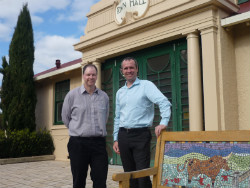
One of the first things was to sign up for IPWEA’s NAMS.PLUS workshop sessions. I participated along with my Asset Management Coordinator, Rob Little. That gave us great guidelines and insight into the link between service levels and cost, the importance of renewal planning, how to manage funding gaps and a host of other aspects. But it also became clear that once you started applying the theory, you needed even more knowledge to keep up the momentum. So we both went on the Infrastructure Asset Management program through the University of Tasmania and we’ve now moved on to NAMS.PLUS2. The great advantage of those courses is that you not only learn important skills but you also have the opportunity of networking with your counterparts in other councils and learning from each others’ experience. In fact, since our workshop sessions, Rob has been instrumental in forming a Northern Tasmanian AM group which meets regularly to discuss common issues.
How have you applied that learning experience in practice?
In numerous ways, but the most important one is that we are now implementing a defined plan to ensure long term sustainability of assets while at the same time maintaining an affordable level of service that reflects the needs of our community and the growth in our region.
I’m also pleased to say that Rob and I have gained the full support of senior managers and councilors in terms of those objectives. So much so in fact, that we’ve been successful in arranging regular councilor workshops so that an understanding of the asset management plan exists from the top down.
An important aspect of that plan is to consult closely with the community to determine what’s affordable and what isn’t.
To give you an example, Council has recently approved a Gifted Asset Policy to manage donated assets. Gifts include a park rotunda built by the Deloraine Rotary Club, and another involved two pedestrian bridges over the Meander River.
They were gratefully accepted gifts, and there will almost certainly be more gifts from various sources in future. But as a council, we need to evaluate the worth of each donated asset individually and factor in its maintenance and operating costs over the long-term. Plus, we have to consider its renewal cost, because in 10 or 20 years’ time the original donor may not be in a position to build another one and we will almost certainly have to pick up the tab. Ideally though, we are encouraging these community-minded groups to consult with us before they go ahead and build something off their own bat. In that way, we can advise them on construction methods, community preferences, longevity, and so forth. What we are trying to ensure is that the community builds assets that they need at a cost they are able to afford.
What other examples of community consultation do you have?
Well Council recently approved a plan to spend $5million over 20 years in developing a major sports park at Prospect Vale. For some councils that may not be a big spend, but for us it’s a lot of money, so we wanted to ensure we get the cost-benefit analysis right. In order to do that, we considered the community’s needs at every step. That meant sounding out a lot of groups, because the park already has 3,000 sports users and it’s also used for non-sport recreation by a lot of local residents. So we did surveys and talked to the community about the need for such things as car parking, lighting, ground upgrades, entrance access, club rooms, playground and barbecue facilities, kiosk improvements, and so forth. A copy of the report can be found on our website at www.meander.tas.gov.au
We find community consultation is always beneficial, even on matters that seem fundamental. As a hypothetical example, if you get complaints about grass mowing, should you increase mowing until the complaints stop, or should you tactfully try to establish a community’s priorities? Increasingly, we find the latter approach can work well if people understand their council can’t afford everything. Often a community might settle for a less frequent mowing service if it means they get better roads. Like everything in life, it all boils down to choices!
In the picture: Ted Ross (right) and Rob Little.