Reports of smart reconstruction techniques from councils throughout Queensland are filling the files of the state’s Reconstruction Authority, which was formed to help communities get back on track after recent natural disasters.
Typical of such innovation is the way Goondiwindi Regional Council recently restored the Hartmann Bridge after floods had made it unsafe for heavy vehicle use. Amongst other uses, the bridge served a pastoral community 40 km west of Goondiwindi that relied heavily on it for transporting goods to market via the Barwon Highway.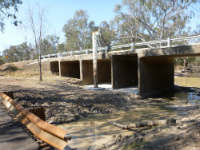
Hartmann Bridge is 5km north of the Barwon Highway and consists of a series of large box culverts and link slabs founded on strip footings over the Weir River.
But when the river flooded back in 2011, the central three box culvert cells sank by up to 175mm. This resulted in sagging of the bridge deck, which made it unsafe for the high speed and heavy load vehicles that frequently used it.
Various repair methods were considered, but the council ultimately settled on cutting-edge Uretek technology – a pressure injected expanding resin – to achieve the most durable and best value-for-money outcome.
The Uretek product stabilised the subgrade under the bridge to prevent future sinking. It was also used to jack up the bridge and reduce the deflection by about 50 per cent.
Once the subgrade had been stabilised, reinforced concrete slabs were constructed between the box culvert legs in the two cells north and south of the central cell. These slabs were tied into the box culvert legs and also tied to the existing cut off walls upstream and downstream of the bridge. The slabs will now provide structural stability for the box culverts and minimise the risk of subsidence in the future.
The damaged reinforced concrete deck was then removed with a profiler. The ‘white rock’ sub-base (between the top of the box culverts and the underside of the deck) also had to be removed due to water damage.
All up, the actual cost to repair the bridge was $327,000, which was below the original estimates of both the council and the Queensland Reconstruction Authority.
“So we’ve achieved value-for-money from the Authority’s program, plus a better outcome for the local community,” said a spokesman for the council.