Until four years ago, the intersection of Ferry Road and Benowa Road in Southport, on Queensland’s Gold Coast, was plagued with traffic problems. Frances Sacco reports.
Ferry Road slopes downward toward the intersection in both directions – a factor which, when combined with wet weather, leads to frequent rear end collisions.
In 2008, Queensland Transport and Main Roads decided to add a high-friction overlay to the surface made with calcined bauxite to the road.
The northbound carriageway had 150 metres of calcined bauxite applied across the through-lanes and the southbound carriageway had 168 metres applied across the through-lanes.
While it did not eliminate accidents at the intersection, a Transport and Main Roads spokesman said the surface treatment led to significant safety improvements.
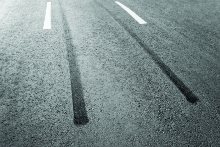
“Research has indicated reductions of up to 25 per cent in skidding accidents can be obtained by increasing surface friction of the road at critical locations,” he said.
Since its introduction in 1989, the high-friction surfacing has been regularly used to treat black spots and areas with difficult traffic conditions.
It can can dramatically reduce vehicle stopping distances and remains useful in the wet because of its textured surface.
STS Applied Systems is the largest installer of high-friction surfacing in Australia. They use a product called Omnigrip HF, which they applied at the intersection of Ferry Road and Benowa Road.
It is a high-friction veneer surfacing system comprised of thermosetting surfacing compound, which incorporates PSV aggregates.
Designed to improve and maintain a high level of skid resistance, it can be used on asphalt or concrete roads, highways and bridge pavements.
STS Applied Systems Operations Manager Stephen Southgate says calcined bauxite imported from China was used to achieve the texture depth and durability necessary to fulfil the product’s design life of 10 years.
“The customer has the assurance that once the surface goes on, they get results from day one and that lasts for 10 years,” he said.
The application consists of calcined bauxite aggregate being held in place by a specialised epoxy-modified resin binder to ensure high-tyre forces do not easily remove the aggregate.
The high-friction surfacing must be laid over an existing substrate that is already sound. Before the new surface is applied, the surface must be cleaned of any contaminates with suitable detergent, a water truck and street sweeper. This ensures that any road grime or oil is removed prior to application to maximise adhesion.
The resin is then applied, followed by the calcined bauxite. The surface is then left to cure for four hours, swept to remove excess material, then re-opened to traffic.
A Queensland Transport and Main Roads spokesman said calcined bauxite has been used in areas with tight curves, steep gradients, approaches to intersections, pedestrian crossings and railway level crossings.
“It may be used to treat a location where there is a history of vehicles skidding, and where traditional surface types cannot provide the required level of skid resistance,” he said.
Its use to date has been selective because of the cost of the treatment.
“There is an extremely high material cost compared to traditional surface types, the cost is over four times that of an asphalt surface and 15 times that of a sprayed seal surface,” the spokesman said.
While he agrees the monetary cost was higher, Southgate says the product’s proven track record demonstrated it is worthwhile.
“It reduces crashes, saves lives and saves government departments money in repairs to road signage, hospitalisation bills, litigation from accidents,” he adds. “It also saves insurance companies on claims due to the reduction in accidents.”
“High Friction is approximately five times more expensive than chip seal and about $10 to $15 (per square metre) more than over lays but when you added benefits and longevity of the system it is value for money,” Southgate says.
“If (state governments) and councils across Australia embraced it more, it would drive installation costs down so it would be more comparable with asphalt.”