The City of Charles Sturt committed $24 million to tackle ongoing flooding along one of Adelaide’s Tier 1 roads. However, just two months into the main construction they encountered a major hurdle that threatened to derail the entire project.
Fast-forward to today and the project is nearing completion and is several million dollars under-budget, thanks to a project team willing to look outside the box for alternative solutions.
With predictable regularity, residences and businesses along Port Road were being flooded. Restaurants were closing for weeks at a time to repair the damage from flood waters, knowing all too well that this wouldn’t be the last time they had to undertake repairs. Something had to be done.
Having the first gazetted Stormwater Management Plan (SMP) for metropolitan Adelaide and through productive discussion with the stormwater management authority (SMA), an agreement was reached to share costs of upgrading the drainage service level along Port Road.
In 2016 designs were produced and a plan put in place to increase the capacity of the drain to a five-year average recurrence interval (ARI), from the approximately three-month arrangement on site. This upgrade would not only reduce flooding along Port Road but also decrease overland flows through some 4500 properties within the 690ha Port Road Drainage Catchment. The upgrades also ensured that during a 100-year ARI, the entrance to the Queen Elizabeth Hospital (QEH) could remain open.
In early 2017, tenders were called for construction, and works commenced on site in May 2017. Residents and businesses could see the works being undertaken and were buoyed by the idea their days of sweeping stormwater out of their properties would soon be over.
A shocking challenge
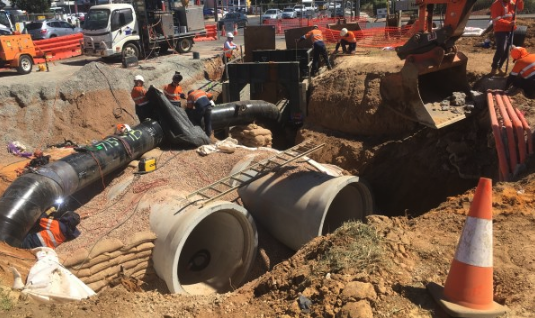
While negotiating known service relocations with SA Power Networks (SAPN), it was discovered that a major SAPN 66kV line feeding the QEH had not been picked up in the design process. Following some investigation, it was confirmed the service clashed significantly with the location of the proposed drainage pipes. A quote was sought from SAPN for relocation of the service. However, when the price came back at $2.2 million, including an 18-month delay, the project team had a significant challenge on their hands.
Through design optimisation and selective modification of the construction methodology, clearance to the service. However, given a lack of familiarity with these types of scenarios, the OTR sought ‘independent’ advice from SAPN, who promptly ruled in a direction that would force the council to spend millions of dollars to upgrade SAPN’s service for them.
Not content to buckle, the project team went back to the hydraulic modelling to see if there was a way to make it work.
Outside the box
At this point, the council’s project manager identified an option not previously considered. The design grade along the 2.6km route is extremely flat, with some sections having grades below 0.1%. This challenge during construction actually became an opportunity in resolving this problem. The flat grades resulted in generally lower velocities within the pipeline, and as such, the losses at a transition structure could be incorporated into the design without significantly impacting the hydraulic grade line (HGL).
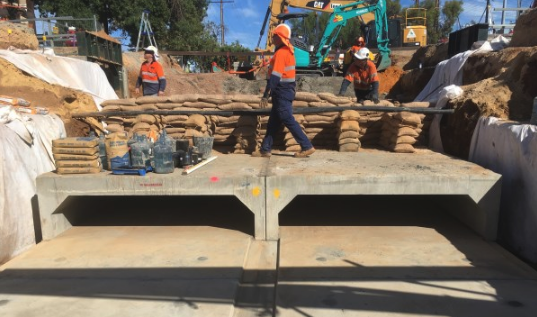
These small losses, together with a deep invert and relatively high existing HGL, provided the opportunity to include a split level system that would sandwich the SAPN service within a void between two levels of wide and shallow culverts.
Some back-of-the-envelope calculations were performed and the idea had merit. Keen to ensure the SMA were still receiving the five-year design standard they were funding, the proposed solution was remodelled to confirm the results. However, they weren’t quite in the clear just yet, as the engineers and those paying the bills couldn’t quite agree on an appropriate ‘k’ value to use in the model. Computational fluid dynamic modelling was undertaken and confirmed the initial calculations: the split level culverts would work!
New culverts were ordered, junction box designs were modified to suit and the problem resolved just in time as the construction crew arrived at the location in question.
The clash with the 66kV is just a distant memory to the project team, who are now looking forward to the job’s completion; but, it continues to act as an example of how there is always more than one way to skin a cat.