As the most asset intensive tier of government, local governments are under constant pressure to fund maintenance and renewal programs and maintain acceptable service levels for their communities.

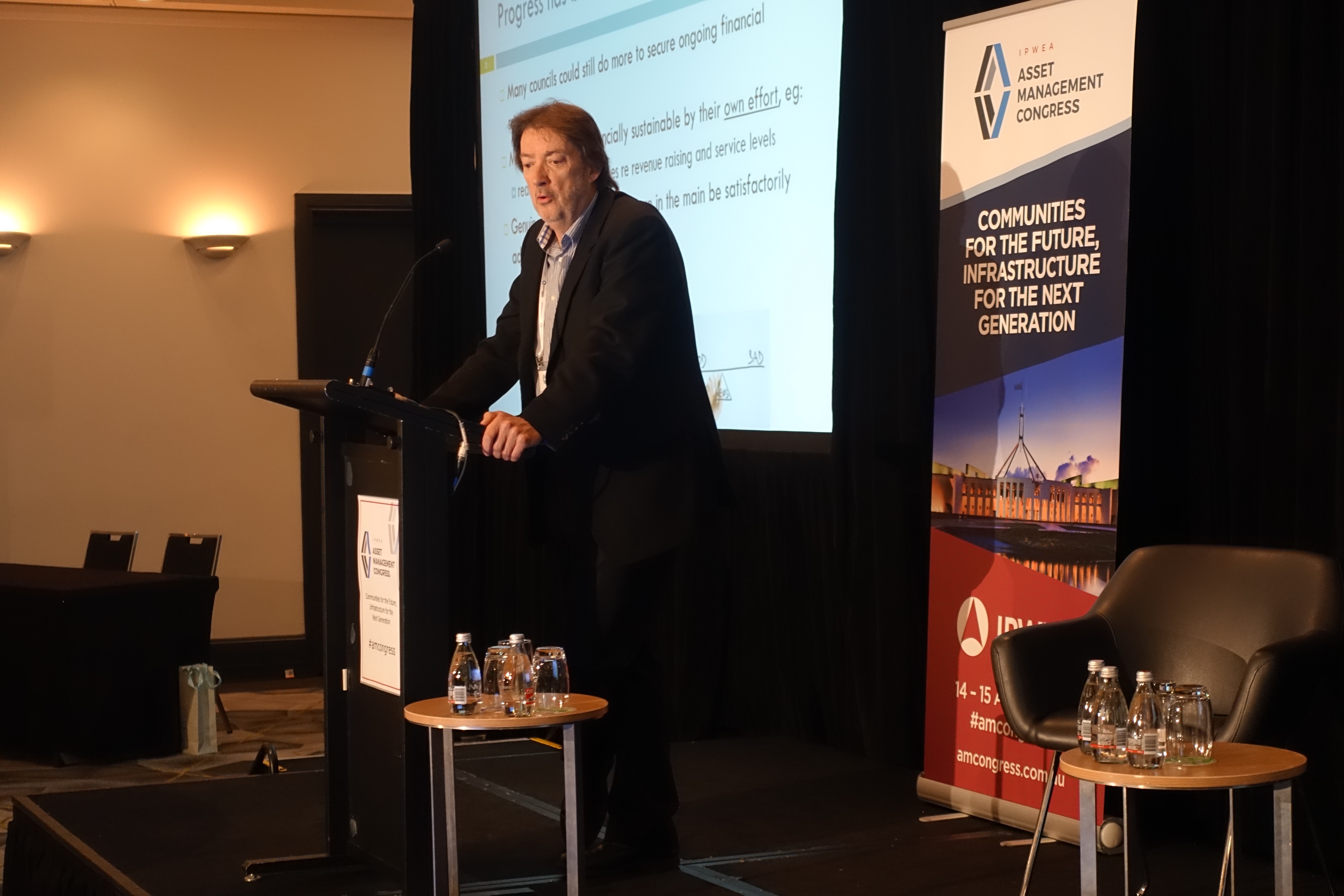
Speaking at IPWEA's Asset Management Congress last week, John Comrie, who co-authored IPWEA’s Australian Infrastructure Financial Management Manual (AIFMM) and is former head of the South Australian Government’s Office for Local Government, delivered his version of a top ten countdown – financial sustainability style.
Comrie said you can’t have good asset management or determine affordable service levels without:
- Reasonable financial planning
- Sound asset accounting
- Appropriate financial management strategies
He told delegates more money was not the answer, asserting that most councils can be financially sustainable and provide service levels and asset renewal without a big cash injection.
“My view is you need better plans. More money by itself won’t solve the problem,” he told delegates.
Here is Comrie’s list of 10 ways councils can improve their financial sustainability:
10. Improve basic financial skills
Comrie said there’s a need to improve financial literacy for both elected officials and council officers.
9. Keep financial information simple and strategic
Long and boring financial reports need to be replaced with a straight-forward focus on the bottom line and forward trends.
“We need to present information in a very simple way, for more than a one year time horizon,” Comrie said. He added that there was no need for confusion if the timing of Financial Assistance Grants (FAGs) varied.
“I’ve seen a number of councils get themselves in a pickle because of the FAG timing. My view is it’s a non-issue. You’re going to get the money – focus on the adjusted results."
 8. Better auditing
Comrie says audit approaches in some states are better than others. “I’m not convinced all auditors have a good idea of the local government operating environment,” he told delegates.
7. Better long-term financial plans
LTFPs need to be short, simple and the implications easy to comprehend, and with reasonable key assumptions the are clearly stated.
6. Improve asset managers’ financial understanding
Comrie said there’s too much of a disconnect between those who prepare financial statements and those who prepare asset management plans.
He advocated for a single, reliable asset register and asset management staff who are comfortable with financial data and understand its implications, allowing them to challenge financial strategies and agitate to ensure adequate funds are allocated for asset renewals.
5. Resolve asset renewal gaps
According to Comrie, many councils actually have a much greater capacity than they think to address asset renewal backlogs.
“The asset renewal funding gap is often really an unwilling to spend gap,” he said, adding that councils need to understand the implications of addressing or not addressing renewal gaps and accept responsibility for the implications.
“Asset management plans need to be based on ‘clear, affordable and willing to fund’ service levels.”
4. Better indicators and guidance
Comrie said better financial requirements were needed, along with implicit and explicit guidance on financial indicators and targets.
“Comparing asset renewal with annual depreciation is absolute rubbish,” Comrie said. “In my view, compare it with what the asset management plan said you should be spending.”
3. Better financial reporting
Comrie called for more guidance around annual financial reporting formats, which he said are often too detailed and confusing.
“I want one bold line that reports the key information: the operating result. I want council members to be able to look at one number,” he said.
2. Clearer publication of key results
Although ‘league ladder’ scoreboards comparing the annual performance of various councils can be unpopular, Comie is a fan.
“I’m a big fan of measuring performance,” he said. “The publication of simple aggregate comparative results is a powerful motivator to do better.”
1. Greater and better use of debt
Coming in at number one was the need to recognise that debt is not a dirty word. Comrie said it’s impossible to share the cost of long-lived assets across generations without using debt.
“It’s the thing that holds us back. People are discouraged from using debt, but we’re asset intensive…it’s usually impossible to intergenerationally fairly charge service recipients without making considerable use of debt,” he said.