If you happen to be in the Netherlands, you can now ride your bike on the world's first 3D printed reinforced, pre-stressed concrete bridge.
Printed at Eindhoven University of Technology, the cycle bridge is part of a new road around the village of Gemert. The first civil infrastructure project to be realised with 3D-concrete printing, the bridge is 8m long, 3.5m wide, and has been designed to have a 30-year lifespan. Developers played it safe and tested the bridge with a load of 5 tonnes; with more cycles than people in the Netherlands, it is expected that hundreds of cyclists will ride over the printed bridge every day.
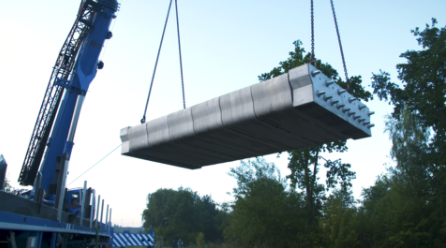
Researchers from the university have developed a process to incorporate steel reinforcement cable while laying a strip of concrete. The steel cable is the equivalent of the reinforcement mesh used in conventional concrete and effectively handles the tensile stress.
The developers say that one of the main advantages of printing concrete is that much less concrete is needed than in the conventional technique, in which a mould is filled with concrete. By contrast, the printer deposits only the concrete where it is needed, which decreases the use of cement. This reduces CO2 emissions, as cement production has a very high carbon footprint.
Another benefit lies in the freedom of form: the printer can make any desired shape, whereas conventional concrete shapes tend to be unwieldy in shape due to use of formwork. Concrete printing also enables a much higher realisation speed. No formwork structures have to be built and dismantled, and reinforcement mesh does not have to be put in place separately. Overall, the researchers think the process is roughly three times faster than conventional concrete techniques.
With this initial project under their belts, the researchers say they will now be able to design even larger printed concrete structures
The bridge is part of the Noord-Om project, a new section of ring road around the village of Gemert. The bridges’ elements were printed at Eindhoven University of Technology, which has a large concrete printer for R&D purposes. The project was led by the company BAM Infra, and it was commissioned by the province of North-Brabant.